 Anuluj

Warunki handlowe
Narzędzia


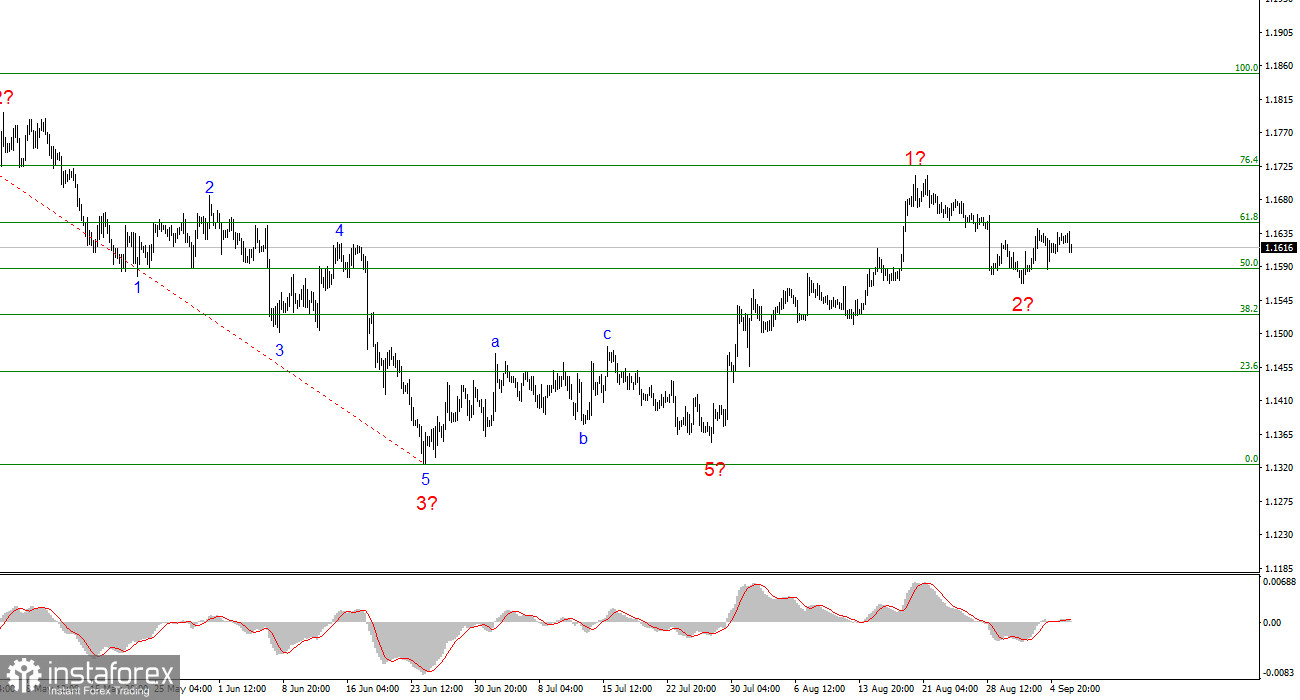
The wave pattern on the EUR/USD 4-hour chart is becoming more complex. There is still no question of canceling the upward trend segment (bottom chart) that began in January last year. On the contrary, we have seen a complete A-B-C corrective structure, which has most likely been completed. We never saw a convincing wave 5 of C. This wave took a shortened form, which also occurs from time to time. Let me remind you that classical wave structures are generally found only in textbooks. In real market conditions, traders and analysts should be more flexible in their analysis.
Unfortunately, the wave structure may become more complex again at present. Wave C may take a three-wave form, the wave following it will be identified as wave D, and the entire trend segment that began on January 27 will take a five-wave corrective form A-B-C-D-E. If this assumption is correct, wave D will take a three-wave form, and on August 21, EUR/USD entered the phase of forming wave E, whose low should be below the low of wave C at 1.1325. At the same time, however, this scenario is an alternative one. Based on the fundamental background, I am more inclined to expect the formation of a global upward wave.
The euro is in no hurry.
The EUR/USD pair remained unchanged throughout Tuesday, although, as always, small price movements may still occur before the end of the day. I would have liked to write about some important news or reports in this review, but there were none today. The market continues to operate in a low-activity mode, and nothing particularly significant is happening at present. Once again, it should be noted that the most important events this week are scheduled for Thursday and Friday.
It may seem that significant market activity will occur on Thursday and Friday. However, in my view, the market may remain relatively inactive after the current period of consolidation. Consider the situation: the ECB's monetary policy tightening on Thursday will not come as a surprise. Certainly, the euro can be expected to strengthen, as the ECB will raise interest rates for the second time this year, unlike the Fed, which is only preparing to take a more restrictive policy stance. Whether it will actually do so remains unknown. I continue to believe that the Fed will delay action for as long as possible. The FOMC's stance ahead of the September meeting cannot be described as restrictive or even decisive. Therefore, in my view, the actual probability of an interest-rate hike in September is no more than 10–20%. Of course, I may be wrong, but I still see no signs of impending monetary policy tightening. Based on this, the euro could substantially strengthen its position this week, but market participants themselves are in no hurry to act. The market has remained unchanged for the third consecutive day.
General Conclusions
Based on my analysis of EUR/USD, I conclude that the pair remains within a local upward trend segment as part of the first wave of a new global upward trend segment. It should be acknowledged that the trend segment that began in January of this year may take the form of A-B-C-D-E. If this assumption is correct, the decline in prices will resume, with targets below the low of wave C at 1.1325. However, I consider this an alternative scenario. I believe that a new upward trend segment began forming in June, which will bring the euro back to the 20 level and take it significantly above that level.
On the higher time frame, an upward trend segment can be seen, followed by the formation of an A-B-C corrective structure. This structure may take a five-wave form, but at present I consider it complete. If so, the formation of a new impulsive upward trend segment has begun.
The main principles of my analysis:
Dzięki analizom InstaForex zawsze będziesz na bieżące z trendami rynkowymi! Zarejestruj się w InstaForex i uzyskaj dostęp do jeszcze większej liczby bezpłatnych usług dla zyskownego handlu.


