 Anuluj

Warunki handlowe
Narzędzia


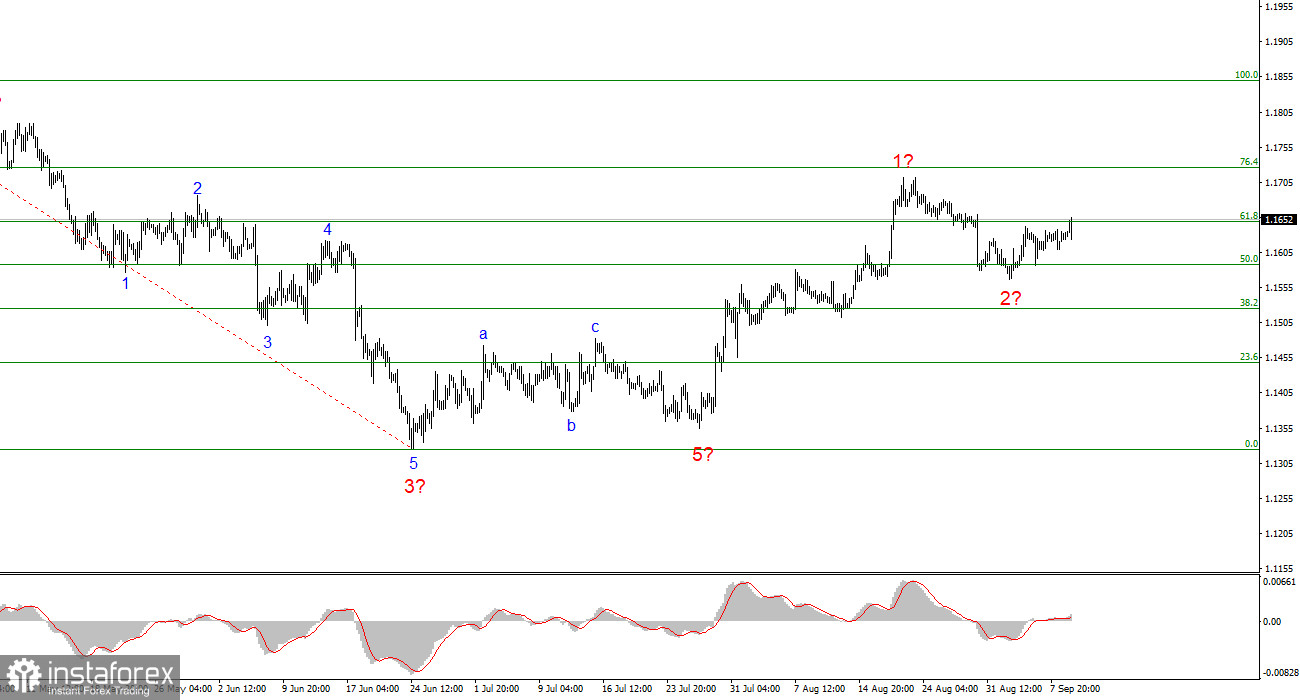
The wave pattern of the 4-hour EUR/USD chart is becoming more complex. There is still no question of invalidating the upward trend segment (lower chart) that began in January last year. On the contrary, we have seen a complete A-B-C corrective structure, which is most likely complete. We never saw a convincing wave 5 within C. This wave took a truncated form, which also occurs from time to time. Let me remind you that classical wave structures are generally found only in textbooks. In real-world analysis, traders and analysts need to be more flexible.
Unfortunately, the wave structure may become more complex again at this point. Wave C may take a three-wave form, the wave that follows it would then be identified as wave D, and the entire trend segment that began on January 27 would take a five-wave corrective form, A-B-C-D-E. If this assumption is correct, wave D would take a three-wave form, and on August 21, EUR/USD entered the phase of forming wave E, whose low should be below the low of wave C at 1.1325. At the same time, this scenario is an alternative one. Based on the news backdrop, I am more inclined toward the formation of a global upward wave.
Market participants are beginning to prepare for increased volatility.
The EUR/USD exchange rate rose by 20 basis points during Wednesday. This is very little, but at least we saw some movement in the market today. The news backdrop was extremely weak again on Wednesday, and there was nothing particularly noteworthy in the economic calendar. Therefore, for now, all that remains is to wait and make plans. In my view, the plans are fairly straightforward. Tomorrow, the ECB will announce a tightening of monetary policy for the second time this year, while whether the Federal Reserve will announce an interest-rate hike next week remains a major question. I believe that the FOMC will once again take a neutral stance, unlike the ECB, where Christine Lagarde may indicate that the central bank is prepared to continue tightening if inflation continues to accelerate.
And inflation is likely to accelerate, as oil prices are rising again following further attacks in the Middle East. This time, the Yemeni Houthis attacked Saudi Arabian ships as well as several facilities belonging to the country's oil companies. In response, the United States destroyed five Iranian tankers, while Iran launched strikes against US military bases in Jordan. Overall, there is nothing fundamentally new, but these developments indicate that there is no prospect of stability in the Middle East. Oil prices continue to rise and exceed $100 today. Everything suggests that crude oil will remain in the $100–120 per barrel range in the near future. Consequently, central banks should prepare for higher inflation. The ECB and the Bank of England are ready. What about the Federal Reserve?
Overall Conclusions.
Based on my analysis of EUR/USD, I conclude that the instrument remains within a local upward trend segment. I would note that the trend segment that began in January of this year could still take the form of A-B-C-D-E. If this assumption is correct, the decline in the exchange rate will resume, with targets below the low of wave C at 1.1325. However, I consider this an alternative scenario. I believe that the formation of a new upward trend segment began in June, which will bring the euro back to the 20th figure and take it significantly above that level. Therefore, I remain focused on long positions with targets above the 17th level.
On the higher time frame, an upward trend segment is visible, followed by the formation of an A-B-C corrective structure. This structure may take a five-wave form, but at present I consider it complete. If so, a new impulsive upward trend segment has begun to form.
The main principles of my analysis:
Dzięki analizom InstaForex zawsze będziesz na bieżące z trendami rynkowymi! Zarejestruj się w InstaForex i uzyskaj dostęp do jeszcze większej liczby bezpłatnych usług dla zyskownego handlu.


