 Anuluj
Warunki handlowe
Narzędzia



The euro fell sharply against the dollar, and the main reason this time was politics rather than data. France's budget crisis is deepening: the opposition is blocking the government's €54 billion austerity plan, and proposals are being discussed to issue bonds to cover the deficit and to service public debt, which is approaching 6.5% of GDP. Hedge funds and large players are reallocating from the euro to the dollar amid this backdrop, and even expectations of further rate hikes in the eurozone are not offsetting the move.
The dollar's appeal in this moment is explained by bond yields, which exceed 5% on 10- and 30-year paper, drawing capital away from riskier assets. Since yesterday's dollar reversal, which followed a strong ADP employment report, the market has largely not retraced; the French story merely added to the pressure. I lean toward this trend continuing at least until today's US labor market data, because those figures are the most likely to outweigh the political factor.
The pound suffered only tangentially in this episode. The UK released a solid manufacturing activity report, and the eurozone showed a similar picture, yet that did not help the currencies: attempts to buy the move after monthly lows failed. It appears that a strong PMI no longer serves by itself as a reason to buy the pound while the dollar remains in favor.
The US ISM manufacturing index came in at 54.5 versus a forecast of 55 and a preliminary 54.6, broadly in line with expectations, and that was enough to support the dollar. Initial jobless claims for last week were 197,000 versus a forecast of 200,000, confirming labor market resilience. The dollar was again the beneficiary, while the euro and the pound lack answers to such a backdrop.
In the first half of the day, the flash eurozone consumer price index for September will be the key event. Preliminary readings from France, Germany, and other countries have already shown notable acceleration, so the aggregate eurozone CPI is forecast at 3.7% after 3.2% in August. Inflation has accelerated for the fourth consecutive month: 2.8% in June, 2.9% in July, 3.2% in August, and expected to be 3.7% in September. This is a serious problem for the ECB, which has already raised rates but has not yet achieved a noticeable effect, and apparently more decisive measures may be required. Core CPI is forecast at 2.5% after a decline to 2.4% in August, and it will be the main argument for those on the council who oppose further hikes.
US nonfarm payrolls will be no less important. September payrolls are expected to rise by only 90,000 after a sharp 162,000 jump in August, while June and July each produced only 20,000. The ADP report already exceeded expectations this week, and weekly claims have averaged around 200,000, so an outcome above forecast is quite possible and would give the Fed additional reason to keep raising rates. The unemployment rate is forecast at 4.1%; attention will also focus on average hourly earnings, expected to rise 0.3%, and on private sector employment dynamics. Fed officials' speeches this week, in my view, are unlikely to add much: the stance that hikes are not expected in October but could occur before year-end has been repeated for some time, and the market will probably react to the employment data rather than rhetoric.
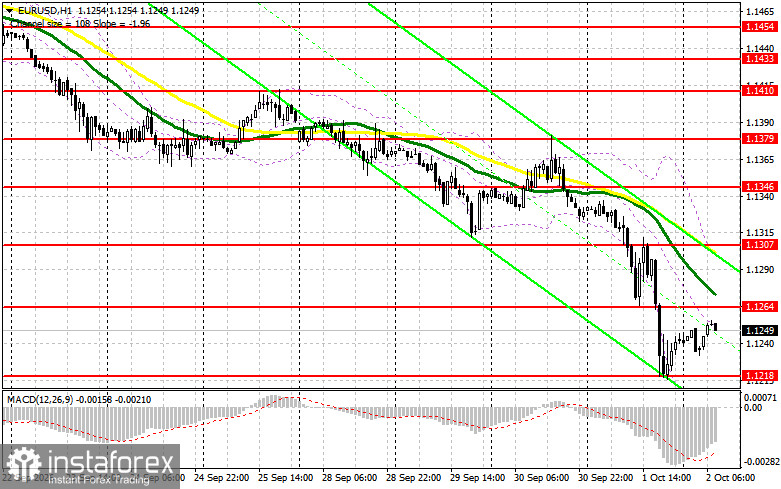
EUR/USD
On the hourly chart, I consider 1.1264 as the level for initiating shorts. A false breakout there would be a trigger for short positions targeting 1.1218, while a full breach of that range is likely only after a strong U.S. employment report. A close below 1.1218 with a subsequent bottom-up retest would increase pressure on the euro and open the way to 1.1174 and then 1.1136, where I would look to buy the bounce for a 25–30 pip move. If bears do not show up at 1.1264 and the employment report is weaker than expected, a break and hold above that level is possible, which would justify adding long positions toward 1.1307 and then 1.1346, where I would sell the rebound for 25–30 pips.
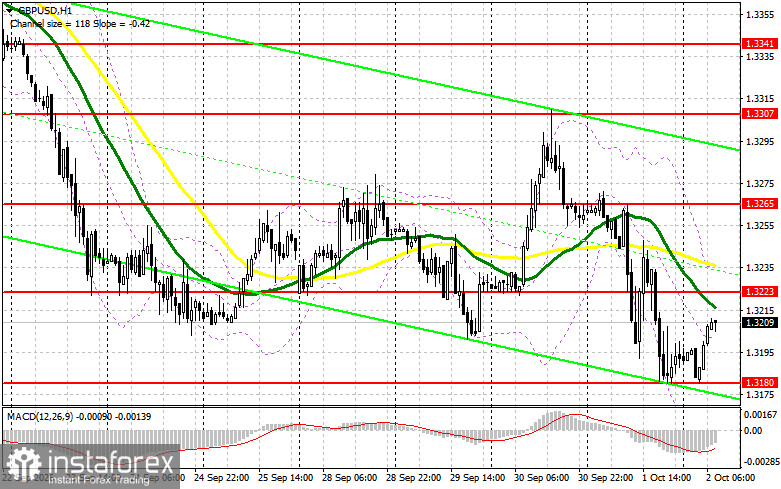
GBP/USD
No major UK fundamental data are due today, so the pound will most likely follow the dollar. Before U.S. employment data the pair is unlikely to fall below 1.3180; I will consider buying if there is a failed close below 1.3223 after attempts to move down to that range, and short positions are possible on a false breakout of 1.3265. A weak US labor report could lift the pound to 1.3307, where I would sell the rebound for 30–35 pips, while if weakness continues, I will consider buys from 1.3180, from 1.3137 on a false breakout, or on a bounce from 1.3097, aiming for a 25–30 pip correction.
Can the employment report reverse today's dynamic in favor of the euro and the pound? I do not think that will happen even with weak figures, because the French political crisis will remain and will weigh on the euro regardless of US statistics. I would risk saying that strong employment data would only accelerate the dollar's upward move, while weak data would at best give the euro and the pound a temporary respite before another wave of selling.
Dzięki analizom InstaForex zawsze będziesz na bieżące z trendami rynkowymi! Zarejestruj się w InstaForex i uzyskaj dostęp do jeszcze większej liczby bezpłatnych usług dla zyskownego handlu.


