 Zůstat

Obchodní podmínky
Nástroje


The wave count on the 4-hour chart for EUR/USD remains unchanged. There is no talk of canceling the bullish trend segment that began in January of last year; however, the wave structure starting from July 1, 2025 has taken on a complex, extended corrective form. In my view, the instrument has completed the construction of corrective wave 4, which has a non-standard internal structure. Within this wave, we observed exclusively corrective formations, leaving no doubt about its corrective nature.
In my opinion, the construction of the bullish trend segment has not yet been completed, and its targets extend as far as the 2.5000 level. In the coming weeks, one can expect a continuation of the bullish wave sequence, which may take the form of a five-wave structure a-b-c-d-e. However, there is no certainty that this trend segment will develop exactly in this way. The entire bullish wave sequence may end after three waves. In that case, the formation of a new downward segment would already be underway—also of a corrective nature.
The EUR/USD pair gained 40 basis points during Thursday and may add another 20–30 by the end of the day. What drove the strengthening of the euro? Most of today's news clearly pointed to increased demand for the U.S. dollar. Let's break it down.
The key event of the day was Donald Trump's cancellation of tariffs he had planned to introduce on February 1 for eight European countries and the United Kingdom. At yesterday's forum in Davos, Trump and NATO Secretary General Mark Rutte reportedly reached an agreement regarding Greenland, prompting the U.S. president to abandon additional import tariffs. At this point, it is still unclear what the agreement actually entails and how EU countries will react to it. For now, it looks like a situation where decisions were made without Europe's direct involvement. The fate of Europe and Greenland was discussed by NATO's Secretary General, while Europe's own position remains unknown. After news of new tariffs, demand for the U.S. dollar fell—so logically, it should have risen today.
In the U.S., the final GDP report for the third quarter was released today, once again exceeding even the most optimistic forecasts. The U.S. economy continues to accelerate even without support from the Federal Reserve, from which Trump continues to demand monetary easing. The reasons behind this acceleration are a separate issue, but the market ignored this report as well.
Additionally, for the second week in a row, U.S. initial jobless claims came in significantly lower than market expectations. During the most recent reporting week, claims totaled just 200,000 versus expectations of around 212,000. As we can see, three separate events on Thursday should have helped the U.S. currency strengthen—but that did not happen.
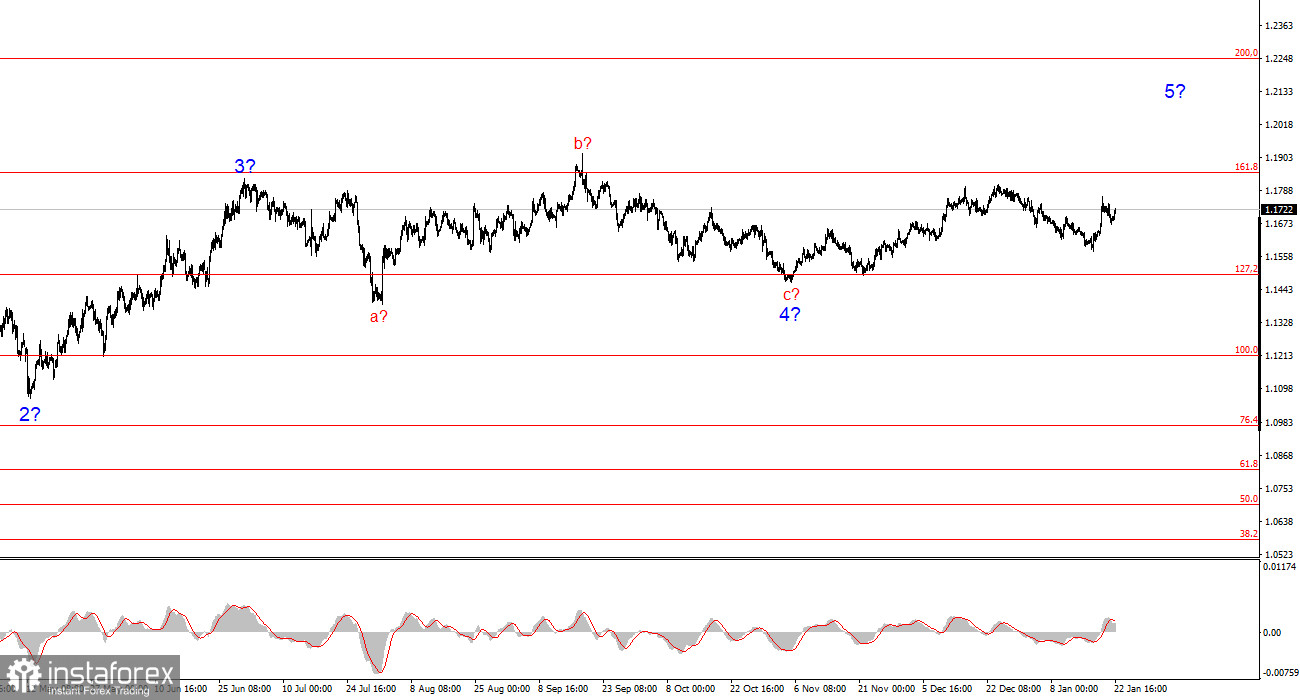
Based on this EUR/USD analysis, I conclude that the instrument continues to build a bullish trend segment. Donald Trump's policies and the Federal Reserve's monetary stance remain significant factors weighing on the U.S. dollar in the long term. The targets of the current trend segment may extend as far as the 2.5000 level. However, for these targets to be reached, the market must clearly and definitively complete the construction of the extended wave 4. At this time, I am not confident that the latest trend segment will take the form of a-b-c-d-e. Therefore, a decline toward the 1.5000 area remains possible.
On a smaller timeframe, the entire bullish trend segment is clearly visible. The wave structure is not entirely standard, as the corrective waves differ in size. For example, the higher-degree wave 2 is smaller than the internal wave 2 within wave 3. This can happen. Let me remind you that it is best to identify clear and understandable structures on charts rather than trying to label every single wave. At present, the bullish structure raises no doubts.
Key Principles of My Analysis:
Díky analytickým přehledům společnosti InstaForex získáte plné povědomi o tržních trendech! Jako zákazníkovi společnosti InstaForex je Vám k dispozici velký počet bezplatných služeb umožňujících efektivní obchodování.


