 Stay
Stay 

Trading Conditions
Products
Tools


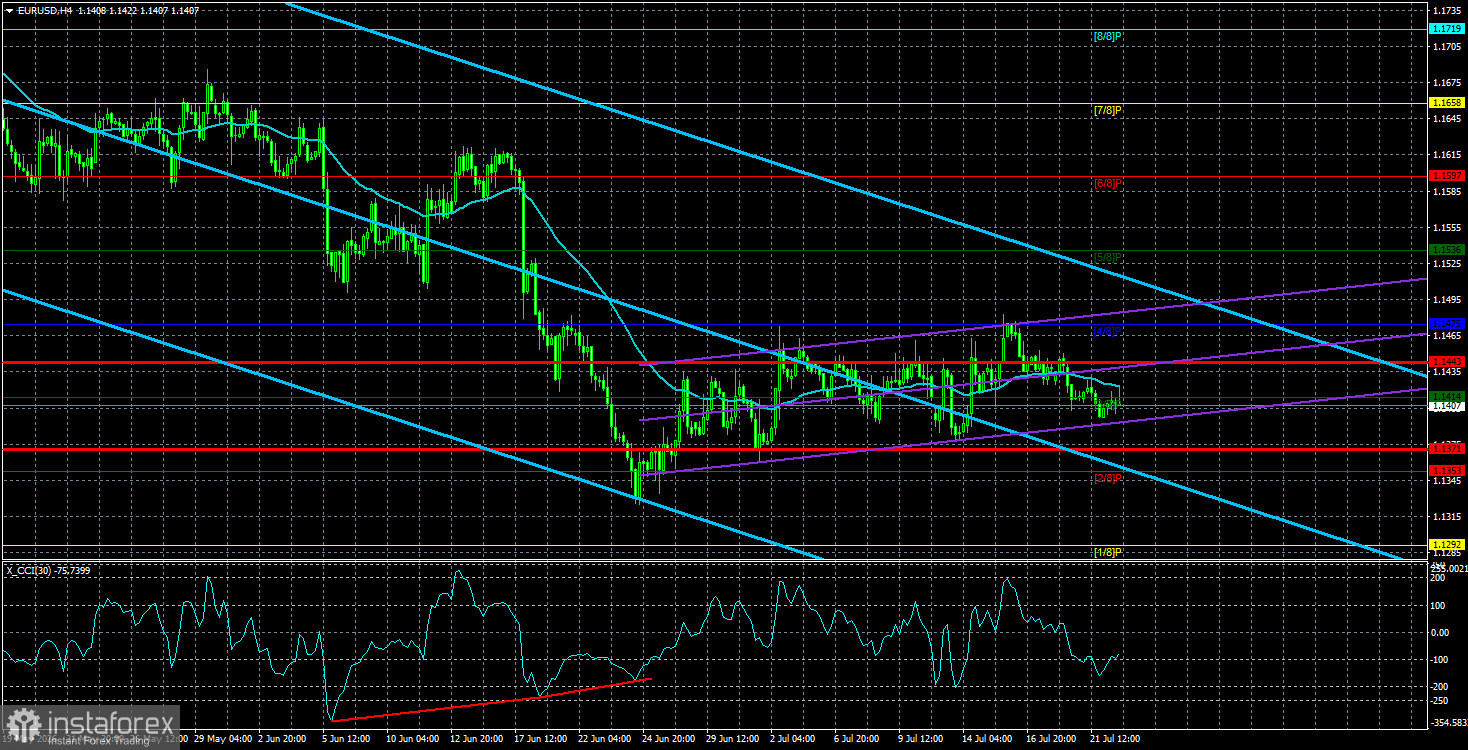
The EUR/USD currency pair did not show any interesting movements on Wednesday, and during the day, traders could only pay attention to the UK inflation report, which, for obvious reasons, has nothing to do with the European currency. Thus, the euro continues to live its own life, and the British pound has its own. Life for the European currency is considerably more boring at this time. For the fourth consecutive week, the pair has been in sideways movement with a slight upward inclination. Volatility indicators have dropped to minimal levels. Over the last thirteen days, the pair has moved more than 50 pips on only three occasions. In our view, this fact best indicates the market's lack of desire to open any positions. The market continues to wait, and a sideways trend is an integral part of any trend.
Unfortunately, predicting the beginning of a flat is nearly impossible, and predicting its end is even harder. We do not know when the market will resume active trading, but from experience, we can say that it usually happens out of the blue. If there is a forthcoming meeting of the Federal Reserve on the horizon, it is highly likely that the flat will not finish on that day but on the following day, when macroeconomic or fundamental background is absent. Charts, technical indicators, waves, patterns, and so forth are just images. Currency rates are ruled by real people, banks, and corporations. There is a constant battle for profit and more advantageous positions for trades in the market. Therefore, we often see movements that are extremely difficult to explain, as manipulations and deliberately false positions can occur.
On Thursday, the European Central Bank will summarize the results of its fifth meeting this year. At the last meeting, the central bank decided to raise rates in response to rising inflation. However, given the slowdown in inflation to 2.6% in June, the ECB prefers to take a wait-and-see approach at this time. Recall that inflation is currently dependent on oil prices, and oil prices are influenced by geopolitics. Iran and the US have been engaged in hostilities for ten days (after a ceasefire ended), but this does not necessarily mean that they will not return to negotiations tomorrow, or that the Strait of Hormuz will not be opened (for a couple more weeks, until the next ceasefire violation). Therefore, the ECB, the Federal Reserve, and the Bank of England will have to react based on the situation. If inflation rises, rates need to be increased. If inflation falls, rates do not need to be raised. Unfortunately, these "swings" can be observed for a very long time, and predicting future changes in monetary policy is simply unprofessional under the current circumstances.
Since the ECB is not planning to change monetary policy parameters in June, it is unlikely that we will see strong movements in the market today. Christine Lagarde is unlikely to provide the market with any specific details about the central bank's future actions. Therefore, the flat is likely to continue today, and volatility is expected to remain low. Recall that a month and a half ago, when the ECB raised all three rates, the market did not respond at all.
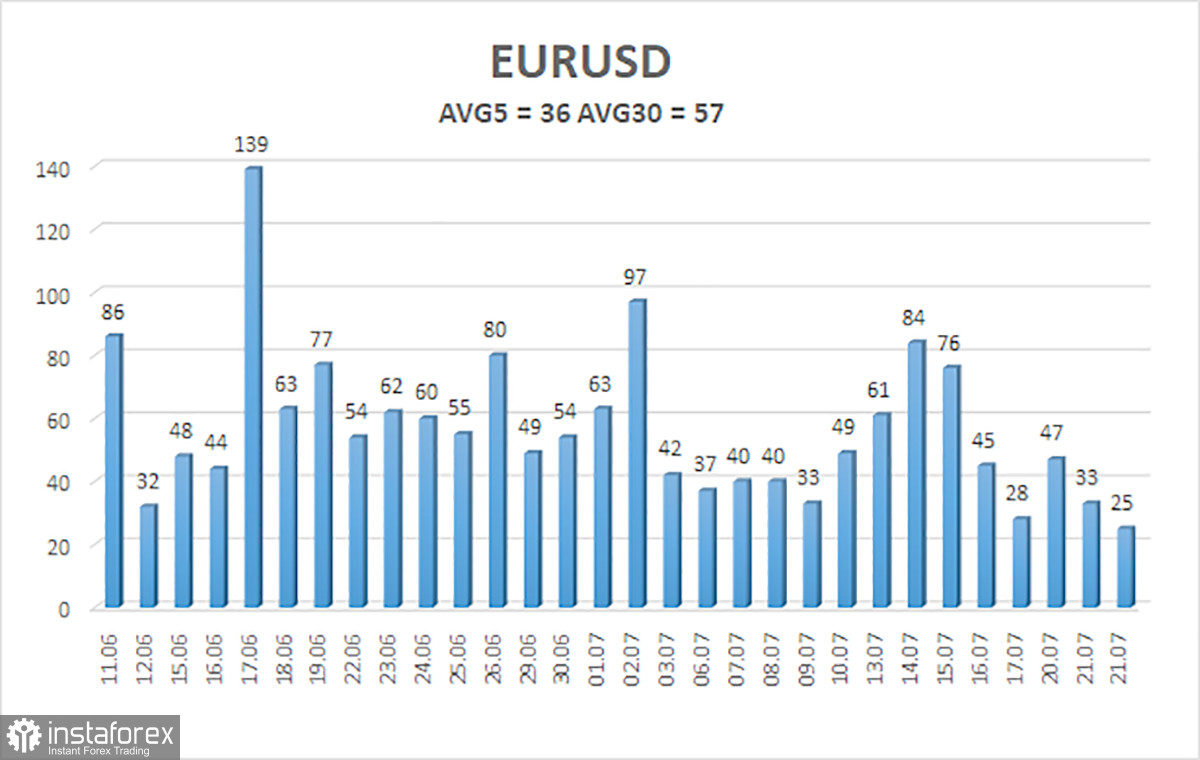
The average volatility of the EUR/USD currency pair over the last 5 trading days as of July 23 is 36 pips and is characterized as "low." We expect the pair to move between 1.1371 and 1.1443 on Thursday. The upper linear regression channel is pointing downward, indicating the continuation of a downward trend. The CCI indicator has entered the oversold area and has formed two bullish divergences, warning of a possible end to the downward trend.
S1 – 1.1414
S2 – 1.1353
S3 – 1.1292
R1 – 1.1475
R2 – 1.1536
R3 – 1.1597
The EUR/USD pair maintains a downward trend, which is presumably a correction within a global upward trend, as is clearly seen on the daily or weekly timeframe. The global fundamental backdrop for the dollar remains negative, but in 2026, initially geopolitical factors and then the "hawkish" stance of the Fed provided substantial support for the US dollar. When the price is below the moving average, short positions can be considered with targets of 1.1371 and 1.1353. Above the moving average line, long positions are relevant with targets of 1.1443 and 1.1475. The market has been in a flat for the fourth consecutive week.
Linear regression channels help determine the current trend. If both are directed in one direction, it indicates that the trend is currently strong;
The moving average line (settings 20,0, smoothed) defines the short-term trend and the direction in which trading should currently be conducted;
Murray levels are target levels for movements and corrections;
Volatility levels (red lines) represent the likely price channel in which the pair will spend the next day, based on current volatility metrics;
The CCI indicator's entry into the oversold area (below -250) or the overbought area (above +250) means that a trend reversal is approaching in the opposite direction.
InstaForex analytical reviews will make you fully aware of market trends! Being an InstaForex client, you are provided with a large number of free services for efficient trading.


