 Stay
Stay 
Trading Conditions
Products
Tools



Yesterday, the dollar spent the day rising, and there were plenty of reasons for that. The euro played catch-up, and although the pound strengthened, it looks more like a cautious bounce than a confident reversal. In my view, the market is stuck between two views on how strong the US economy really is and is not yet ready to bet on either.

From the morning in Europe, no new figures had yet been released, nor in the UK. The euro and the pound traded on yesterday's carry and await their own news, which will appear in the first half of the day. I will describe them below.
During the US session yesterday, three reports arrived at once, each pulling in its own direction. I'll start with the labor market. Private-sector companies added 90,000 jobs in September by ADP's estimate, while far fewer were expected. In dollar terms, that is a positive sign, as steady hiring suggests the economy is holding up. Consumer spending followed, rising 0.6% in August — the strongest month since March 2025. The most interesting was the core personal consumption expenditures index. This is the inflation measure the Federal Reserve watches, and "core" excludes fuel and food, so it shows whether inflation is heating up inside the economy. It rose 0.2% versus 0.3% expected, and July's figure was revised down. The result is a strange mix. Jobs and spending point to an economy not ready to give in, while inflation behaves quieter than feared. The market has re-priced the odds of an October rate decision to around 36%. So the dollar has both support and a ceiling, and the euro and pound don't have that freedom. I think both pairs will search for direction through the end of the week until a fresh catalyst shifts the balance.
Today the euro faces a dense block of reports, all fitting into the first half of the day. It starts with Germany's September manufacturing PMI. It's based on a purchasing managers' survey, and the 50 mark separates expansion from contraction. Germany is the region's largest economy, so its figure usually sets the tone for the entire bloc. Then the eurozone aggregate PMI will be released, showing whether manufacturing outside Germany is holding up, followed by unemployment data. For the euro to rise, each of these readings must beat expectations, and that is a high bar. Bundesbank President Joachim Nagel will also speak, and markets listen because he participates in European Central Bank decisions. I think strong numbers, paired with cautious but not overly dovish rhetoric, could give the euro a real reason to rise. If even one block disappoints, the pair will be left without impulse, and given yesterday's mood around the dollar, that more often means sliding down rather than a calm sideways market.
For the pound, the morning will be all British. The UK manufacturing PMI for September will be released, and the market expects a decent print. If expectations are met, the pound can consolidate its morning gain. Then Bank of England Governor Andrew Bailey and MPC member Catherine Mann will speak. If data meet forecasts and the speakers' tone is restrained, GBP/USD will hold the morning rise. If figures disappoint and the speeches are cautious, pressure will return quickly. Neither alone will determine the picture; the combination of PMI and comments will give the pound direction through the European session. The threshold for the pound is lower than for the euro—meeting forecasts may be enough for GBP, while the euro needs beats—so I consider the pound more resilient today.
If the morning block delivers a meaningful surprise, momentum will not be long in coming.
For the euro to the upside, the breakout point is 1.1346, targets 1.1379 and 1.1410. Such a scenario requires an almost perfect morning — strong prints and support from Nagel — so I consider it less likely. To the downside, 1.1312 works, then 1.1284 and 1.1249. This path seems closer to me, since it only requires disappointment in one of the indicators, and yesterday's US data did not add confidence to the euro. There are just over thirty pips between 1.1312 and 1.1346, and while the price wanders inside this range, it is too early to trade the breakout.
For the pound to the upside at 1.3270, with targets at 1.3307 and 1.3341. The scenario looks like a natural continuation of the morning rise if PMI meets expectations and Bailey and Mann say nothing unexpected. But I would prefer to wait for a consolidation above the level rather than the first touch. The bottom is 1.3238, targets 1.3206 and 1.3173. It will trigger if the prints disappoint and the Bank of England voices sound cautious. There are only thirty-two pips between the two breakout points, and in such a narrow band the pound can easily run side to side before choosing a direction.
Here I play false breakouts, and this scenario fits the morning well when prints come close to forecasts and the market, after the first rush, pulls back.
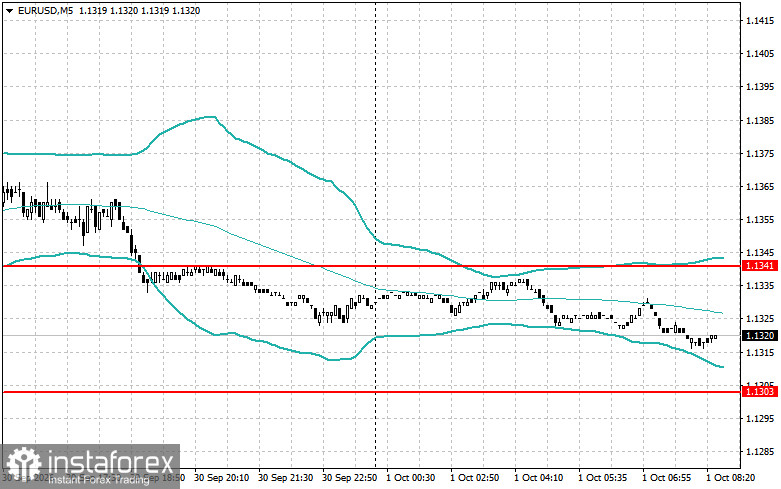
For the euro to the upside, I watch 1.1341. It sits only five pips below the breakout point 1.1346, so the price will touch it before a real breakout begins. If the pair enters the zone between 1.1341 and 1.1346 and quickly returns below, I consider selling because the move found no buyers. If it consolidates above 1.1346, that is a breakout and selling there is forbidden. On a single touch, you cannot distinguish a return from a true breakout in such a tight zone, so I would skip the first reaction. I place the stop above 1.1346 with a small buffer. The lower reference, 1.1303, lies nine pips below the breakout point 1.1312 and noticeably above the first target, 1.1284. I look for buys here when price first passes 1.1312, reaches 1.1303, fails to continue, and returns. If the decline continues and 1.1303 is confidently breached, do not return to long positions, and I hide the stop below that level.
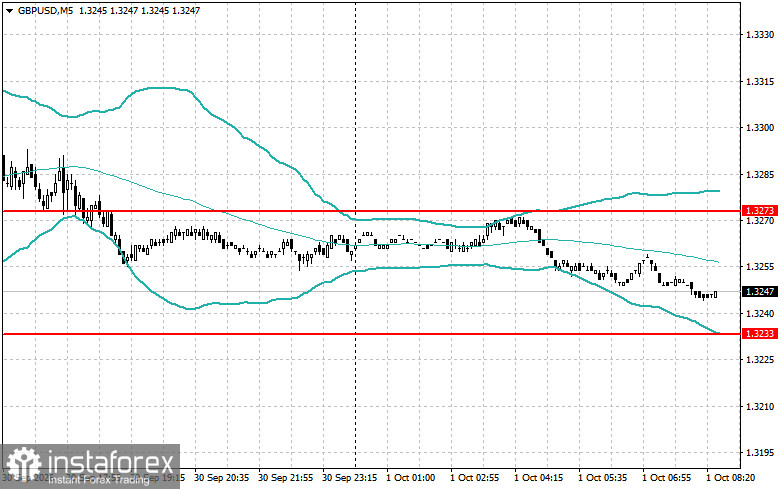
For the pound, the upper reference 1.3273 sits only three pips above the breakout point 1.3270 — the tightest placement in the whole analysis. If price passes 1.3270, reaches 1.3273, and consolidates above, the breakout works with target 1.3307, and selling against it is forbidden. If it dipped into those three pips, failed to hold, and returned below 1.3270, I consider selling because the move found no follow-through. In the first minutes, both options look identical, and I would wait for the candle to define itself rather than enter on the first touch. I place the stop above 1.3273 with a small buffer. The lower reference, 1.3233, sits five pips below the breakout point, 1.3238, and the situation there is mirrored. If price drops below 1.3238, reaches 1.3233, and quickly returns above, I seek buys. If it consolidates below, that is a breakout toward 1.3206, and buying against it is forbidden. I hide the stop under 1.3233 with a buffer. Of the two pairs, the return trade appeals to me more on the pound today, since the morning rise has already occurred and if PMI prints near forecast, the market has little reason for a confident surge. But until Bailey and Mann speak, I remain cautious, as one unexpected phrase can pull the pair through both zones without stopping.
InstaForex analytical reviews will make you fully aware of market trends! Being an InstaForex client, you are provided with a large number of free services for efficient trading.


