 Stay
Stay 

Trading Conditions
Products
Tools


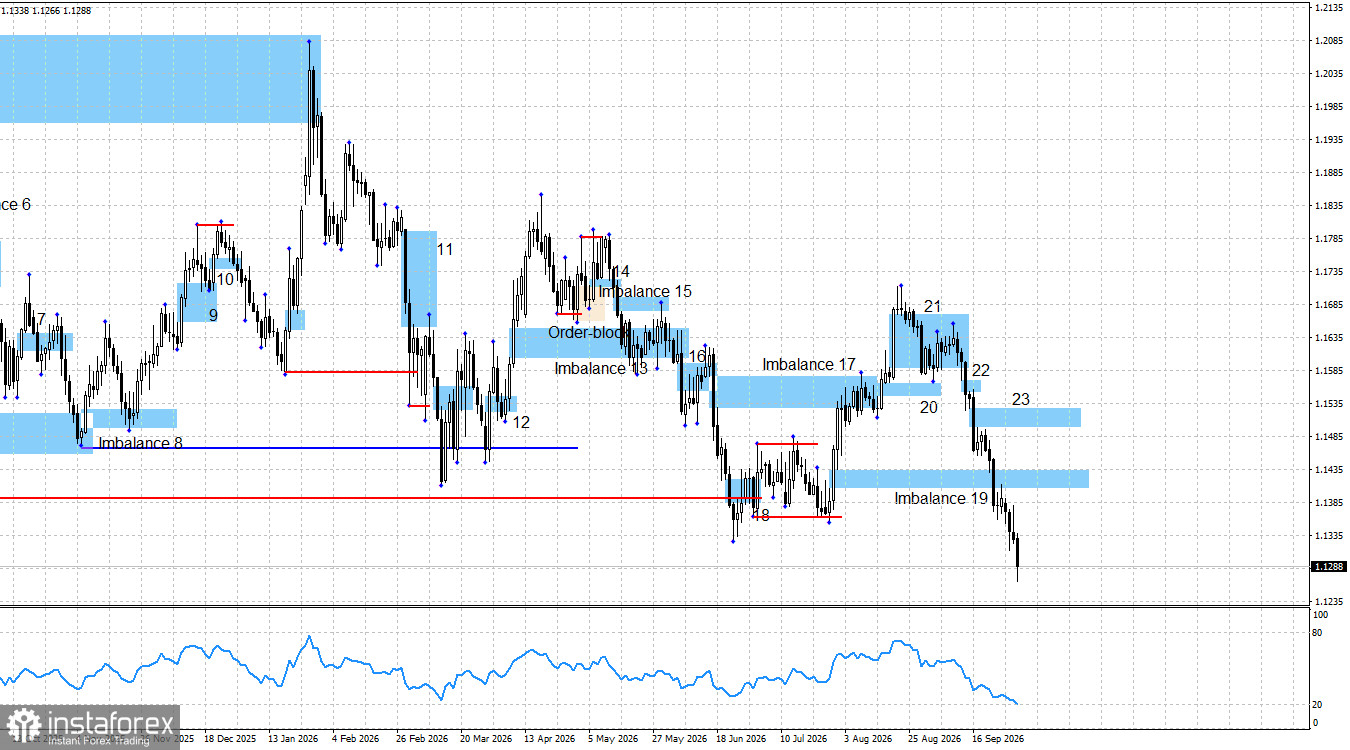
The EUR/USD pair has been declining for sixteen consecutive days, apart from several brief pauses. During this period, the euro has lost 380 points. The euro's decline began three weeks ago as the market prepared for an FOMC rate hike. Since then, the market has continued buying the dollar based on the Federal Reserve's hawkish monetary policy stance, which has already been contradicted several times by FOMC policymakers. Many Fed officials openly state that further monetary policy tightening is necessary, but at the same time, they do not provide specific guidance on the extent of further tightening. The latest dot plot showed that another 0.25% rate hike should be expected. This week, Federal Reserve Bank of New York President John Williams went so far as to say that the Fed should not rush into further policy tightening. Has the dollar not appreciated too much on the prospect of two rate hikes, the timing of the second of which remains unknown? The dollar is rising as if the Fed had shifted from an absolutely neutral stance to an ultra-hawkish one, with the market having considered such a scenario virtually impossible. In reality, however, monetary policy easing could begin as early as 2027, as Fed policymakers themselves have stated that the impact of higher oil prices will be limited in duration. The same applies to the impact of Donald Trump's trade tariffs.
Nothing can currently stop the euro's decline. Tighter ECB policy, positive economic data from the European Union, and the technical picture, including bullish patterns, have failed to provide meaningful support for the euro. With Imbalance 19 invalidated, the euro now has every chance of falling below the psychological level of $1.10. Moreover, Bullish Imbalance 19 is not merely invalidated; it has turned into a Bearish Inverted Imbalance and has already generated a sell signal. The bulls could have relied on the two most recent swings, but they failed to do so.
Last week, the FOMC committee indicated its willingness to continue tightening policy, which was enough for the bears to continue their strong advance. Even after the Federal Reserve tightened monetary policy in September and potentially tightens it again in October or December, I do not see what other factors could prompt traders to continue buying the US currency. The dollar has certainly performed strongly in recent weeks, but what factors have supported it during this period? FOMC monetary policy tightening and nothing else?
Overall, in my view, the fundamental background remains favorable to the bulls. Despite the Federal Reserve's more hawkish monetary policy stance, this is not the only factor influencing currency prices. I would remind you that US Treasury yields are reaching record highs, placing significant pressure on the federal budget; the US economy has slowed in recent quarters; in 2026, Donald Trump resumed a series of trade and non-trade disputes with numerous countries around the world; and the US stock market continues to raise serious concerns because of uncontrolled credit-financed investment in technology companies involved in AI development.
The current technical picture indicates that the bearish momentum is intact. There are currently no active patterns, either bearish or bullish. However, the current week could end with the formation of a new bearish imbalance. At present, the bulls do not even have any potential patterns.
The economic background was of no significance on Thursday. The same was true on Wednesday, Tuesday, Monday, and last week. Bearish traders continue to attack regardless of the fundamental background or its absence. Important US labor-market and unemployment reports will be released tomorrow, but they are also of little significance after three weeks of dollar gains.
The bulls still have numerous reasons to attack in 2026. Structurally and globally, Trump's policy, which led to a significant decline in the dollar last year, has not changed. At present, I do not see any significant factors supporting the US currency despite the FOMC's hawkish stance. Geopolitical developments, which supported demand for the US currency through much of the first half of 2026, are no longer having the same effect.
The economic calendar for October 2 contains four entries, all of which can be considered important except for the US earnings report. The economic background could have a significant impact on market sentiment throughout Friday and during the entire trading day.
In my view, the pair remains in the process of forming a bullish trend that has paused for an entire year. The fundamental background shifted sharply in favor of the bears seven months ago, but the trend that has been in place for four years cannot be considered canceled or complete. In the long term, I would describe the pair as being in a range. A range does not invalidate the broader bullish trend. Thus, the bulls may resume their advance in 2026, but they currently have no concrete opportunities to do so. The bears have received a new sell signal within Imbalance 19, and another bearish imbalance could form this week. The bulls can only hope for weak Nonfarm Payrolls data.
InstaForex analytical reviews will make you fully aware of market trends! Being an InstaForex client, you are provided with a large number of free services for efficient trading.


