 Stay
Stay 

Trading Conditions
Products
Tools


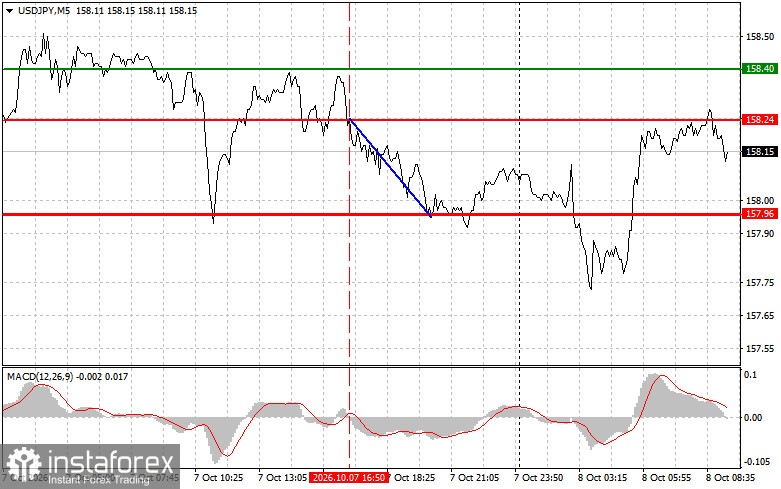
The test of 158.24 occurred when the MACD indicator was only beginning to move down from the zero line, confirming a correct entry point to sell the dollar. As a result, the pair fell toward the target area near 157.96.
The yen managed to hold ground against the dollar after the US currency largely ignored the Federal Reserve's September minutes last night. The document brought no surprises: the rate rise to 3.75–4.00% was supported unanimously, and most participants expect another hike before year-end, though nobody emphasized October. Inflation risks remain tilted upward because of the Middle East situation and a sharp rise in AI-related investment. That backdrop is uncomfortable for the yen — high US yields support the dollar — so the yen's stability is notable.
This morning's Japanese data helped. The current-account surplus for August was JPY 2,979.4bn versus expectations of JPY 2,100.0bn and JPY 2,523.1bn a month earlier; seasonally adjusted it was JPY 4,062.0bn versus a forecast of 3,194bn. For a country reliant on energy imports, that outperformance matters because it shows the external balance is firmer than feared. The September Tankan survey also came in slightly better: the assessment of current conditions rose to 47.0 from 46.7 (July was 46.4), though it remains below 50 and thus cautious. Expectations for the months ahead fell to 47.4 from 48.3, reminding us that the recovery is fragile.
A notable morning event was the 30-year JGB auction. Demand was solid as high yields attracted investors: the alloted yield was 4.11% versus 4.08% last time, and the bids-to-cover ratio rose to 3.88 from 3.79 and a 12-month average of 3.56. Investors remain cautious on fiscal policy.
The picture is mixed. In the US, Treasuries are discussed as a potential stress source, while in Japan long bonds were absorbed at higher yields without trouble. For the yen, this is a two-edged signal: rising yields support expectations of BOJ normalization, while fiscal worries limit confidence in the currency.
For intraday strategy, I will rely mainly on Scenario 1 and Scenario 2.
Scenario 1: Buy USD/JPY today if price reaches the entry area around 158.25 (green line) with a target of 158.53 (thicker green line). Around 158.53, plan to exit long positions and open short positions for a counter-move (expecting 30–35 pips). Prefer to return to longs on corrections and significant pullbacks. Important: before buying, ensure MACD is above zero and only beginning its rise.
Scenario 2: Also buy if there are two consecutive tests of 158.10 while MACD is in the oversold area. This would limit downside potential and trigger a reversal upward. Expect moves toward 158.35 and 158.53.
Scenario 1: Sell USD/JPY only after the 158.10 level is breached (red line); this should lead to a rapid decline. Sellers' key target is 157.83, where I plan to exit shorts and immediately open longs for a counter-move (expecting 20–25 pips). Sellers can return at any moment — any hint from the central bank is enough. Important: before selling, ensure MACD is below zero and only beginning its decline.
Scenario 2: Also sell if there are two consecutive tests of 158.25 while MACD is in the overbought area. This would cap upside and trigger a downward reversal. Expect declines to 158.10 and 157.83.
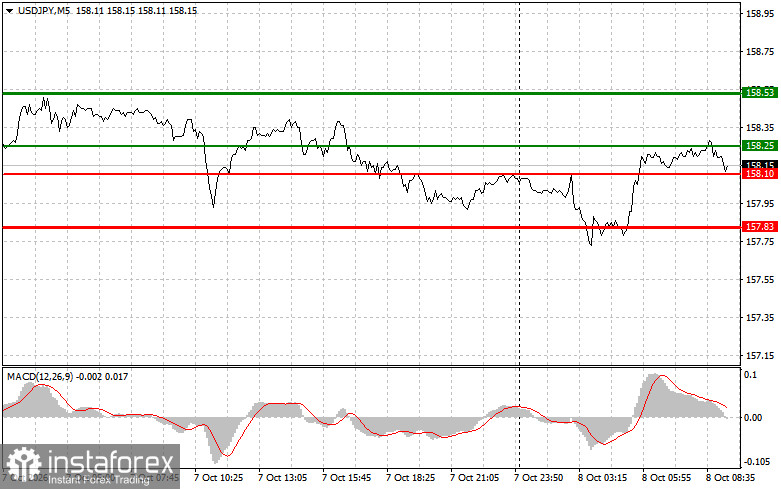
Thin green line – entry price at which you can buy the trading instrument.
Thick green line – approximate price where you can place Take Profit or manually lock in profits, since further upside above this level is unlikely.
Thin red line – entry price at which you can sell the trading instrument.
Thick red line – approximate price where you can place Take Profit or manually lock in profits, since further downside below this level is unlikely.
MACD indicator. When entering the market, it is important to follow the overbought and oversold zones.
Important. Beginner traders in the Forex market must be very cautious when making entry decisions. It is best to stay out of the market before the release of important fundamental reports to avoid getting caught in sharp price swings. If you decide to trade during news releases, always place stop orders to minimize losses. Without stop orders,, you can quickly lose your entire deposit, especially if you don't use money management and trade large volumes.
Remember that successful trading requires a clear trading plan, like the example above. Spontaneous trading decisions based on the current market situation are inherently a losing strategy for an intraday trader.
InstaForex analytical reviews will make you fully aware of market trends! Being an InstaForex client, you are provided with a large number of free services for efficient trading.


