 Stay
Stay 
Trading Conditions
Products
Tools



Analysis of Trades and Trading Advice for the Japanese Yen
The test of 158.25 occurred when the MACD indicator had just started moving upward from the zero line, confirming the validity of the entry point for a long position on the dollar. However, the pair did not proceed to a significant increase.
The yen is entering the U.S. trading session with an unexpectedly strong political background. In terms of economic data, U.S. weekly initial jobless claims, expected at around 200,000, and wholesale inventories will be released in the second half of the day, followed by a speech by Alberto Musalem, whose remarks are unlikely to interfere with the current strengthening of the dollar against risk-sensitive assets. However, the main news for the yen came not from the United States but from Tokyo.
Prime Minister Sanae Takaichi stated that Japan no longer needs a policy aimed at stimulating inflation, as the economy is no longer in a state of deflation. The government is signaling a shift away from its reflationary policy, and this change coincided with recent comments by U.S. Treasury Secretary Scott Bessent, who urged Japan to leave efforts to stimulate the economy behind. Inflation in Japan is expected to approach 3% by the beginning of next year, while the core inflation rate remained above the Bank of Japan's 2% target for four consecutive years through 2025. This shift is important for the yen because it reduces some of the uncertainty surrounding the continuation of the Bank of Japan's rate normalization, while Ueda had previously said that greater attention should be paid to the risks of rising prices.
The morning data supported this outlook. The current account surplus for August amounted to JPY 2,979.4 billion, compared with expectations of JPY 2,100.0 billion, while the Economy Watchers Survey showed a current conditions index of 47.0 versus a forecast of 46.7. The 30-year bond auction attracted strong demand, but investors remain cautious about Takaichi's tax bill, and the question of its financing remains open. The Prime Minister's comments provide the yen with a relatively stable source of support; however, high U.S. yields and continued demand for the dollar are unlikely to allow USD/JPY to decline significantly until the market receives new signals from the Federal Reserve.
As for the intraday strategy, greater emphasis will be placed on the implementation of Scenarios #1 and #2.
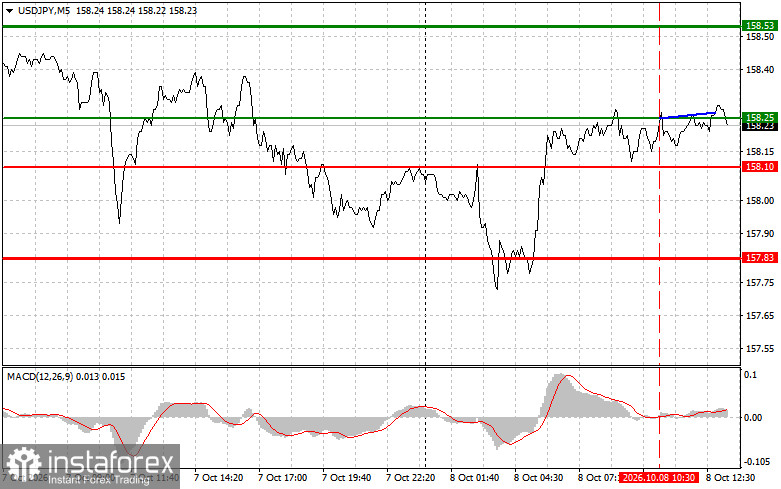
Buy Signal
Scenario #1: USD/JPY can be bought today when the entry point near 158.31 is reached (the thin green line on the chart), with a target of 158.53 (the thicker green line on the chart). Around 158.53, the long position can be closed and a short position opened in the opposite direction (targeting a move of 30–35 points in the opposite direction from the level). An increase in the pair can be expected today, but the potential for such a move is relatively limited. Important! Before buying, make sure that the MACD indicator is above the zero line and has only just started rising from it.
Scenario #2: USD/JPY can also be bought today if the price tests 158.16 twice consecutively while the MACD indicator is in the oversold zone. This would limit the pair's downward potential and lead to a reversal to the upside. A rise toward the opposite levels of 158.31 and 158.56 can be expected.
Sell Signal
Scenario #1: USD/JPY can be sold today after the 158.16 level is broken (the red line on the chart), which would lead to a rapid decline in the pair. The key target for sellers will be 157.83, where the short position can be closed and a long position opened in the opposite direction (targeting a move of 20–25 points in the opposite direction from the level). Downward pressure on the pair could return if the central bank intervenes. Important! Before selling, make sure that the MACD indicator is below the zero line and has only just started declining from it.
Scenario #2: USD/JPY can also be sold today if the price tests 158.31 twice consecutively while the MACD indicator is in the overbought zone. This would limit the pair's upward potential and lead to a reversal to the downside. A decline toward the opposite levels of 158.16 and 157.83 can be expected.
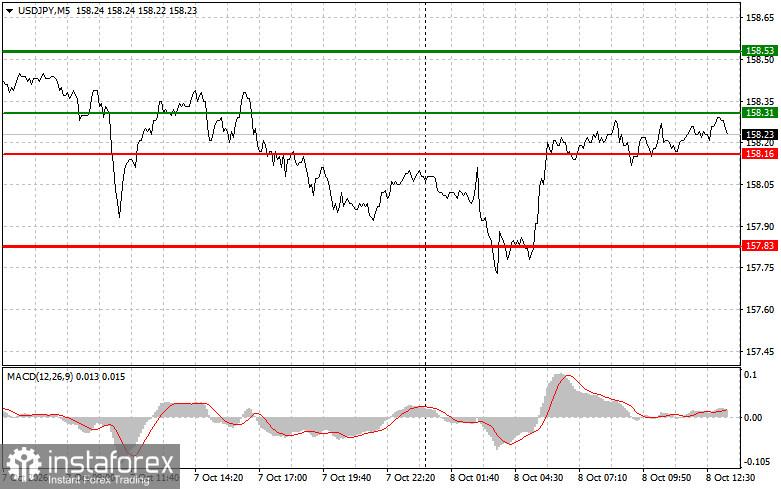
What Is Shown on the Chart:
Important. Beginner Forex traders should make entry decisions very cautiously. Before the release of important fundamental reports, it is best to stay out of the market in order to avoid exposure to sharp price fluctuations. If trading during news releases, always use stop orders to minimize losses. Without stop orders, the entire trading account can be lost very quickly, especially when risk management is not used and large trading volumes are involved.
It is important to remember that successful trading requires a clear trading plan, such as the one presented above. Making trading decisions spontaneously based on the current market situation is inherently an unfavorable strategy for an intraday trader.
InstaForex analytical reviews will make you fully aware of market trends! Being an InstaForex client, you are provided with a large number of free services for efficient trading.


