 Anuluj

Warunki handlowe
Narzędzia


USD/CAD continues its uptrend for the third consecutive week: if the loonie traded near the base of the 1.38 area in early September, buyers have now already tested resistance around 1.4050 — roughly the upper Bollinger-Band on the H4 timeframe.
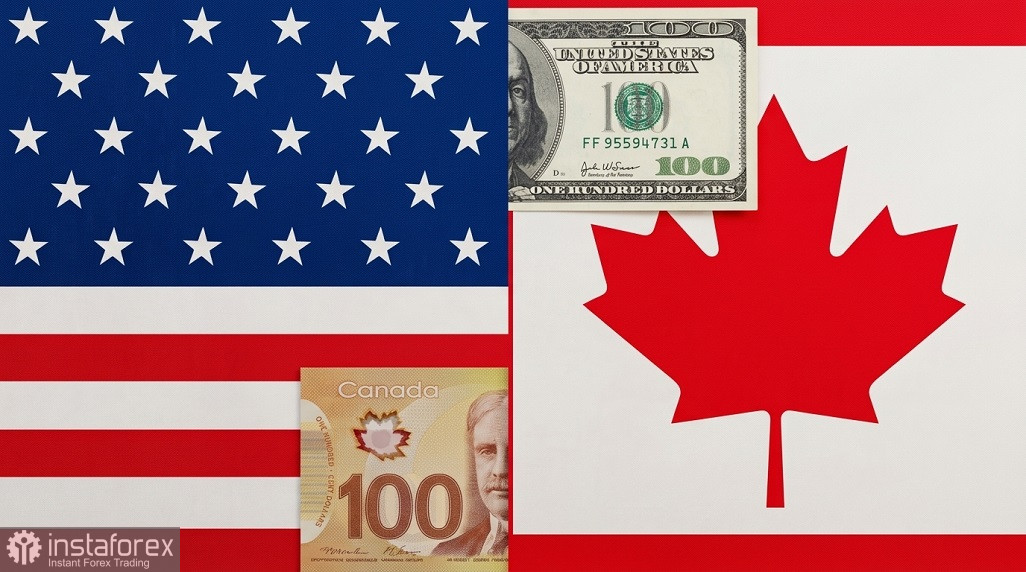
The main engine of USD/CAD's rise is the monetary-policy divergence between the Bank of Canada and the Federal Reserve. At its September meeting, the Bank of Canada once again left the policy rate at 2.25%, while the Fed raised the federal-funds range to 3.75%–4.00%. The resulting interest-rate gap is already about 150–175 basis points in favor of the US dollar. Moreover, the Fed's updated median projection this month implies a year-end policy rate near 4.1%. A large majority of FOMC members expect at least one more 25-bp hike at one of the remaining meetings this year (likely in December).
One key factor weighing on the loonie is the inflation picture. The September 14 CPI print initially looks stiff: headline CPI in August held at July's level of 3.0% year-on-year, i.e., near the upper bound of the BoC's tolerance. However, the release's structure is much less hawkish. Gasoline inflation eased to 22.8% y/y (from 25.7%), food inflation fell from 3.1% to 2.8%, and the transport component eased to 7.5% (from 7.8%). Apparel and footwear inflation slowed markedly from 2.4% to 1.2%. Importantly, headline CPI was negative month-on-month in August (-0.1% vs a 0.0% forecast).
So the "3.0%" headline in the Canadian CPI is somewhat misleading. The higher overall inflation is largely explained by the energy component, while there is no broad-based, persistent acceleration in price pressures. Core measures remain much closer to target and well below headline CPI: CPI-median is 2.0%, CPI-trim 1.9%, and CPI-common eased to 2.6% (from 2.7%). The inflation impulse is still concentrated in energy and some services rather than spreading evenly across the economy.
This character of inflation is consistent with the Bank of Canada's cautious stance. At the September meeting, the BoC left the policy rate at 2.25%, noting the economy appears to operate with some excess supply and the labor market shows signs of weakness. The Governing Council also acknowledged rising inflation risks and warned that if elevated energy prices pass through more broadly, further tightening may become necessary.
In short, a rate hike at the BoC remains possible but is not the baseline scenario for now. At the same time, the widening policy gap and persistent oil-price uncertainty continue to favor USD/CAD appreciation.
Against this backdrop, the contrast with the Fed's stance becomes even more pronounced. The US central bank not only raised rates but effectively signaled one more hike before year-end. Fed officials noted resilient domestic demand, strong productivity growth and persistently elevated inflation.
Thus, the interest-rate differential works in the US dollar's favor. While the Bank of Canada must weigh a weak economy and excess supply, the Fed has room for further tightening. For USD/CAD, this factor remains the primary driver of the uptrend.
The oil market also works against the loonie on Tuesday. Crude prices are falling on reports of potential restoration of shipments through the Strait of Hormuz and prospects for renewed US-Iran diplomacy. That is negative for the loonie because lower oil prices typically reduce support for the commodity-linked Canadian dollar.
This means USD/CAD buyers receive support from two sides: first, the persistent Fed-BoC policy gap in favor of the dollar; and second, the easing of the oil-driven inflation argument that had helped the loonie.
Moreover, continued de-escalation in the Middle East would likely increase pressure on the loonie, since lower oil prices would remove one of Canada's key supports. Cheaper oil would ease inflationary pressure in Canada and lower the odds of further BoC tightening. In those conditions, the decoupling of Fed and BoC policy positions becomes the main driver of USD/CAD appreciation.
Technically, the pair is at the upper Bollinger-Band on the H4 and D1 timeframes and sits above the Ichimoku lines. On the weekly chart, the pair is between the middle and upper Bollinger-Band. A decisive break above 1.4050 (H4 upper Bollinger-Band) would open the way toward the next barrier around 1.4110 (monthly Kijun-sen). Given the prevailing fundamental backdrop, it is reasonable to consider long positions on south-side pullbacks in USD/CAD.
Dzięki analizom InstaForex zawsze będziesz na bieżące z trendami rynkowymi! Zarejestruj się w InstaForex i uzyskaj dostęp do jeszcze większej liczby bezpłatnych usług dla zyskownego handlu.


