 Stay
Stay 

Trading Conditions
Products
Tools


The wave pattern on the 4-hour chart for EUR/USD has transformed, but overall it still remains quite clear. There is no talk of canceling the bullish trend segment that began in January 2025; however, the wave structure since July 1 has taken on a complex and extended form. In my view, the instrument has completed the construction of corrective wave 4, which turned out to be highly unconventional. Within this wave, we observed exclusively corrective structures, leaving no doubt about the corrective nature of the decline.
In my opinion, the construction of the bullish trend segment has not been completed, and its targets may extend as far as the 2.5000 level. The series of waves a–b–c–d–e appears complete; therefore, I expect the formation of a new bullish wave sequence in the coming weeks. We have seen the presumed waves 1 and 2, and the instrument is now in the process of forming wave 3 or C. I expected this wave to push the instrument up to the 1.1717 level, which corresponds to the 38.2% Fibonacci retracement; however, this wave is becoming more extended, which is very positive, as it may turn into an impulsive wave—along with the entire bullish wave sequence.
During Wednesday, the EUR/USD pair began to lose market support. The single European currency declined by about 60 basis points from yesterday's highs. However, in my view, this decline does not even deserve minimal attention. As shown in the chart above, such pullbacks occur regularly. The internal wave structure of the presumed wave 3 or C does not look textbook-like. Even now, more than five waves can be identified within it, suggesting that it may become quite extended. Accordingly, this wave may continue to develop, and today's decline is merely a corrective pullback.
Tomorrow, the ECB will hold its final meeting of the year. The rate decision is already known—no changes are expected. However, market participants are highly interested in the answer to the following question: what actions will the European regulator take in the first half of 2026? If inflation continues to rise gradually, as it has in recent months, the ECB may take preventive measures and carry out one round of monetary policy tightening. However, such decisions will depend solely on inflation. Therefore, I do not expect Christine Lagarde and her colleagues to announce rate hikes for next year tomorrow.
And what about inflation? As of November, the Consumer Price Index remained unchanged at 2.1% year-on-year. Consequently, at this moment the ECB does not even need to consider raising interest rates next year. I believe the outcome of the ECB meeting will be extremely uneventful, and the market will show little to no reaction to this event.
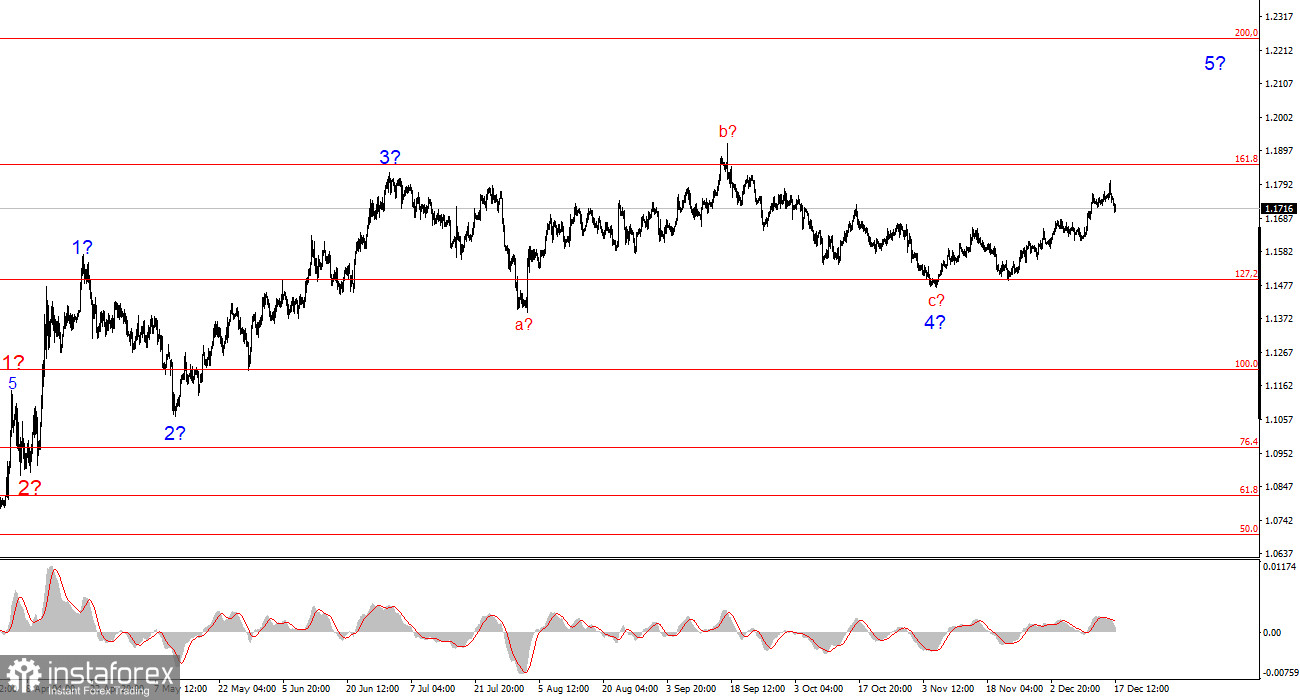
Based on the EUR/USD analysis, I conclude that the pair continues to build a bullish trend segment. Donald Trump's policies and the Federal Reserve's monetary policy remain significant long-term factors weighing on the U.S. dollar. The targets of the current trend segment may extend as far as the 2.5000 level. The current upward wave sequence is beginning to gain momentum, and one would like to believe that we are now witnessing the formation of an impulsive wave sequence as part of the global wave 5. In this case, growth toward the 2.5000 level should be expected, as I have mentioned previously.
On a smaller scale, the entire bullish trend segment is clearly visible. The wave structure is not entirely standard, as corrective waves vary in size. For example, the higher-degree wave 2 is smaller than the internal wave 2 within wave 3. However, this also happens. I would like to remind you that it is best to identify clear and understandable structures on charts, rather than strictly adhering to every individual wave. At present, the bullish structure raises no doubts.
Key Principles of My Analysis:
InstaForex analytical reviews will make you fully aware of market trends! Being an InstaForex client, you are provided with a large number of free services for efficient trading.


