 Stay
Stay 
Trading Conditions
Products
Tools



On Wednesday, market participants learned about the state of the US labor market as of January. It turned out that the situation is improving, with jobs being created at a pace close to "normal" times. However, what conclusions can traders draw regarding the forecast of the American currency's future movements?
First, the Fed has decided to pause following its December monetary policy easing. Jerome Powell and some of his colleagues have stated that it will take some time for the impact of the rate cuts to fully reflect on the labor market and the economy as a whole. Consequently, the Fed has planned a pause of at least 3-4 months regardless of the Non-Farm Payrolls and unemployment figures.
We learned that unemployment decreased, and far more jobs were created in January than expected. Does this mean that the Fed will resume its easing cycle ahead of schedule? Certainly not, as there is no sense in doing so unless inflation continues to slow down in the coming months.
As banal as it may sound, inflation rises to the forefront following labor market reports. Recall that the Fed's reluctance to lower interest rates to the levels demanded by Donald Trump was primarily related to high inflation. Last fall, the FOMC committee was forced to move towards easing, as the labor market showed a threatening trend. The labor market needed urgent attention, and three rounds of monetary easing were quite sufficient.
Therefore, inflation will be the determining report for the Fed in the coming months. On Friday, it may be revealed that the inflation rate has slowed to 2.5% year-on-year. According to some reports, inflation may even slow to 2.4%. The current Fed rate stands at 3.75%, while the ECB, which has managed to combat high inflation and bring it down to target levels, is around 2%. Hence, as American inflation approaches 2%, the Fed will have solid reasons to resume its easing cycle—not at the behest of Trump, but to avoid inflation slowing below 2%.
In my view, the likelihood of a new rate-cut round has not decreased today, as everything now depends on inflation.
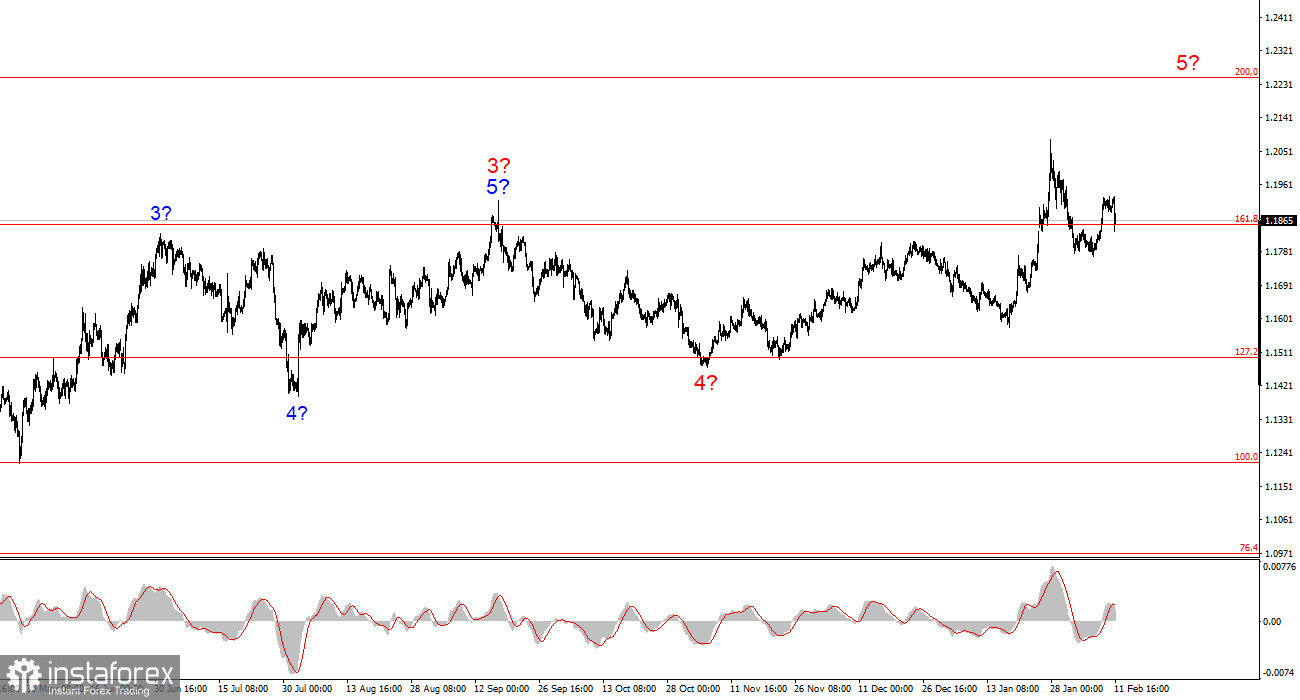
Based on the analysis of EUR/USD, the instrument continues to develop an upward trend segment. The policies of Donald Trump and the Fed's monetary policy remain significant factors in the long-term decline of the American currency. The targets for the current trend segment could reach the 25 figure. At present, I believe that the instrument remains within the framework of global wave 5, so I expect increases in quotations in the first half of 2026. However, in the near term, I anticipate a downward wave (or series of waves), as the structure a-b-c-d-e also appears complete. Readers can look for areas and levels for new longs with targets located around 1.2195 and 1.2367, corresponding to 161.8% and 200.0% Fibonacci.
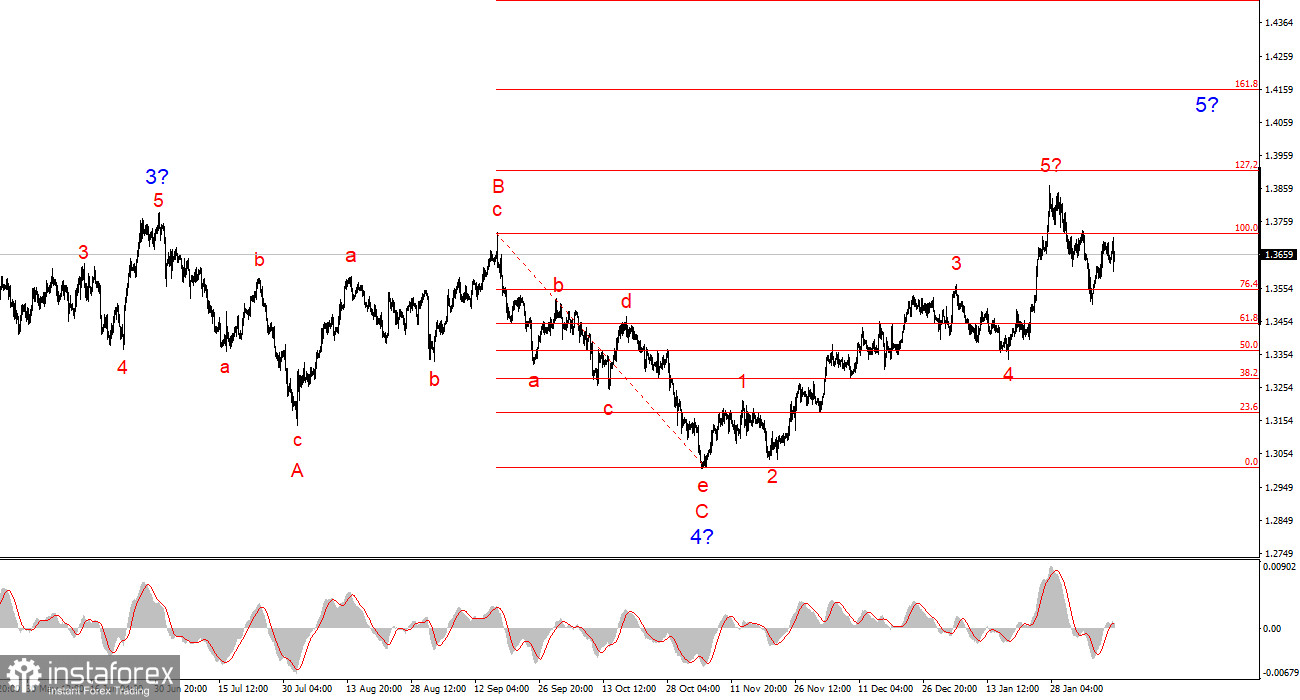
The wave pattern for the GBP/USD instrument appears quite clear. The five-wave upward structure has completed its formation, yet global wave 5 may take on a much more extended appearance. I believe that in the near future, we may observe the construction of a corrective wave set, after which the upward trend will resume. Thus, in the coming weeks, I recommend looking for opportunities for new longs. In my opinion, under Donald Trump, the British pound has every chance of reaching 1.45-1.50$. Trump himself welcomes the decline of the dollar. All his actions have a dual effect: the decline of the dollar and the resolution of internal, external, trade, and geopolitical issues.
InstaForex analytical reviews will make you fully aware of market trends! Being an InstaForex client, you are provided with a large number of free services for efficient trading.


