 Stay
Stay 

Trading Conditions
Products
Tools


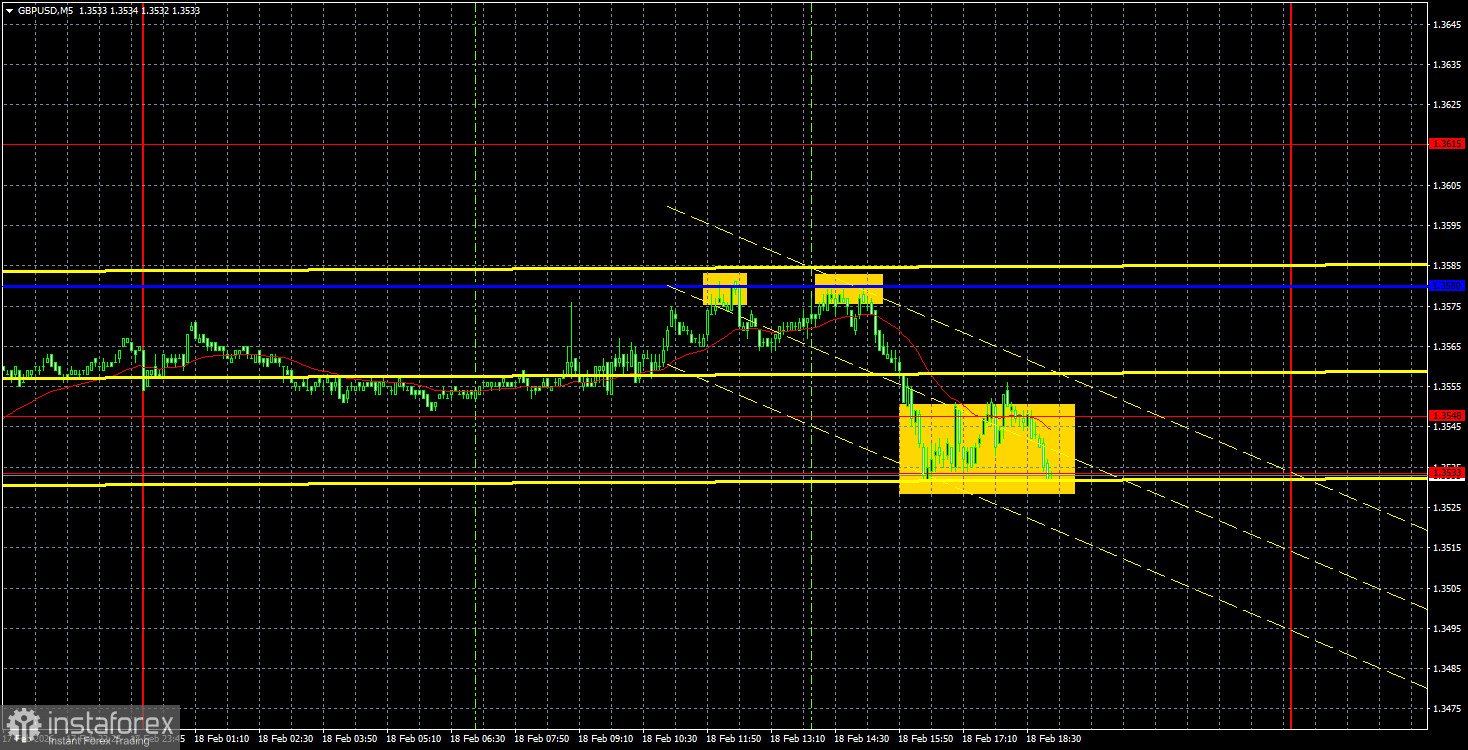
The GBP/USD currency pair continued its downward movement throughout Wednesday. If the unemployment rate negatively impacted the British currency on Tuesday, then all reports on Wednesday supported the dollar in one way or another. And it cannot be said that these were important reports with significant figures! Perhaps only the UK inflation report truly carried the status of "important." However, the value of this report exactly matched the experts' forecasts—3%. In our view, the drop in inflation from 3.4% to 3.0% year-on-year puts an end to speculation about the decision the Bank of England will make at its next meeting. Thus, the pound fell throughout the day quite deservedly, although it might have managed without it. However, American data also supported the decline in quotes, and the trend that had formed over the past week and a half was downward. Therefore, the British pound declined due to a combination of factors.
From a technical standpoint, a descending trend line has also been established for the pound. The price bounced off the critical Kijun-sen line yesterday, thus forming a strong sell signal. Interestingly, the decline began only during the American session, while European traders largely ignored the slowdown in UK inflation. Therefore, it is quite possible that the reasons for the pair's decline do not lie in the "dovish" prospects of the BoE.
On the 5-minute timeframe, the price bounced off the critical line twice yesterday, allowing traders to open short positions. During the American trading session, the 1.3533-1.3548 range was breached, further strengthening bearish sentiment. Thus, traders could open one short position, which by the evening was approximately 50 pips in profit. The breach in area 1.3533-1.3548 allowed the trade to be carried over to Thursday.
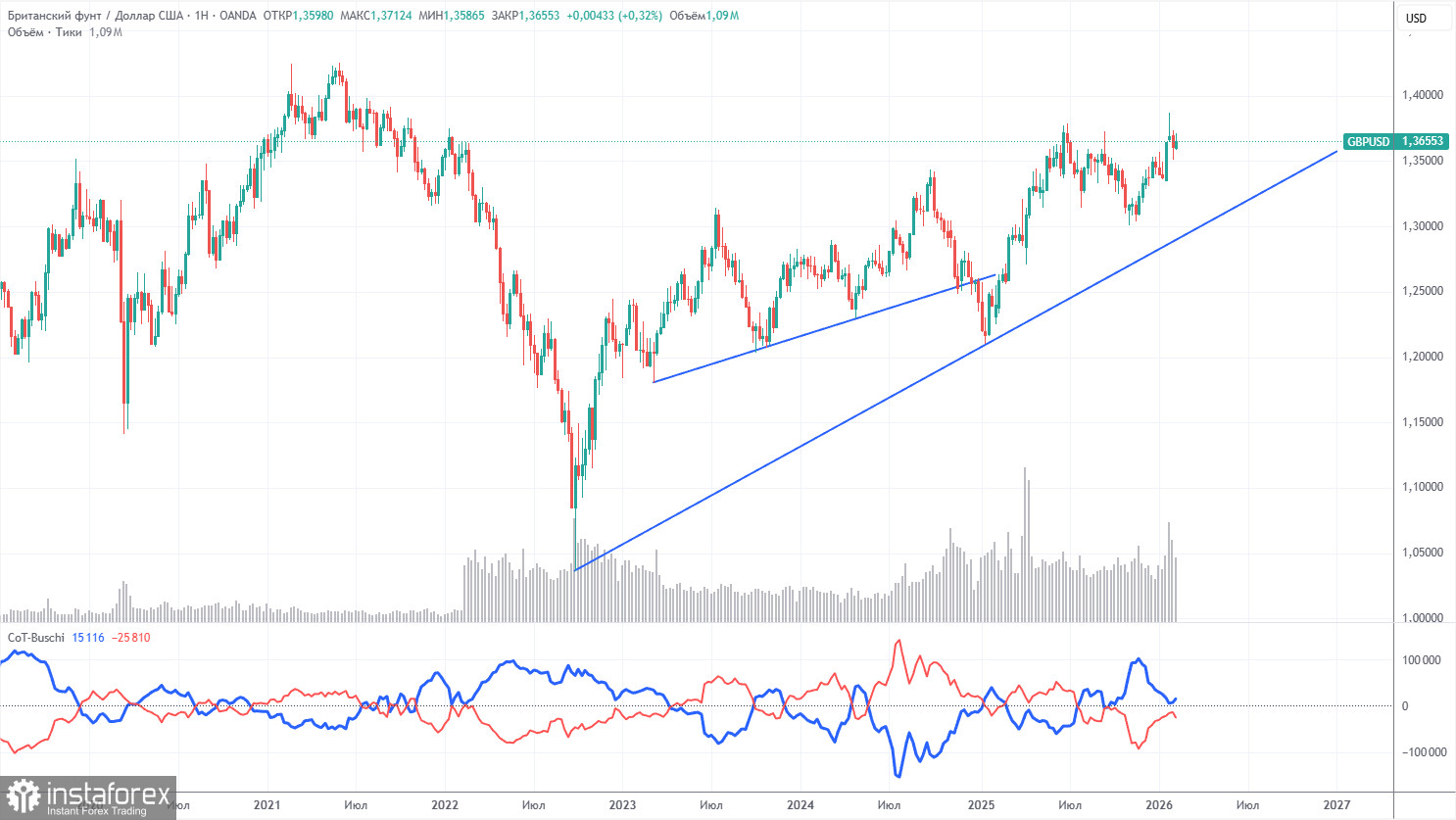
The COT reports for the British pound show that commercial traders' sentiment has been changing steadily over the past few years. The red and blue lines, which represent the net positions of commercial and non-commercial traders, frequently cross each other and are mostly close to the zero mark. Currently, the lines are approaching one another, with non-commercial traders still dominating with... sales. Recently, speculators have increased their long positions, so a change in sentiment may occur soon, though it is unlikely to affect the GBP/USD pair.
The dollar continues to decline due to Donald Trump's policies, as clearly seen on the weekly timeframe (illustration above). The trade war will continue in one form or another for a long time, and the Federal Reserve will, in any case, lower rates over the next 12 months. Demand for the dollar will, one way or another, fall. According to the latest COT report (dated February 10) for the British pound, the "non-commercial" group closed 6,500 buy contracts and opened 5,300 sell contracts. Thus, the net position of non-commercial traders decreased by 11,800 contracts over the week.
In 2025, the pound rose significantly, but it should be understood that there is only one reason for this: Trump's policies. Once this reason is neutralized, the dollar may begin to rise. But when that will happen is uncertain.
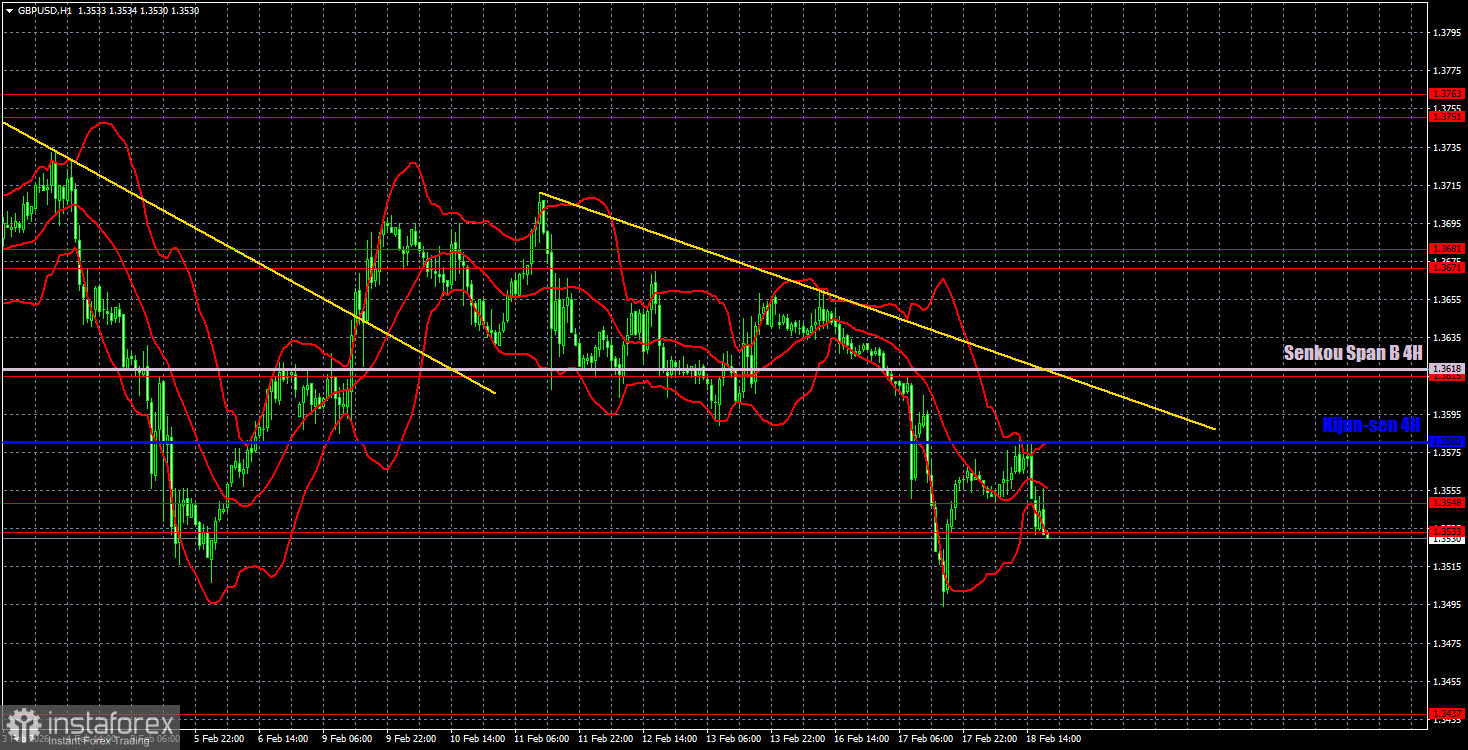
On the hourly timeframe, the GBP/USD pair has formed a new downward trend. Various events continue to hinder the British currency's growth and have recently supported the dollar. Some data is simply ignored by the market. We still believe that, in the medium term, the British pound will rise amid a weakening US dollar. However, the current trend is downward, so it is advisable to wait until it is complete.
For February 19, we highlight the following important levels: 1.3201-1.3212, 1.3307, 1.3369-1.3377, 1.3437, 1.3533-1.3548, 1.3615, 1.3671-1.3681, 1.3751-1.3763, 1.3846-1.3886, 1.3948. The Senkou Span B (1.3618) and Kijun-sen (1.3580) lines can also serve as potential sources of signals. It is recommended to set the Stop Loss at breakeven when the price moves in the correct direction by 20 pips. The lines of the Ichimoku indicator may move throughout the day, which should be considered when determining trading signals.
On Thursday, there are no major events planned in the UK, so the British pound will have the opportunity to catch a break from its decline. In the US, only a minor report on unemployment claims will be released. The pair's volatility today may be low.
Today, traders may stay in short positions with a target of 1.3437 since the price formed several sell signals yesterday. Long positions will become relevant with a target of 1.3671-1.3681 if the price surpasses the trend line and the Senkou Span B line.
Support and resistance price levels – thick red lines, where movement may end. They are not sources of trading signals.
The Kijun-sen and Senkou Span B lines – lines of the Ichimoku indicator, transferred to the hourly timeframe from the 4-hour timeframe. They are strong lines.
Extreme levels – thin red lines, which the price previously bounced off. They are sources of trading signals.
Yellow lines – trend lines, trend channels, and any other technical patterns.
Indicator 1 on the COT charts – the size of the net position of each category of traders.
InstaForex analytical reviews will make you fully aware of market trends! Being an InstaForex client, you are provided with a large number of free services for efficient trading.


