 Stay
Stay 
Trading Conditions
Products
Tools



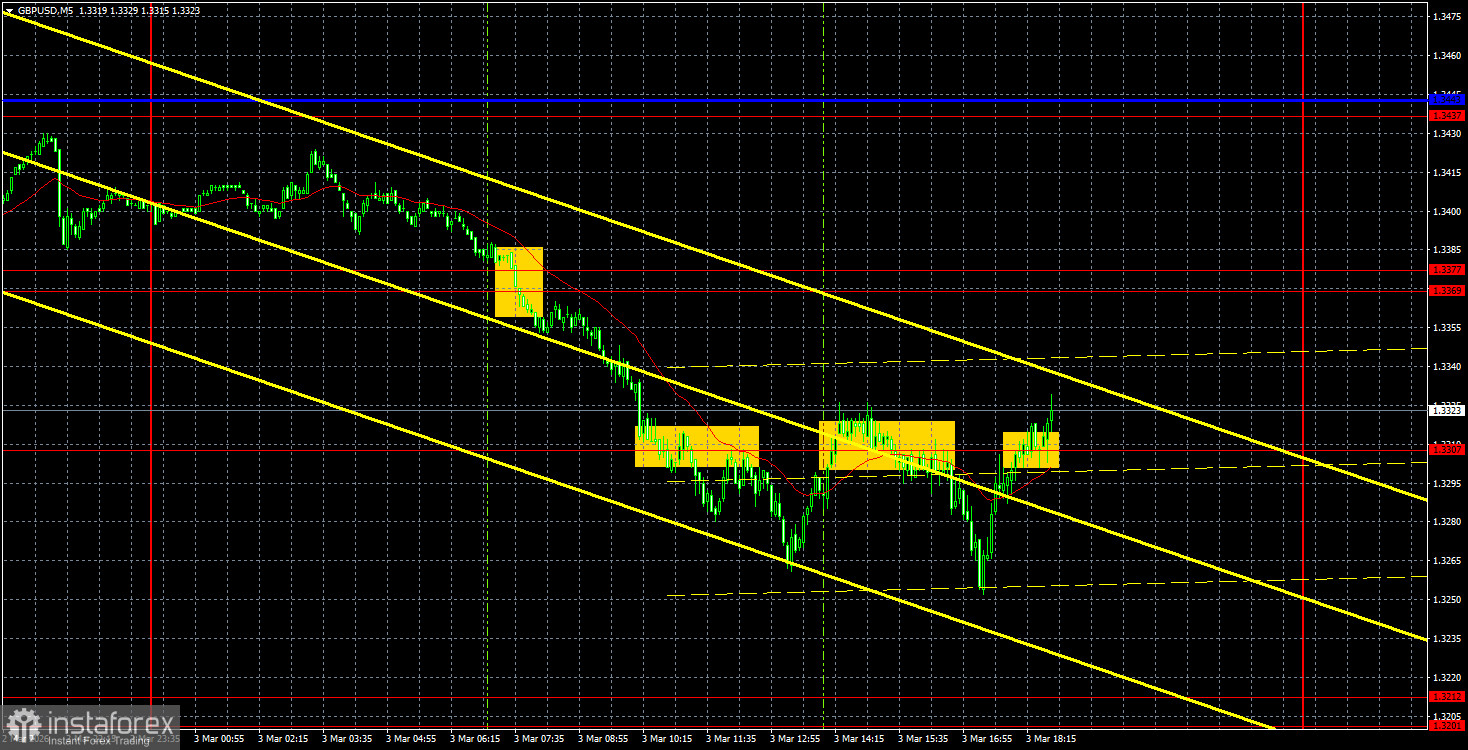
The GBP/USD currency pair continued its nearly freefall on Tuesday, but by the end of the day (just like the day before), it did come to a stop. As on Monday, we do not conclude that the decline has finished based on this minor retracement. The market has been panic-buying the dollar for two full days, but even before that, it had been slowly buying the American currency in anticipation of a worse outcome in the Middle East. As we see, it was correct. All positive sentiment for the British pound has been immediately dashed, although it should be noted that there has been very little positive news for the British currency in February. Thus, there is currently an interesting situation in which the dollar lacks long-term foundations for growth but may rise on geopolitical grounds almost anywhere. The upward trend on the daily timeframe remains, but when it will resume and how events in Iran will unfold is uncertain at this point.
From a technical standpoint, it is currently impossible to establish a new trend line, as the movement is practically vertical. Therefore, we can only wait for the market to become saturated with dollar purchases. The macroeconomic backdrop has taken a back seat, but traders may recall on Friday that the US labor market and the Fed's monetary policy are also important for the American currency. However, it would be foolish to deny that, at this time, the geopolitical factor is much more significant. The conflict in the Middle East could escalate into something much larger than a local war.
On the 5-minute timeframe, several trading signals were formed on Tuesday. Early in the European trading session, the pair broke through the 1.3369-1.3377 range, allowing traders to open short positions. Subsequently, the 1.3307 level was breached, but the dollar struggled to move further down. The day ended around the level of 1.3307, where profit could be taken on shorts.
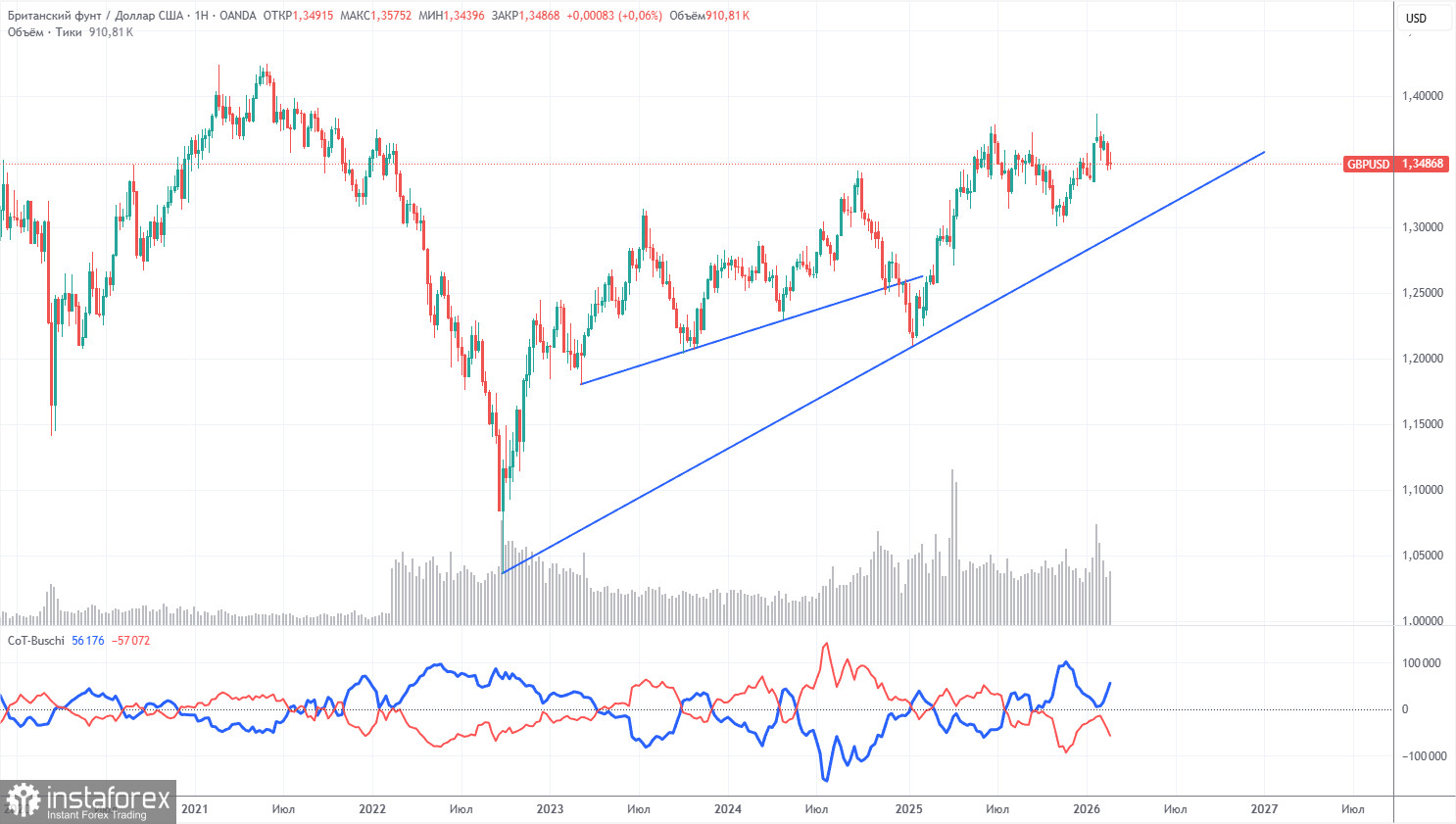
COT reports for the British pound show that commercial traders' sentiment has been changing steadily in recent years. The red and blue lines, which display the net positions of commercial and non-commercial traders, consistently cross each other and are mostly near the zero mark. Currently, the lines are approaching each other, with non-commercial traders still dominating with... sales. Recently, speculators have actively increased long positions; however, they have not managed to move into a zone of superiority.
The dollar continues to decline due to Donald Trump's policies, as shown in the weekly timeframe. The trade war will continue in one form or another for a long time, and the Fed will inevitably lower rates in the next 12 months. Demand for the dollar will decline one way or another. According to the latest COT report (dated February 24) regarding the British pound, the "Non-commercial" group closed 14,800 contracts in buys and 100 contracts in sells. Thus, the net position of non-commercial traders decreased by another 14,700 contracts over the week.
In 2025, the pound rose significantly, but it is essential to understand that the reason is singular—Trump's policies. Once this reason is addressed, the dollar may begin to rise. But when that will happen is unknown.
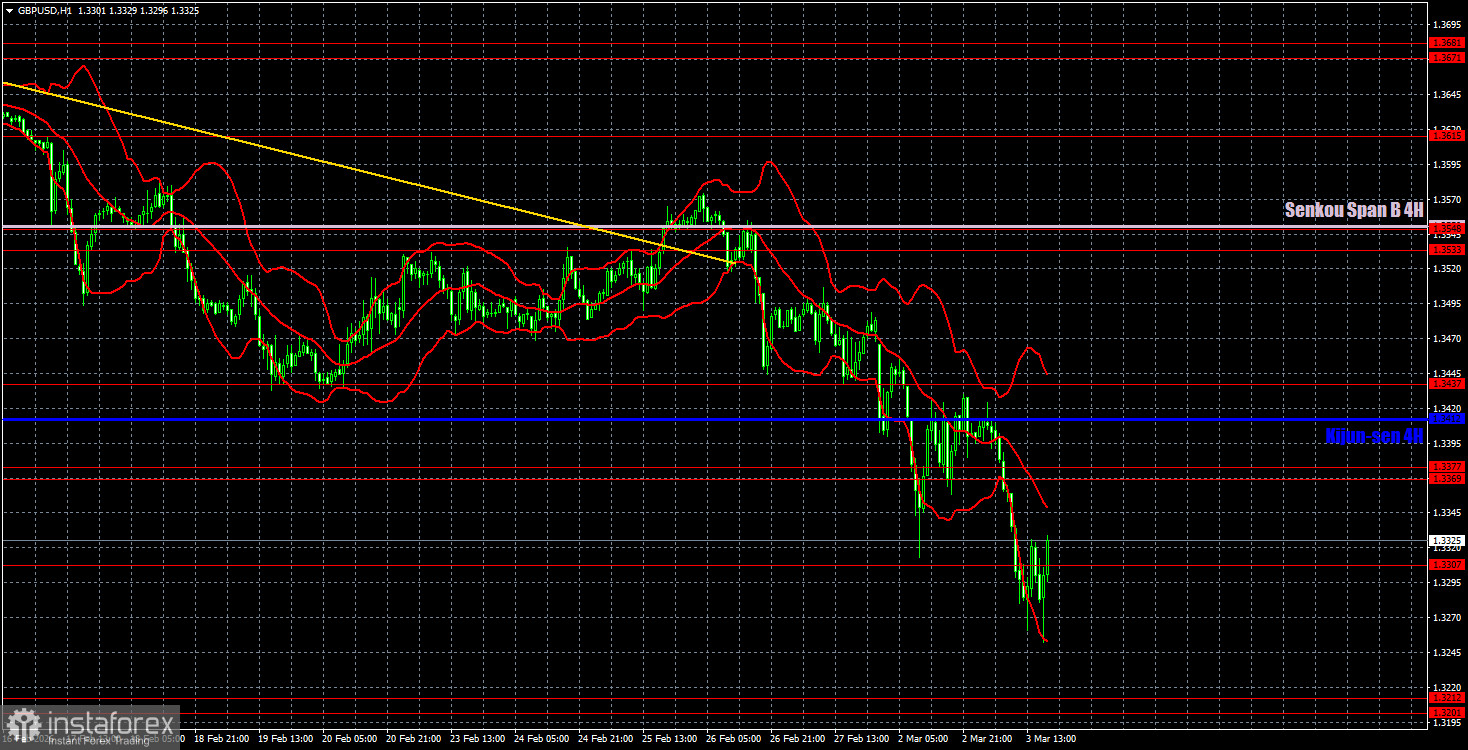
On the hourly timeframe, the GBP/USD pair could have formed an upward trend, but geopolitics has dragged the British pound into a whirlpool. Despite the strong decline of the pair in February-March, we still view it as a correction. The daily timeframe confidently signals the preservation of the upward trend. Unfortunately, geopolitics is very unpredictable and can drastically change the nature of the movement.
For March 4, we identify the following important levels: 1.3096-1.3115, 1.3201-1.3212, 1.3307, 1.3369-1.3377, 1.3437, 1.3533-1.3548, 1.3615, 1.3671-1.3681, 1.3751-1.3763. The Senkou Span B line (1.3550) and Kijun-sen (1.3412) may also serve as sources of signals. It is recommended to set the stop-loss order at breakeven once the price moves in the right direction by 20 pips. The Ichimoku indicator lines may shift during the day, which should be taken into account when determining trading signals.
On Wednesday, no significant events are scheduled in the UK, while the US will release the ISM reports for the services sector and ADP. We believe that the ISM index could provoke a market reaction, whereas the ADP report is less likely to do so. However, the critical question will be whether the market has finished panic-buying the dollar.
Today, traders may open new short positions with targets at 1.3201-1.3212 and 1.3096-1.3115 if the pair consolidates below 1.3307. Long positions will become relevant with targets of 1.3369-1.3377 and 1.3412 if the price breaks through the level of 1.3307.
Price levels of support and resistance are indicated by thick red lines, around which movement may end. They are not sources of trading signals.
The Kijun-sen and Senkou Span B lines are lines from the Ichimoku indicator that are transferred from the four-hour timeframe to the hourly one. They are considered strong lines.
Extremum levels are indicated by thin red lines from which the price previously bounced. They are sources of trading signals.
Yellow lines indicate trend lines, trend channels, and any other technical patterns.
Indicator 1 on the COT charts shows the size of each category of traders' net position.
InstaForex analytical reviews will make you fully aware of market trends! Being an InstaForex client, you are provided with a large number of free services for efficient trading.


