 Stay
Stay 

Trading Conditions
Products
Tools


Oil prices have resumed their rise, compensating for the sharp drop experienced yesterday. This comes amid new concerns that other countries may become involved in the war in the Middle East. The escalating geopolitical tension in the region remains a key factor shaping the dynamics of the oil market. Investors, fearing further escalation of the conflict and potential supply chain disruptions, have again started actively hedging their portfolios, leading to increased demand for commodities, primarily oil.
Yesterday's decline appears to have been a temporary correction, prompted by speculative statements from Trump regarding negotiations with Iran, aimed at lowering energy prices rather than genuine fundamental factors. Notably, these negotiations have not received confirmation from Iran. Today's rise demonstrates that fundamental factors related to supply security continue to dominate short-term market fluctuations.
Particular concern arises regarding the potential consequences of other Gulf states becoming involved in the conflict, including those that play significant roles in the global energy system. Such scenarios could lead to serious disruptions in oil production and transportation, which would, in turn, provoke shortages in the market and sharp price increases comparable to past oil shocks.
Currently, the price of Brent crude has approached the mark of $103 per barrel after a drop of 11% on Monday. American West Texas Intermediate (WTI) oil has increased by about 3%.
As I noted earlier, among the countries that could be drawn into the war is Saudi Arabia, which has been systematically targeted by Iranian missile strikes. If other Gulf states join the conflict, it would signify a significant escalation.
This month, Brent crude prices have risen more than 40% amid fears that hostile actions between the US, Israel, and Iran, which have shaken the Middle East, could trigger a global energy crisis and fuel inflation. The war has complicated transit through the Strait of Hormuz, forcing Gulf producers to cut daily oil production by millions of barrels. Prices for oil products, such as diesel and aviation fuel, have risen even more sharply than oil itself, putting pressure on consumers and alarming governments.
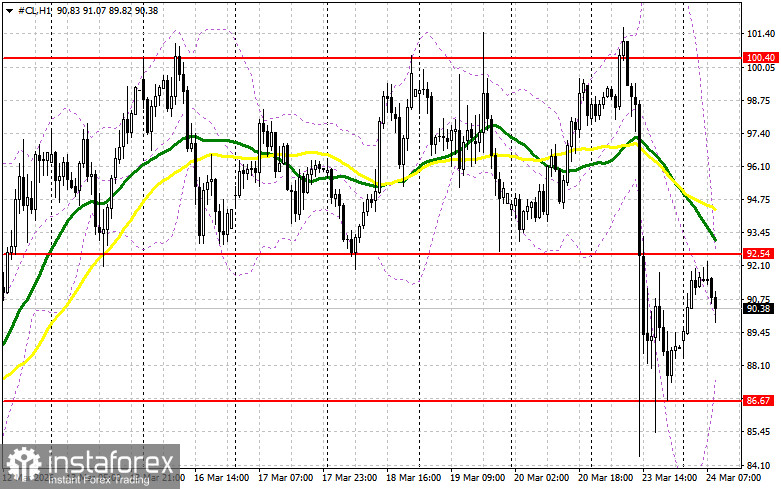
In terms of the current technical picture for oil, buyers need to reclaim the nearest resistance at $92.54. This would set the target towards $100.40, above which it will be quite challenging to break through. The furthest target would be around $106.83. In the event of a decline in oil prices, bears will attempt to take control at $86.67. If this is successful, breaking through this range will deliver a serious blow to bull positions and push oil down to a low of $81.38, with the potential to reach $74.85.
InstaForex analytical reviews will make you fully aware of market trends! Being an InstaForex client, you are provided with a large number of free services for efficient trading.


