 Stay
Stay 

Trading Conditions
Products
Tools


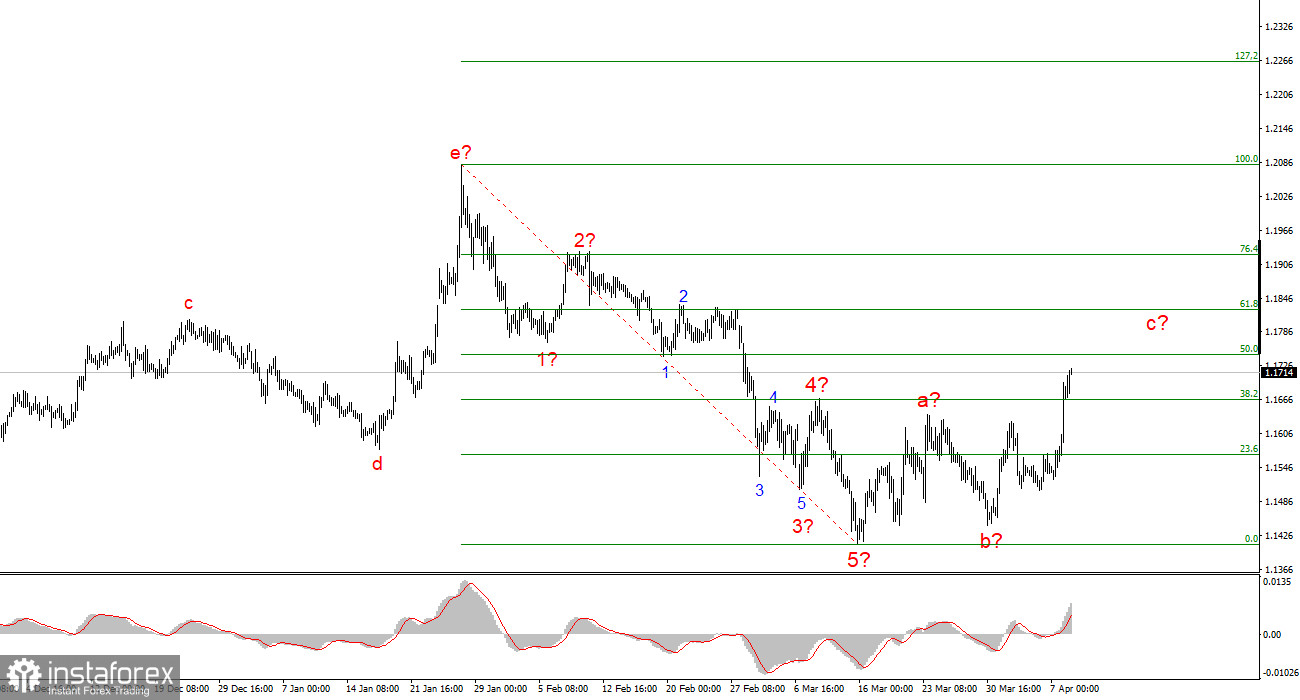
The wave pattern on the 4-hour chart for EUR/USD has changed. There is still no talk of canceling the upward trend segment (lower chart), which has been developing since January of last year, but the wave structure now looks quite ambiguous. In such situations, I always recommend switching to a lower timeframe (upper chart) and analyzing the simplest and smallest wave structures to make short-term forecasts—which is sufficient for opening trades. Wave structures can be very complex and allow for multiple scenarios. The easiest approach is to trade based on standard "five-three" patterns.
In the chart above, a classic five-wave impulse structure with an extended third wave can be identified. If this is indeed the case, then the formation of this structure has been completed, and we should expect a corrective phase consisting of at least three waves. Therefore, in the near term, an increase in quotes is likely—but within a correction relative to the last trend segment. So far, recent wave structures do not fit well into the higher-level count, but the situation should become clearer over time. In the near future, the euro may recover toward the levels of 1.1666 and 1.1745.
The EUR/USD rate increased by 50 basis points on Tuesday and added another 130 points on Wednesday. The sharp rise in demand for the euro was driven by a single event. Overnight, Donald Trump—and later Iranian authorities—announced a two-week ceasefire. The parties agreed on a halt to hostilities, reopening of the Strait of Hormuz, and further negotiations aimed at establishing long-term peace.
However, by Wednesday afternoon, the U.S. had already attacked one of Iran's oil refineries again, Iran launched strikes on Kuwait and Bahrain, and Israel—apparently not informed about the ceasefire—continued launching hundreds of missiles at targets in Lebanon. Therefore, I personally view such a ceasefire with skepticism. It is best to wait for Donald Trump to wake up and comment on the situation. Most likely, both Trump and Tehran will accuse each other of violating the ceasefire and continue military actions with the same intensity.
Nevertheless, the market reacted positively even to such a "fragile peace." Demand for risk assets is increasing, oil prices are falling, and the dollar is losing appeal. In my view, the market could soon reverse again, as the ceasefire exists only on paper. However, from a wave perspective, we have seen the expected three-wave corrective structure. The EUR/USD pair rose to the 1.17 level, as anticipated, but I now have serious doubts about further growth.
If Donald Trump manages to clarify today what happened during his absence and succeeds in restoring the ceasefire, the upward wave structure could continue developing. Otherwise, it appears more likely that a new downward trend segment will begin to form.
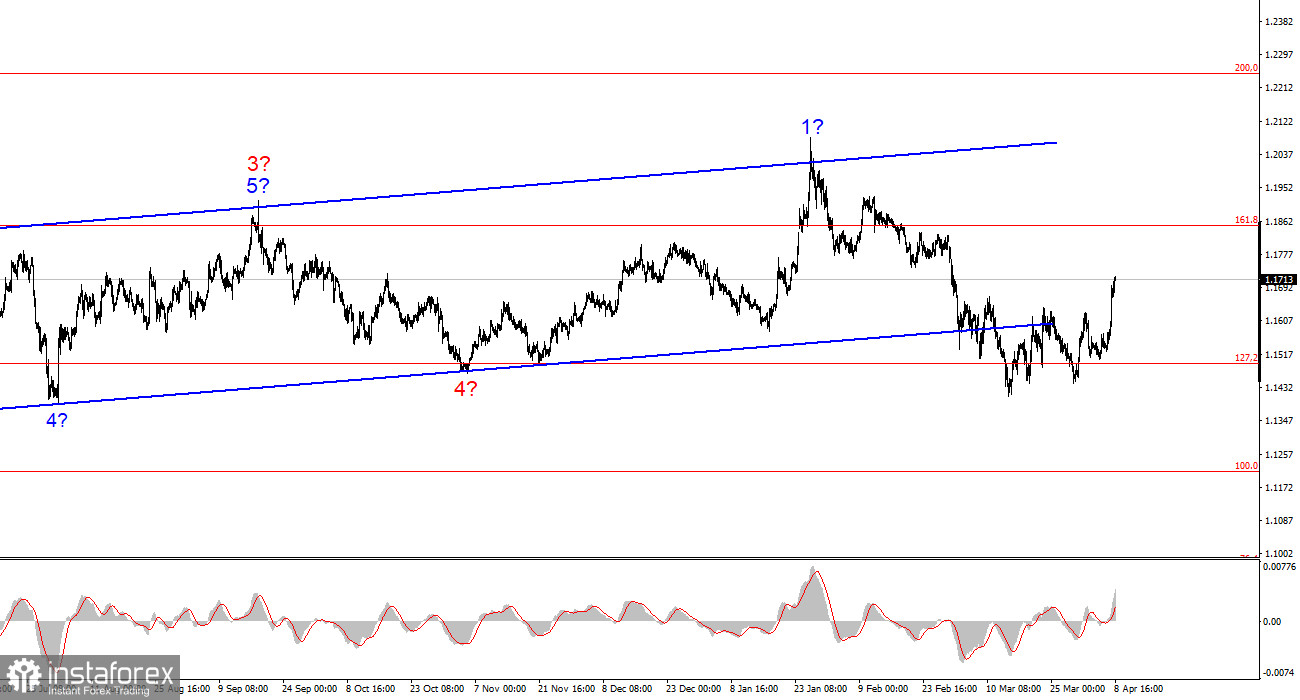
Based on the analysis of EUR/USD, I conclude that the instrument remains within an upward trend segment (lower chart), and in the short term—within a corrective structure. The corrective wave set appears largely complete and could only extend further if a stable ceasefire is established between Iran, the U.S., Israel, and all other countries in the Middle East. Otherwise, a new downward wave structure may begin forming from current levels.
On the smaller timeframe, the entire upward trend segment is visible. The wave structure is not entirely standard, as corrective waves vary in size. For example, the higher-level wave 2 is smaller than the internal wave 2 within wave 3. However, such cases do occur. It's important to focus on clear and understandable structures rather than trying to strictly label every wave. The trend may reverse in the near future.
Core Principles of My Analysis
InstaForex analytical reviews will make you fully aware of market trends! Being an InstaForex client, you are provided with a large number of free services for efficient trading.


