 Stay
Stay 
Trading Conditions
Products
Tools



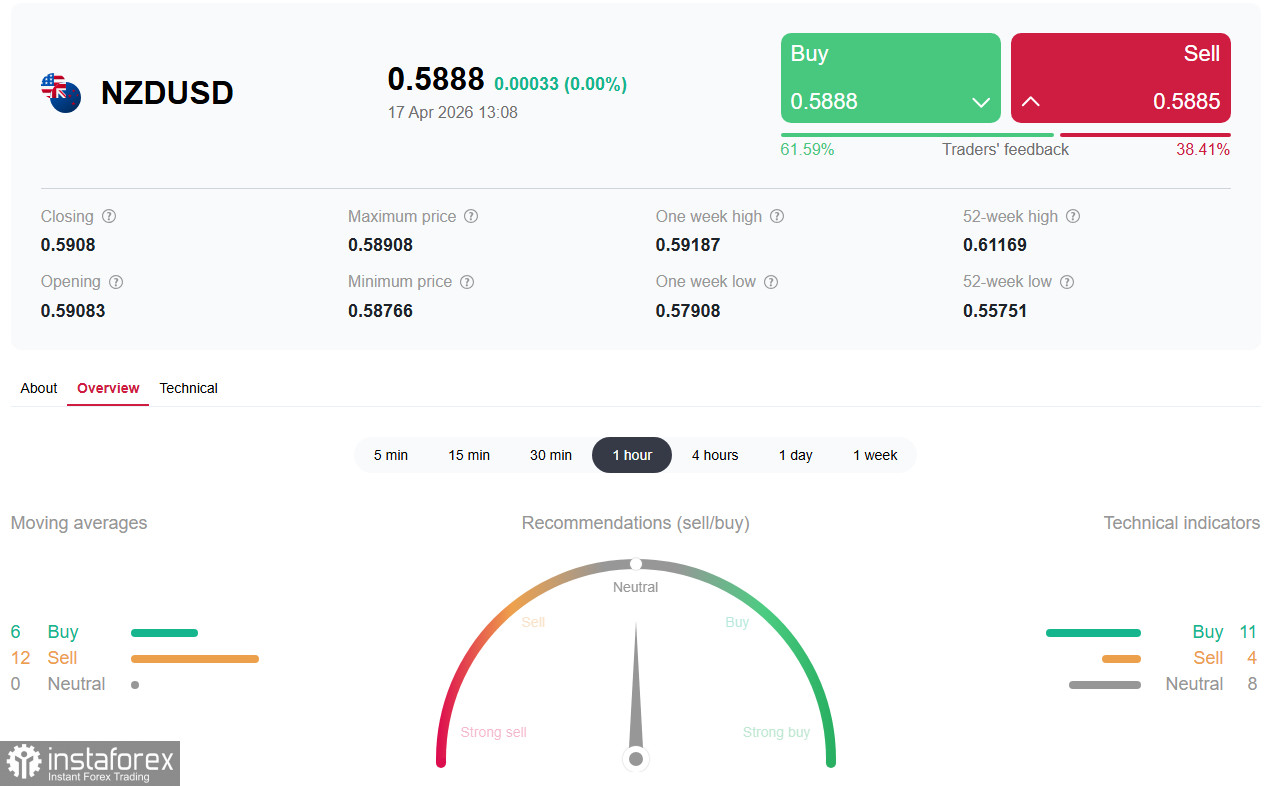
See also: InstaForex trading indicators for NZD/USD
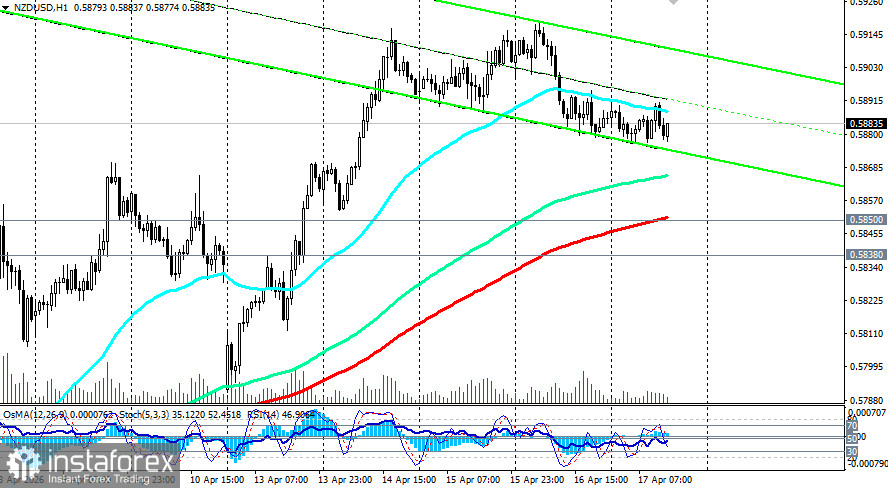
The NZD/USD pair finishes the week in a state of uncertainty, consolidating below the key psychological level 0.5900. After an impressive rally to monthly highs near 0.5925, the New Zealand dollar faced seller pressure and pulled back. Traders froze, weighing two powerful but opposing forces: persistent geopolitical risks in the Strait of Hormuz that support the US dollar as a haven and renewed hopes for peace talks between the US and Iran that exert opposite pressure on the greenback.
Fundamental background: between escalation and diplomacy
Despite encouraging signals from diplomatic circles, reality on the ground remains tense. The US-imposed maritime blockade of Iranian ports remains in effect, creating a direct threat to global energy supplies. Moreover, Iran's armed forces command threatened to halt regional trade entirely if the blockade does not lift.
This uncertainty supports demand for the US dollar as a safe haven. The dollar index, USDX, tries to recover from six-week lows, creating a headwind for the risk-sensitive kiwi.
Alongside escalation, diplomatic efforts continue. President Donald Trump expressed optimism, saying the conflict is close to conclusion, and the Wall Street Journal reported a principle agreement to hold a new round of talks this coming weekend.
This optimism prevents the US dollar from fully realizing its bullish potential and serves as the key factor limiting NZD/USD's decline. Markets hope that renewed dialogue will lead to de-escalation and reopening of the Strait of Hormuz, which would reduce global inflationary risks.
Monetary background: hawkish RBNZ versus paused Fed
The New Zealand dollar receives meaningful support from hawkish rhetoric at the Reserve Bank of New Zealand. RBNZ Governor Anna Breman signaled that the central bank stands ready to act decisively with rate hikes if core inflation shows signs of pickup, especially given fuel price pressure linked to Middle East tensions.
Markets reacted immediately: current pricing includes nearly three RBNZ rate hikes by year-end, totaling about 75 basis points. That makes the New Zealand dollar one of the more attractive yields among G10 currencies.
However, economists warn that such aggressive pricing may be excessive, expecting only a single 25-basis-point hike in Q4 2026. They point to a negative output gap in New Zealand and growth below trend, which raises the bar for aggressive tightening.
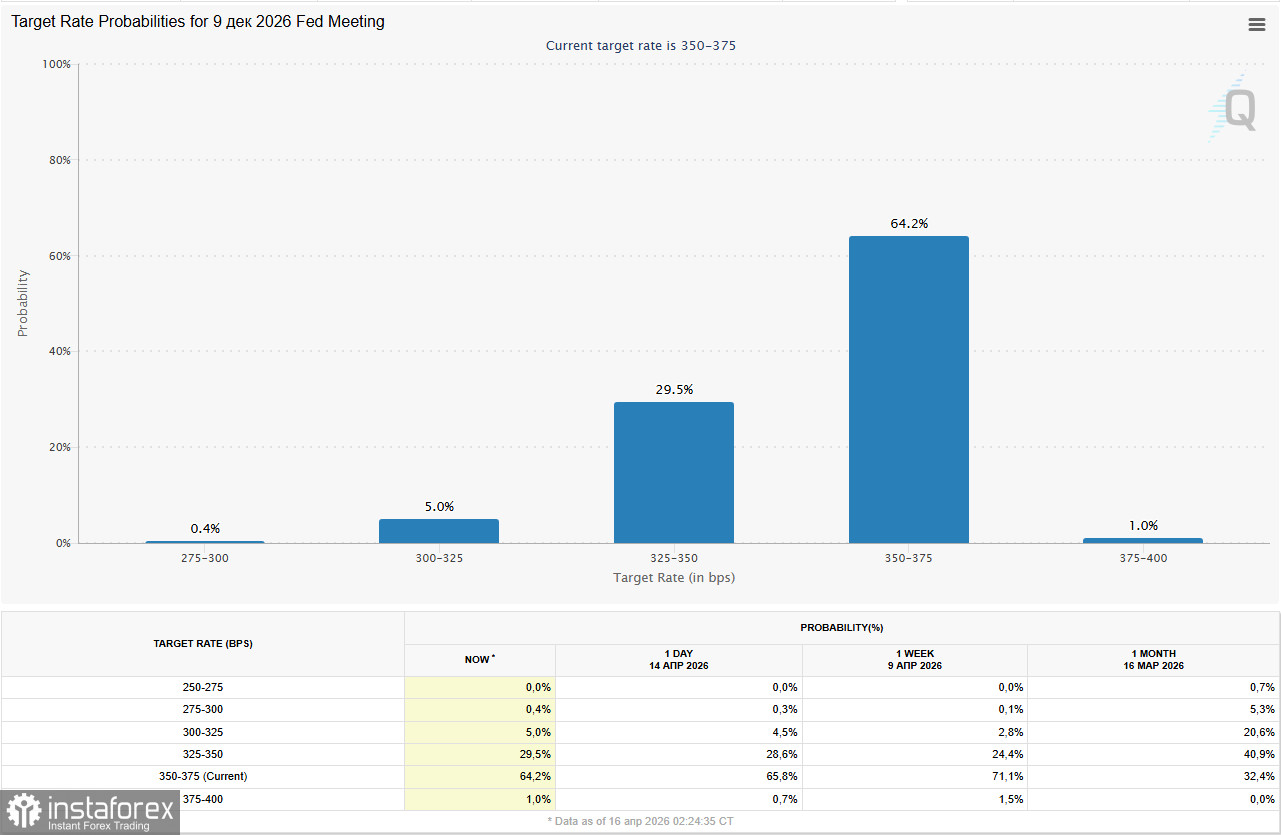
Unlike the RBNZ, the Federal Reserve maintains a wait-and-see stance. The FedWatch tool from CME Group assigns a 99% probability of no change at the April meeting, and markets price only about a 30% chance of one cut by year-end.
Weak March PPI data published this week eased concerns about persistent inflationary pressure, allowing the Fed to remain patient. Nevertheless, New York Fed President John Williams warned that the war in the Middle East already lifts inflation, and he projects inflation in the 2.75%–3.0% range this year.
China factor: unexpected tailwind
The most important driver for NZD/USD this week came from China — New Zealand's largest trading partner. China's economy grew 5.0% year on year in Q1 2026, beating forecasts and accelerating from 4.5% in the prior quarter.
That delivered a powerful bullish signal for the kiwi, because New Zealand's economy ties closely to Chinese demand for commodities, especially dairy and timber. Sustained Chinese growth, even amid external challenges, supports New Zealand's export demand and, accordingly, the kiwi exchange rate.
Short technical analysis
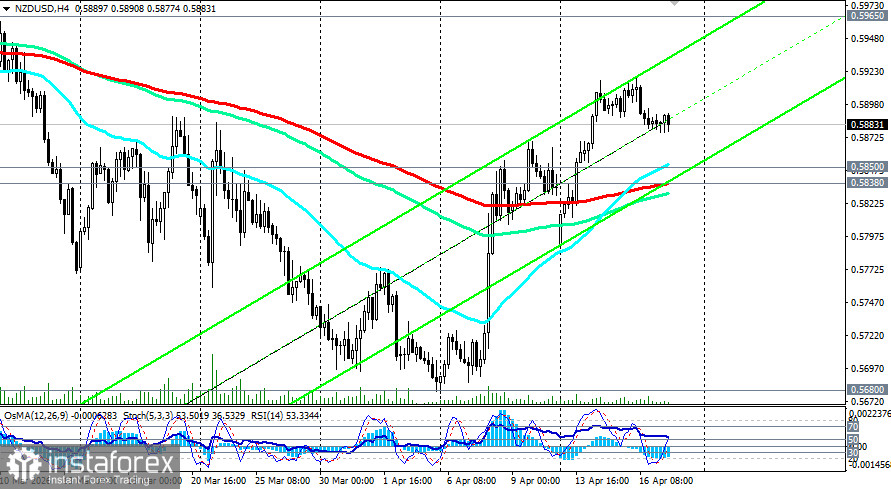
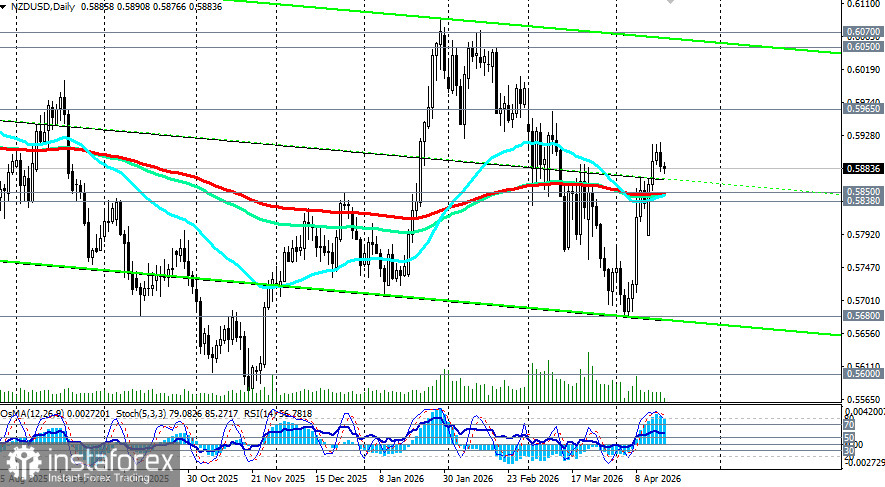
From a technical perspective, NZD/USD stands at a critical threshold. The pair successfully broke the resistance zone 0.5838 (EMA200 on the H4 chart)–0.5850 (EMA200, EMA144 on the D1 chart, and EMA200 on the H1 chart), confirming a short-term trend shift to bullish.
Indicators, rather, support a bullish narrative than aggressively signal further upside: the 14-day RSI holds around 56, and OsMA has been in positive territory since April 8. Stochastic gives a reversal signal from overbought, but it remains in that zone for now.
Any decline will likely find support at 0.5850, and only a breach of 0.5838–0.5830 (EMA144 on the H4 chart) will put the bullish structure in doubt.
Key weekend events
Weekend, Possible second round of US-Iran talks, the main geopolitical trigger—will determine risk-appetite dynamics
April 22: Expiration of the two-week truce. Possible extension or escalation
Conclusion
NZD/USD stands at the epicenter of a clash between two powerful forces. On one side, hawkish RBNZ rhetoric (markets price in 75 basis points of tightening by year-end) and strong Chinese data (GDP growth 5.0%) support the kiwi. On the other side, persistent risks in the Strait of Hormuz and uncertainty around US-Iran talks push investors into the dollar as a safe asset.
The key zone 0.5850–0.5930 will become the arena for a decisive battle in the coming days. Holding above 0.5885 will preserve bulls' chances to test 0.5965 and 0.6000. Technical indicators remain supportive: RSI at 56 and OsMA in positive territory point to sustained buyer pressure.
At the same time, economists warn that aggressive RBNZ pricing looks vulnerable against weak New Zealand growth. Any disappointment in hawkish expectations or a breakthrough in talks could trigger a correction. Investors should closely watch diplomatic developments over the weekend — their outcome will determine whether the kiwi gets the long-awaited impulse to break 0.6000 or faces a deep correction to 0.5800 and below.
See also our today's review GBP/NZD: reversal under pressure from two currencies.
InstaForex analytical reviews will make you fully aware of market trends! Being an InstaForex client, you are provided with a large number of free services for efficient trading.


