 Stay
Stay 
Trading Conditions
Products
Tools



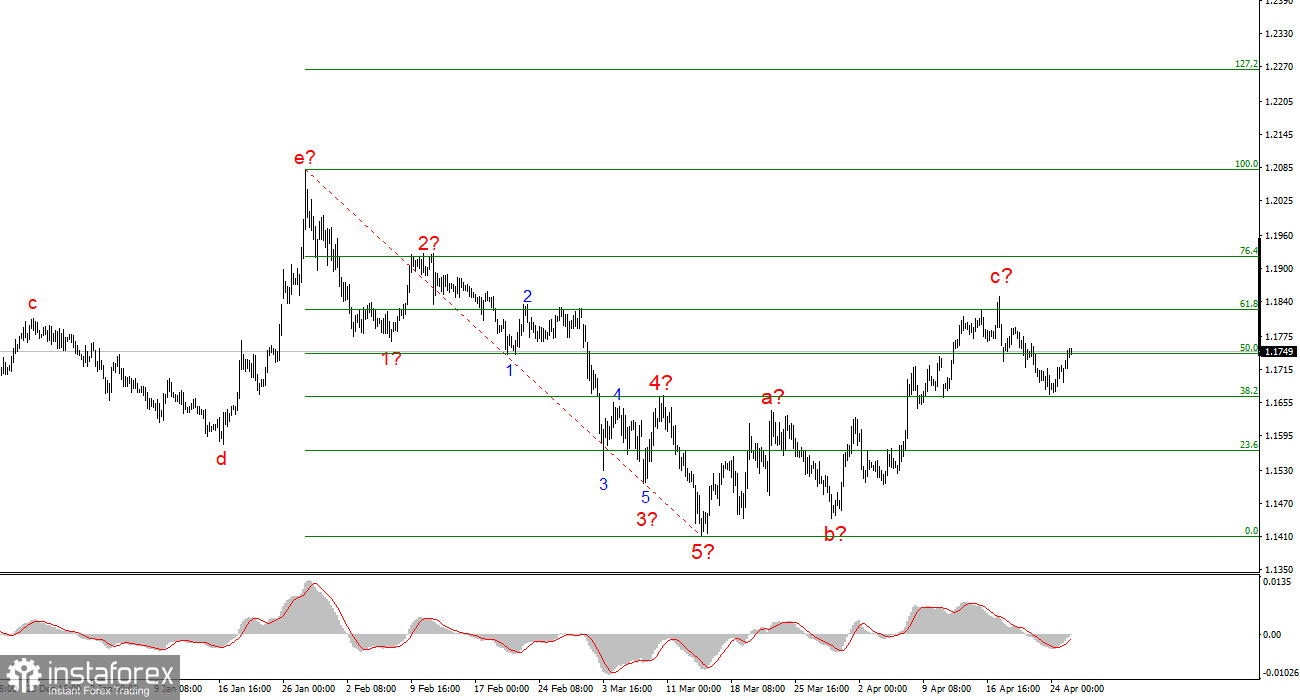
The wave pattern on the 4-hour chart for EUR/USD has changed somewhat. There is still no talk of canceling the upward trend segment (lower chart), which began in January of last year, but the structure of the trend now looks rather ambiguous.
In such situations, I always recommend switching to a lower timeframe (upper chart) and focusing on the simplest and smallest wave structures to make short-term forecasts—which is quite sufficient for opening trades. Wave structures can be very complex and allow for multiple scenarios. The easiest approach is to trade standard "five-three" patterns.
In the chart above, I can identify a classic five-wave impulse structure with an extended third wave. If this is correct, then this structure has already been completed, and the market is currently forming a corrective phase consisting of at least three waves. We have already seen three waves, so in the near term, the market will likely form at least one more corrective wave.
Future developments will depend on geopolitics: whether the correction becomes more complex or a new downward trend segment begins.
EUR/USD gained about 55 basis points despite a complete lack of news. On Monday, there were no updates even on geopolitics.
Recall that last Friday, the market regained optimism after news of Iranian Foreign Minister Abbas Araghchi's visit to Pakistan. However, by Saturday morning, it became clear that Mr. Araghchi would not meet with U.S. representatives, and the American delegation had not even departed for Islamabad. In other words, another attempt to organize talks between Tehran and Washington failed.
At the same time, various insider reports suggest that informal negotiations between Iran and the U.S. are ongoing—but these are more like exchanges of proposals aimed at eventually leading to formal talks.
Nevertheless, market participants seem to favor this scenario. Indeed, even the appearance of negotiations—offering a chance for a deal and a ceasefire—is preferable to a fragile truce that could collapse into escalation at any moment.
Interestingly, the oil market does not appear to believe in a positive resolution to the Iran-U.S. standoff. The spot price of Brent crude rose today to $107 per barrel and has increased by about $20 over the past two weeks.
At the same time, demand for the U.S. dollar has noticeably declined over the same period. This leads to one conclusion: markets no longer need the dollar as a safe haven, yet they also do not strongly believe in a near-term resolution of the Middle East conflict.
Based on this, EUR/USD may continue to rise, but it is important to remember that three central bank meetings are scheduled for this week.
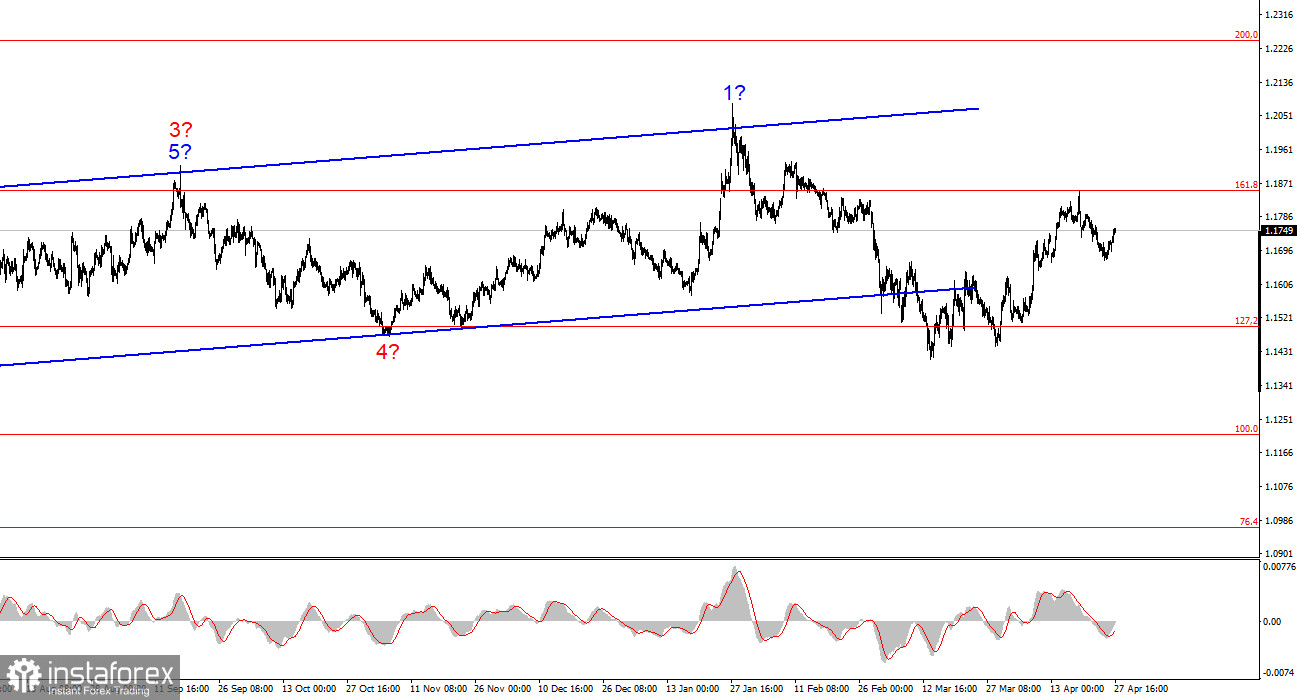
Based on the EUR/USD analysis, I conclude that the instrument remains within the upward trend segment (lower chart) and, in the short term, within a corrective structure.
The corrective wave pattern appears largely complete and could only become more complex and extended if the geopolitical situation in the Middle East improves. Otherwise, a new downward wave sequence may begin from current levels.
We have already seen a corrective wave; what happens next will depend on the market's belief in a successful outcome of negotiations.
On the lower timeframe, the entire upward trend segment is visible. The wave structure is not entirely standard, as corrective waves vary in size. For example, the higher-degree wave 2 is smaller than the internal wave 2 within wave 3. However, such cases do occur.
I would emphasize that it is better to focus on clear and understandable structures rather than trying to rigidly label every wave. The trend may reverse in the near future.
Key Principles of My Analysis:
InstaForex analytical reviews will make you fully aware of market trends! Being an InstaForex client, you are provided with a large number of free services for efficient trading.


