 Stay
Stay 

Trading Conditions
Products
Tools


The British pound enters the new week in an even more dismal state than the euro. While the euro has lost about 150-160 points, the pound sterling has plummeted by 300. It is safe to say that the ongoing political crisis in the UK has exacerbated the situation for the British currency; however, in my opinion, this is just an excuse. The current crisis is neither a government resignation nor a change in political or economic direction, and it has yet to yield significant economic consequences. In my view, the pound's failures should be attributed solely to geopolitics.
Consequently, the EUR/USD review is sufficient to understand what my readers can expect next week. However, the pound also has an "additional factor" that may already be in play. On Wednesday, May 20, the UK inflation report for April will be released, and its significance may puzzle market participants and the pound sterling. Contrary to the common belief that inflation is bound to rise in most countries due to the energy crisis and spikes in oil and gas prices, UK inflation could decline to "pre-war levels." Economists expect consumer price growth to slow to 3%, which was recorded in January and February 2026. The reason for the deceleration in inflation is less important. However, I believe the market may have already priced in this factor as early as last week.
If inflation in the UK does not increase (and this conclusion can be drawn from the April results), the Bank of England may revert to a more accommodating monetary policy stance. Perhaps not in the summer, but in the second half of 2026, the BoE could conduct one or two more rounds of interest rate cuts. Meanwhile, European Central Bank officials assure that interest rates in the Eurozone may be raised as early as June, and the Federal Reserve is unlikely to implement even one round of easing by the end of the year. This means that the Bank of England may become the only central bank among the Big Three focused on easing rather than tightening. This is a reason for reduced demand for the British pound, which the market may have already taken into account. Inflation, geopolitics, and the monetary policies of the FOMC and the BoE are compelling reasons to maintain a bearish stance. The wave count also indicates the formation of a downward wave set that could become impulsive.
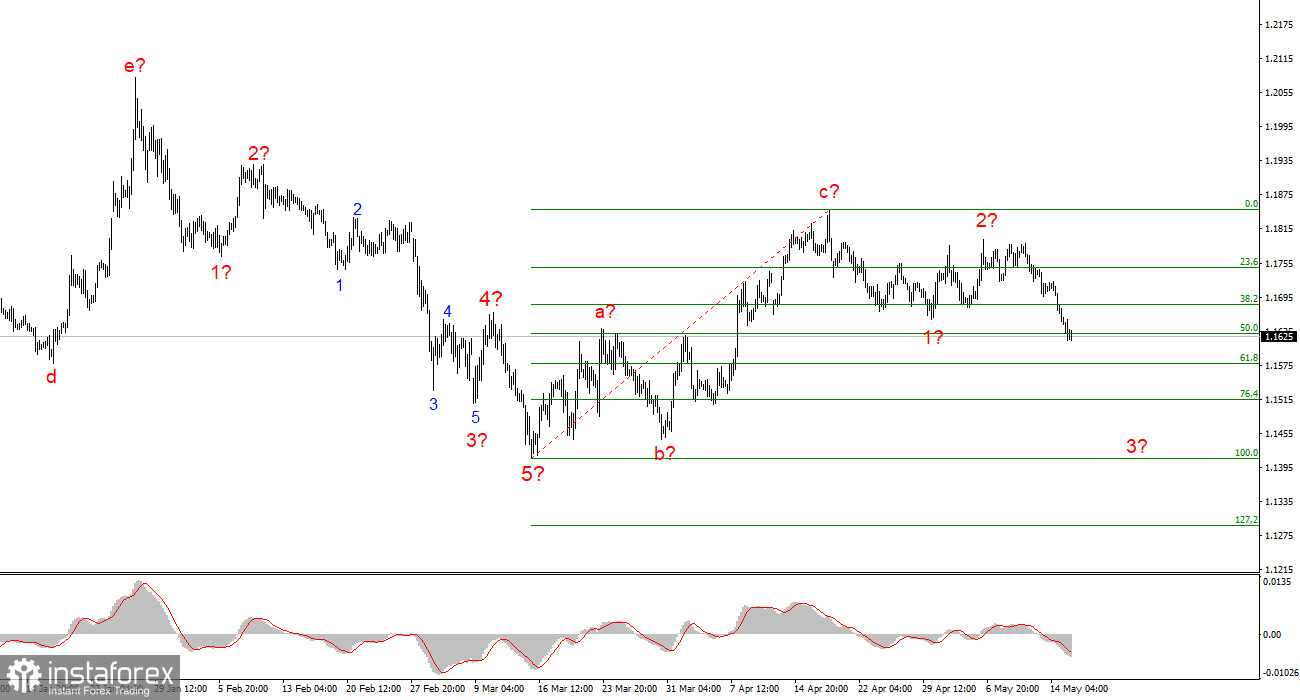
Based on the analysis of EUR/USD, I conclude that the instrument remains within an upward segment of the trend (bottom image) and, in the short term, within a corrective structure. The corrective wave set a-b-c appears to be complete. Therefore, wave 3 in C might have begun, with targets extending to the 14th figure. If the current wave count is correct, the entire wave C could complete its structure much lower than the 14th figure. However, such a scenario would require strong geopolitical support.
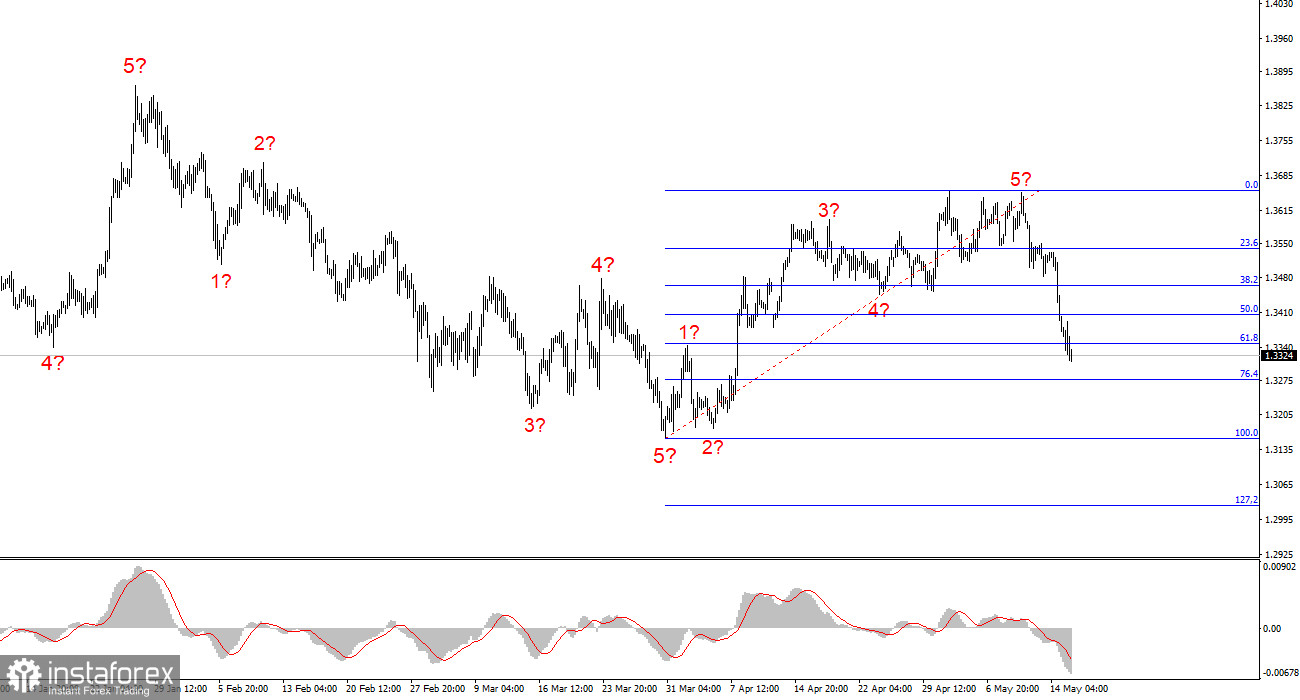
The wave picture for the GBP/USD instrument has become clearer over time. We can now see a distinct upward structure on the charts that is complete. Thus, I expect the formation of a downward wave set that may take on an impulsive nature and coincide with the impulsive structure of the EUR/USD instrument. Consequently, after a 300-point decline, a corrective wave can be anticipated, followed by a new drop to the 30-31 figures. I previously alerted about a new decline for the pound but expected a correction. However, the harsh reality shows that this may manifest as a full-fledged impulsive structure, considering the strength of its first wave.
InstaForex analytical reviews will make you fully aware of market trends! Being an InstaForex client, you are provided with a large number of free services for efficient trading.


