 Stay
Stay 

Trading Conditions
Products
Tools


Can markets shift their attention away from developments in the Middle East today? That is the key question ahead of the release of the U.S. employment report.
The inability to resolve the standoff between the United States and Iran has already led to a deadlock that has created significant uncertainty across financial markets.
When the conflict began in March, the market reaction was relatively straightforward. A clear pattern emerged in which rising oil prices supported the U.S. dollar and weighed on precious metals. Although this relationship remains in place, it is no longer as consistent as before. For example, declining oil prices no longer necessarily lead to gains in gold. Recently, there have been periods of uncoordinated market movement, with both oil and gold prices falling simultaneously.
In the Forex market, the U.S. Dollar Index has spent the last two weeks trading within an exceptionally narrow range—the narrowest seen over the past year. Certain currency pairs, such as AUD/USD and NZD/USD, have experienced substantial declines in recent days compared with EUR/USD and GBP/USD. However, their influence on the index remains relatively limited.
The key factor behind this market behavior is the prolonged crisis in the Middle East, with no clear resolution in sight. The conflict continues to put pressure on energy prices, contributing to higher inflation. Central banks are monitoring the situation closely, recognizing that if the issue remains unresolved, they may be forced to raise interest rates to combat inflation, which could further weigh on already fragile economies.
Every day, news headlines are filled with reports of negotiations between Washington and Tehran, followed by reports of their suspension, only for discussions to resume again shortly afterward. Market participants must also take into account the rhetoric of the U.S. administration and President Donald Trump, who continues to express confidence that progress is being made. Markets appear increasingly skeptical of these statements, which is reflected in the significant reduction in directional price movement across many assets. While market swings were substantial from March through mid-May, they have narrowed considerably over the past two weeks. At the same time, volatility remains elevated. This volatility is being driven by erratic intraday price action, with assets often rising during the session before falling back close to the previous day's closing levels.
Even the release of important economic data has been unable to stabilize market conditions. In the past, traders would actively react to such reports by buying or selling assets, particularly currency pairs involving the U.S. dollar.
Today, markets will receive a series of labor market reports, including U.S. unemployment data, Nonfarm Payrolls, and several other important indicators. Economists expect the U.S. economy to have added 85,000 jobs in May, down from 123,000 in April.
This raises an important question: will the market react meaningfully to the data?
The answer is difficult to determine. Since April, when reports reflecting the post-conflict period began to be released, the market has largely ignored labor market data. The same could happen today. Market attention remains heavily focused on developments surrounding the Strait of Hormuz, Lebanon, and the ongoing negotiations between the United States and Iran. As a result, the reaction to the Nonfarm Payrolls report may once again be muted. Even if a reaction occurs, it is likely to be less pronounced than under normal circumstances.
What can be expected from markets today?
In my view, the current environment of uncertainty is likely to persist until either the conflict ends, a clear signal emerges that it is approaching resolution, or central banks begin raising interest rates. Any of these developments could trigger more decisive and sustained market movements, particularly in the currency market.
Forecast of the Day:
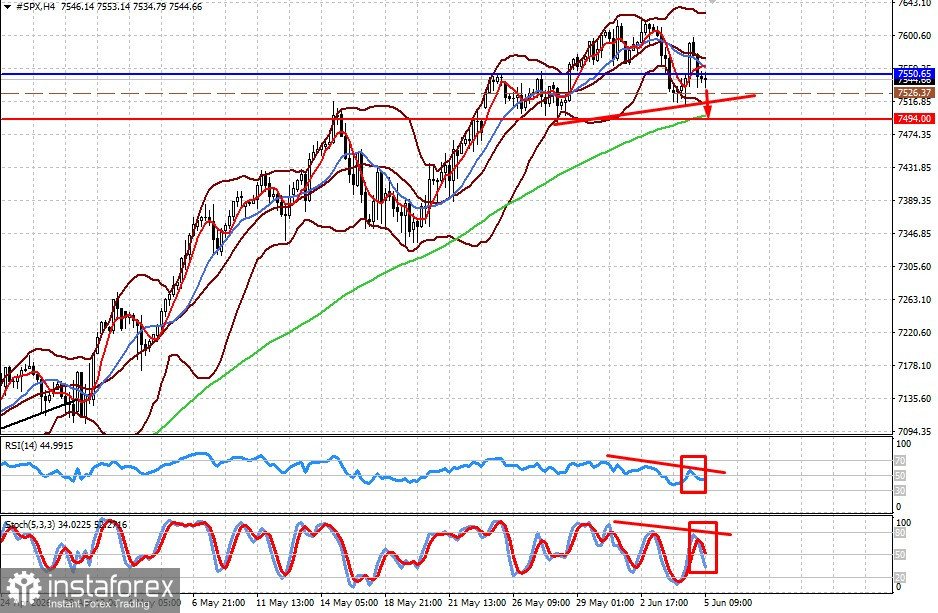
#SPX
The S&P 500 futures CFD is trading below the 7550.65 level. Against the backdrop of persistent market uncertainty and potentially weak U.S. employment data, the index could decline toward 7494.00. Under this scenario, short positions may be considered around 7526.37.
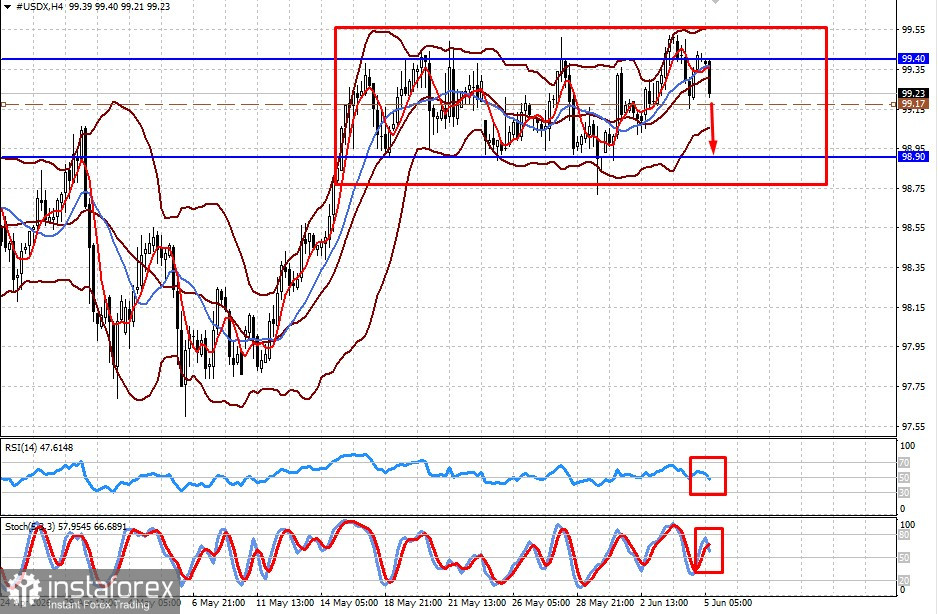
#USDX
The U.S. Dollar Index continues to trade within a sideways range of 98.90–99.40. Ongoing uncertainty surrounding the Strait of Hormuz could push the index toward the lower boundary of the range near 98.00. A potential selling level may be located around 99.17.
InstaForex analytical reviews will make you fully aware of market trends! Being an InstaForex client, you are provided with a large number of free services for efficient trading.


