 Zostať
Podmienky obchodovania
Nástroje



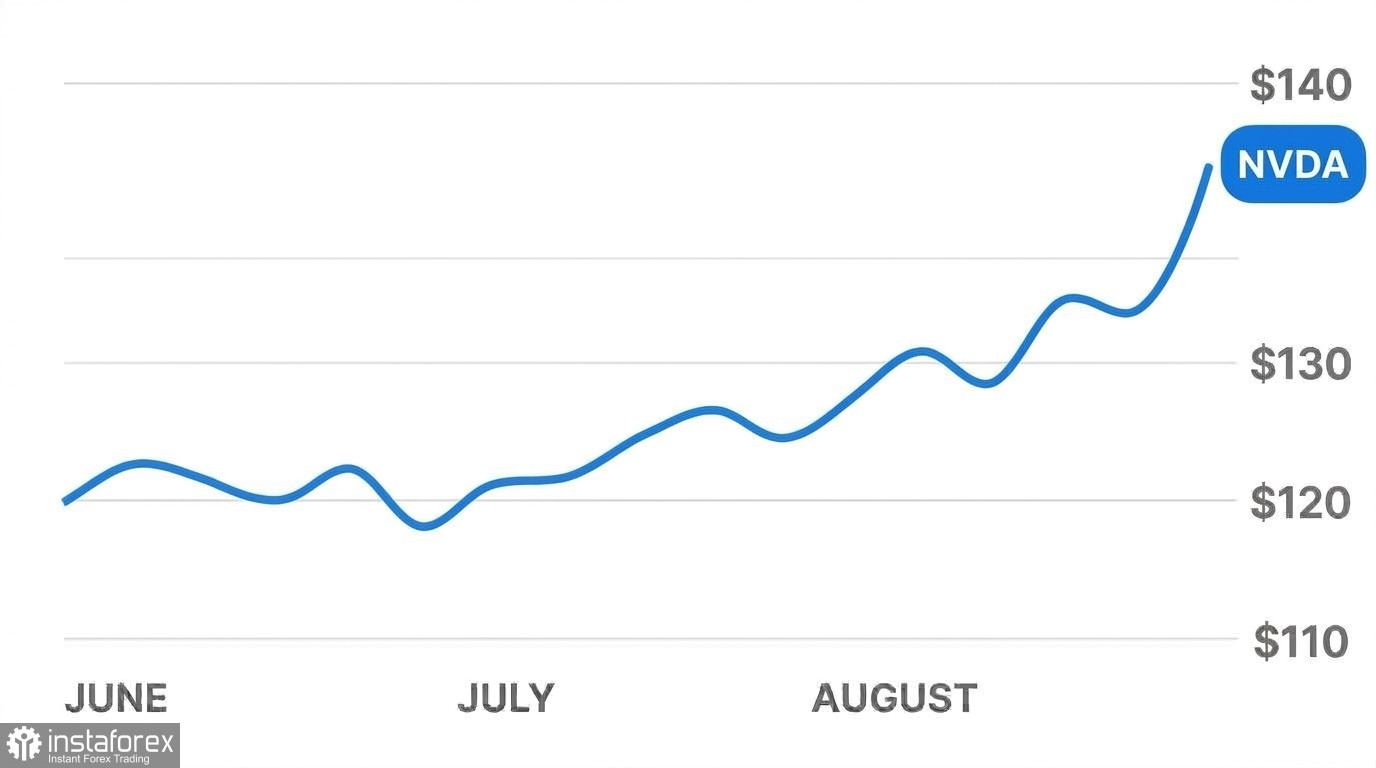
Nvidia (NVDA) stock analysis amid $150B buyback and macroeconomic headwinds
The board of directors approved a record $150 billion expansion of its share repurchase authorization. Under this mechanism, the company buys back shares on the open market, reducing outstanding share count and lifting earnings per share (EPS). The total remaining buyback authorization now stands at $235 billion through fiscal year 2028, signaling management's confidence in long-term free cash flow generation.
Morgan Stanley reiterated Nvidia as its top pick in the semiconductor sector, maintaining a price target of $300 per share. The bank highlighted an attractive valuation, noting that the shares currently trade at roughly 15 times projected fiscal year 2028 earnings. Meanwhile, Wall Street consensus estimates place the average price target at $321.89, with BNP Paribas raising its target to $345, Cantor Fitzgerald targeting $350, Melius Research projecting $420, and Evercore setting an upper-bound target of $465.
Compute demand continues to expand beyond hyperscale cloud data centers. SpaceX has begun seeking $40 billion in financing via its Apollo investment vehicle earmarked specifically for Nvidia hardware. Elon Musk's startup xAI plans to expand its Colossus 2 computing cluster to 1.2 million GB200 and GB300 processors by year-end, while Anthropic signed long-term compute infrastructure leasing agreements worth $84.5 billion powered by Nvidia systems.
Component suppliers corroborate persistent order growth. Electronics manufacturer Foxconn posted record monthly revenue fueled by AI server assembly. According to the Semiconductor Industry Association (SIA), global chip sales rose 144% year-over-year in August. AM Intelligence ordered 20,000 next-generation Vera Rubin chips for data center deployments across Malaysia and India; the new architecture delivers up to a 25-fold speedup in neural network inference over the prior Blackwell generation.
Major institutional asset managers continue expanding their allocations. Robinhood Asset Management increased its Nvidia position by 71.6%, acquiring an additional 108,138 shares, bringing total institutional ownership above 65% of outstanding float. In parallel, Nvidia is expanding into telecom infrastructure, unveiling its 30-billion-parameter Nemotron 3 model to optimize network routing for carriers including SoftBank and AT&T.
Five key constraints continue to weigh on the stock's valuation and pace of expansion:
•Executive insider selling at peak valuations Over the past 90 days, corporate officers and board members sold 1.76 million shares totaling $399.5 million. CFO Colette Kress sold $7.6 million in shares, while director Mark Stevens completed a $144 million block sale. Systematic profit-taking at all-time highs signals executive caution and increases secondary market supply.
•US Treasury yields at 20-year highs The 10-year US Treasury yield moved above 5.3% during recent sessions. With risk-free sovereign debt offering yields exceeding 5%, institutional capital faces higher hurdle rates to justify elevated valuation multiples in mega-cap tech, while elevated borrowing costs tighten liquidity across risk assets.
•Rising memory costs and gross margin pressure Supply constraints in High Bandwidth Memory (HBM) have increased component procurement costs. As a result, Nvidia has had to lift average selling prices on full-rack server solutions by 15%, which is projected to compress gross margins from 73% to roughly 71–72% in Q4.
•Data center infrastructure bottlenecks and in-house silicon Site development for modern data centers faces acute land and power grid capacity shortages. Amazon is exploring up to $8 billion in commercial offerings for its custom silicon, reducing external reliance. Concurrently, DeepSeek and Huawei have formed an alliance to build an alternative software ecosystem aimed at bypassing CUDA and displacing US silicon in Asian markets.
•Litigation and circular vendor-financing exposure Shareholders of chip developer Groq filed suit over a $20 billion IP licensing transaction involving Nvidia. Analysts have raised scrutiny over vendor-financing dynamics, where chip vendors invest in early-stage AI firms that subsequently purchase their hardware. Regulatory scrutiny has also intensified following an investigation into alleged indirect server diversion to China via $300 million in offshore leasing structures.
Our baseline outlook for Nvidia remains considerably more measured than the broader Wall Street consensus range of $320–$465.
Across October and November 2026, the stock is likely to consolidate within a $230–$250 trading range. The $150 billion buyback program provides strong downside support above $225, but roughly $400 million in recent insider sales and Treasury yields north of 5% will limit near-term breakout momentum. Markets will look for further clarity from TSMC's quarterly results and actual hyperscaler capital expenditure prints.
The primary ceiling on near-term growth remains operational: power distribution delays and cooling supply bottlenecks are slowing server cluster commissioning. Material financial contributions from the next-generation Feynman architecture are not expected until fiscal 2028. Until then, revenue trajectory remains bound by Blackwell fabrication capacity and customer willingness to absorb higher debt service costs for compute buildouts.
By late 2026 into Q1 2027, Nvidia is projected to stage a measured advance toward $260–$280, stabilizing its market capitalization around $6.2–$6.5 trillion as deliveries for SpaceX and xAI come online. However, aggressive price targets near $350–$400 appear improbable over this horizon. Current holders are best positioned maintaining existing allocations, while new capital should wait for consolidations toward key support near $230 before initiating exposure.
InstaForex analytical reviews will make you fully aware of market trends! Being an InstaForex client, you are provided with a large number of free services for efficient trading.


