 Zostať
Podmienky obchodovania
Nástroje



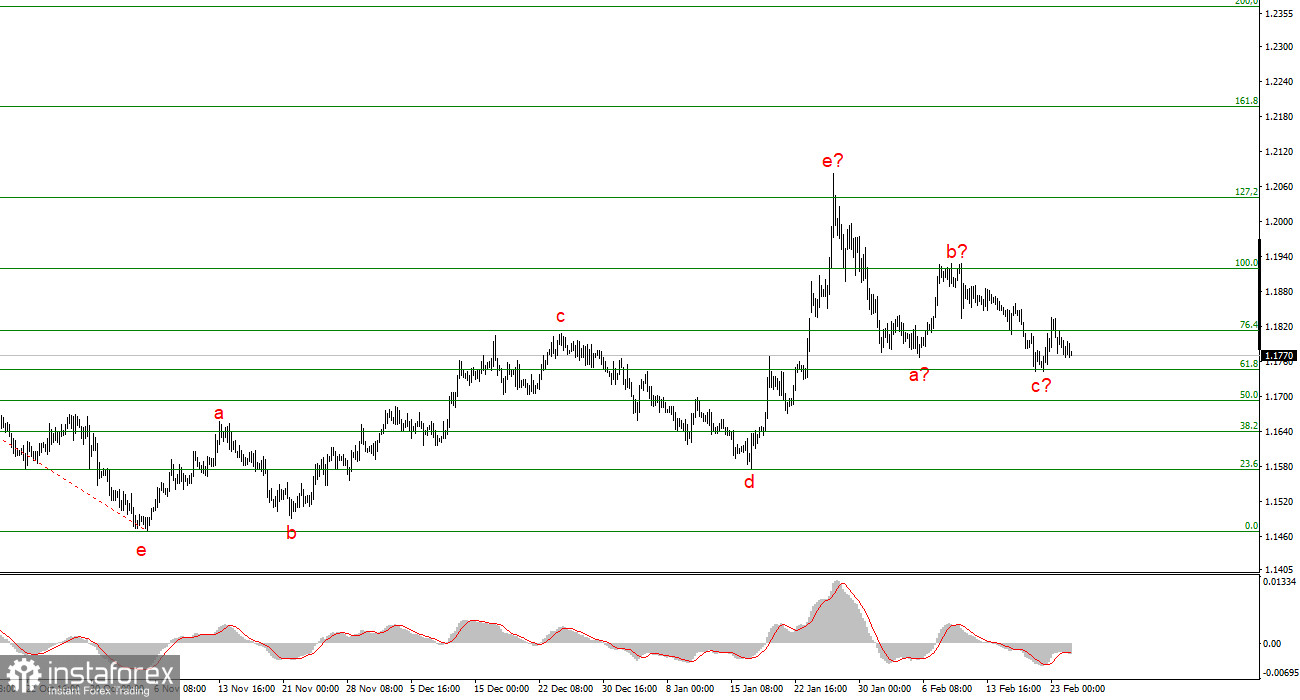
The 4-hour chart wave count for EUR/USD looks less than ideal, but it raises no major concerns. There is still no talk of canceling the upward segment of the trend that began in January last year; only the internal wave structure is occasionally adjusted. In my opinion, the instrument has completed the formation of the global wave 4 (see lower chart). If this assumption is correct, wave 5 is currently forming. This wave could be quite extended, with targets reaching as high as the 1.25 level.
The internal wave structure of the projected wave 5 is not entirely straightforward (see upper chart). The upward wave set cannot be considered impulsive due to the presence of fairly strong corrective waves. At present, it is interpreted as a-b-c-d-e. However, if wave 5 becomes extended, its internal structure will also be quite complex. If this is the case, the wave count may undergo several more transformations. In any case, I expect EUR/USD to resume its upward movement, while the corrective a-b-c structure already looks largely complete.
EUR/USD fell by 20–30 basis points on Tuesday, but again the range of movements was low. The range was not high even on Monday, when quotes jumped 50 basis points in the first hour after the market opened. Today it is even lower. This is not surprising, given that there has been no news flow for the second day in a row and none is expected tomorrow, except for minor reports marked as "secondary" even in economic calendars. What have we learned this week? Germany's business climate index and the weekly ADP report—nothing more. On the other hand, the market is not actively trading at this time because it is openly ignoring more significant events and topics. For example, last Friday's weak US GDP report went unnoticed.
I will not repeat the discussion on Trump's trade tariffs, which has already been covered extensively in recent days. I will only note that the new tariffs threaten to disrupt many already agreed trade deals. The European Parliament has paused ratification of a trade agreement, India has suspended talks with Washington, and the UK may soon respond with its own tariffs, as its trade agreement assumed a 10% tariff, while Trump unilaterally set tariffs of 15% for all countries worldwide.
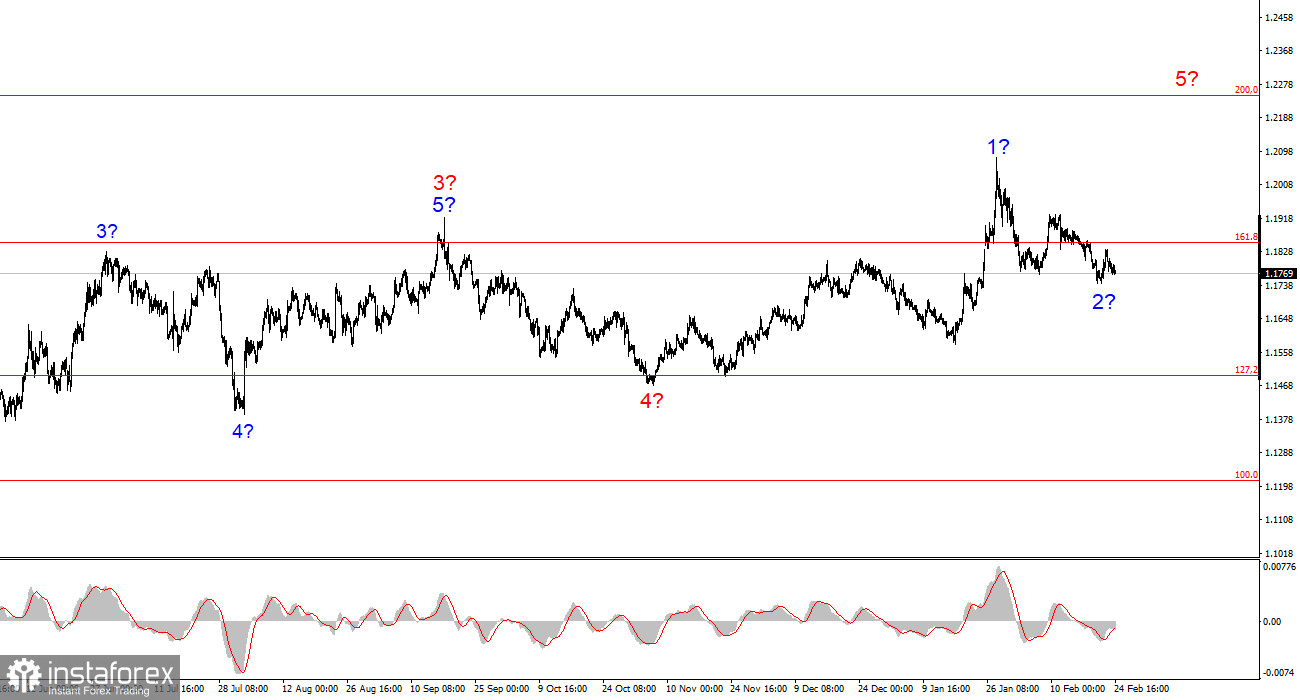
Based on this EUR/USD analysis, I conclude that the instrument continues its upward trend. Donald Trump's policies and the Fed's monetary policy remain significant long-term factors in the dollar's weakness. The current trend's targets may extend as high as 1.25. At present, I consider the instrument to be within global wave 5, so I expect price increases in the first half of 2026. The a-b-c corrective structure may end at any moment, as it already appears largely complete. I consider it appropriate to look for areas and levels for new purchases, with targets around 1.2195 and 1.2367, corresponding to 161.8% and 200.0% Fibonacci extensions.
At a smaller scale, the entire upward segment of the trend is visible. The wave count is not entirely standard, as corrective waves vary in size. For example, the larger wave 2 is smaller than the internal wave 2 within wave 3. However, this does happen. I remind readers that it is best to focus on clear structures on the charts rather than adhere strictly to every wave. The current upward wave structure is unambiguous.
Key Principles of My Analysis:
InstaForex analytical reviews will make you fully aware of market trends! Being an InstaForex client, you are provided with a large number of free services for efficient trading.


