 Zostať

Podmienky obchodovania
Nástroje


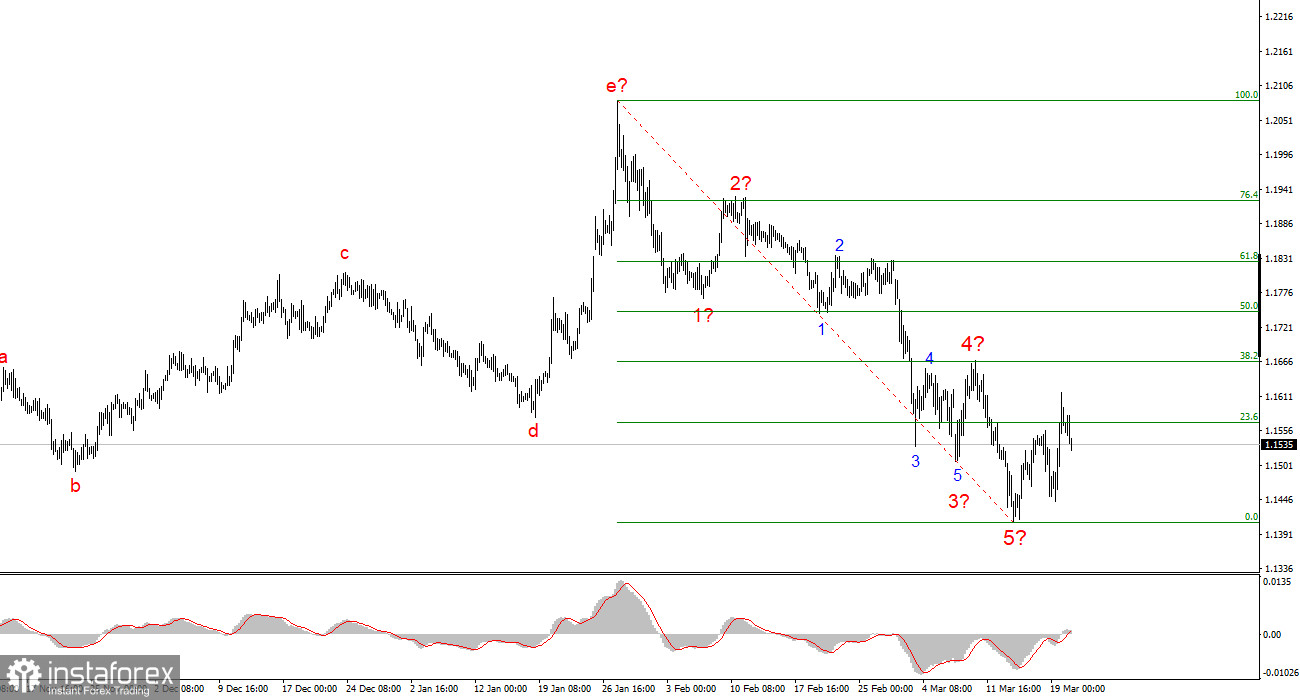
The wave pattern on the 4-hour chart for EUR/USD has changed. There is still no indication that the upward trend that began in January of last year has been canceled, but the wave structure now looks quite ambiguous. In such situations, I always recommend switching to a lower timeframe and focusing on simpler, smaller wave structures in order to make short-term forecasts, which are sufficient for opening trades.
In the chart above, a classic five-wave impulse structure can be identified, with an extended third wave. If this interpretation is correct, then this structure has already been completed, and a corrective pattern of at least three waves is now expected. Therefore, in the near term, a rise in the pair is likely—but within a correction relative to the latest trend segment. Recent wave formations do not fit well into the higher-level structure, but the situation should become clearer over time. In the short term, the euro may recover toward 1.1568 and 1.1666.
On Friday, the EUR/USD pair rose by 45 points after gaining 120 the day before. There was no significant news in either Europe or the U.S., and even the Middle East provided little new information. Therefore, the decline in demand for the euro should be viewed calmly—it is just one of many minor corrective waves frequently seen on charts.
In my view, the market remains driven by geopolitics, but the news this week has slightly adjusted sentiment. Markets now expect the ECB to raise interest rates—provided inflation rises significantly in the coming months. Christine Lagarde acknowledged the possibility of tightening monetary policy, although the ECB's stance was more dovish than the Bank of England's and more hawkish than the Federal Reserve's.
If geopolitical factors move out of focus, EUR/USD may benefit from the ECB's relatively hawkish tone to build a more convincing upward corrective structure. Beyond that, forecasting becomes difficult, as geopolitical developments can change rapidly and unpredictably. If the pair declines again next week, it would suggest that monetary policy is currently far less important to the market than geopolitical developments. While traders could not ignore central bank meetings, Friday's price action did not reflect the strong signals from Wednesday and Thursday.
Thus, the current situation in the currency market is largely driven by geopolitics. Even if a solid corrective structure forms, the previous downward move was impulsive, meaning that once the correction is complete, a new downward trend phase may begin.
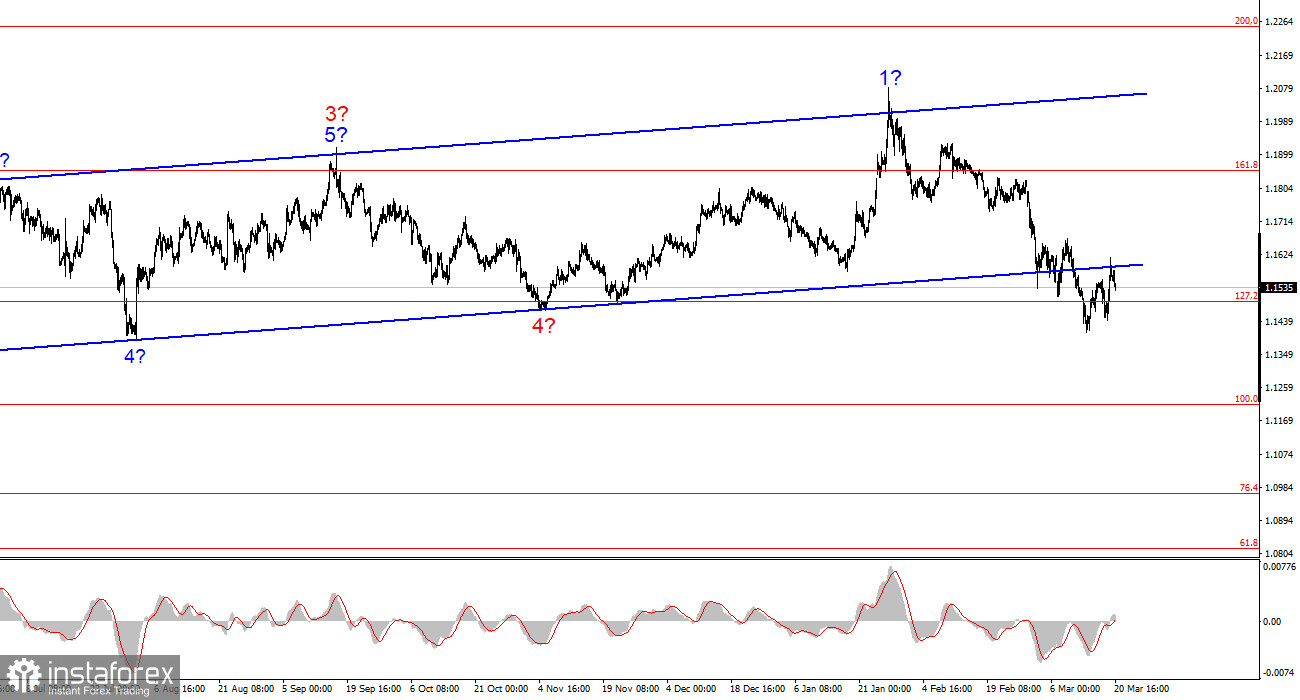
Based on this analysis, EUR/USD remains within an overall upward trend (as shown in the lower chart), but in the short term has begun forming a downward phase. Since the five-wave impulse structure appears complete, a rise toward 1.1568 and 1.1666 (corresponding to the 23.6% and 38.2% Fibonacci levels) can be expected over the next one to two weeks. Further movement will depend entirely on developments in the Middle East.
On a smaller timeframe, the entire upward trend is visible. The wave structure is somewhat irregular, as corrective waves differ in size—for example, the higher-degree wave 2 is smaller than the internal wave 2 within wave 3. This does occur. It is best to focus on clear and understandable structures rather than trying to strictly label every wave. A trend reversal may occur in the near future.
Key Principles of My Analysis:
InstaForex analytical reviews will make you fully aware of market trends! Being an InstaForex client, you are provided with a large number of free services for efficient trading.


