 Zostať
Podmienky obchodovania
Nástroje



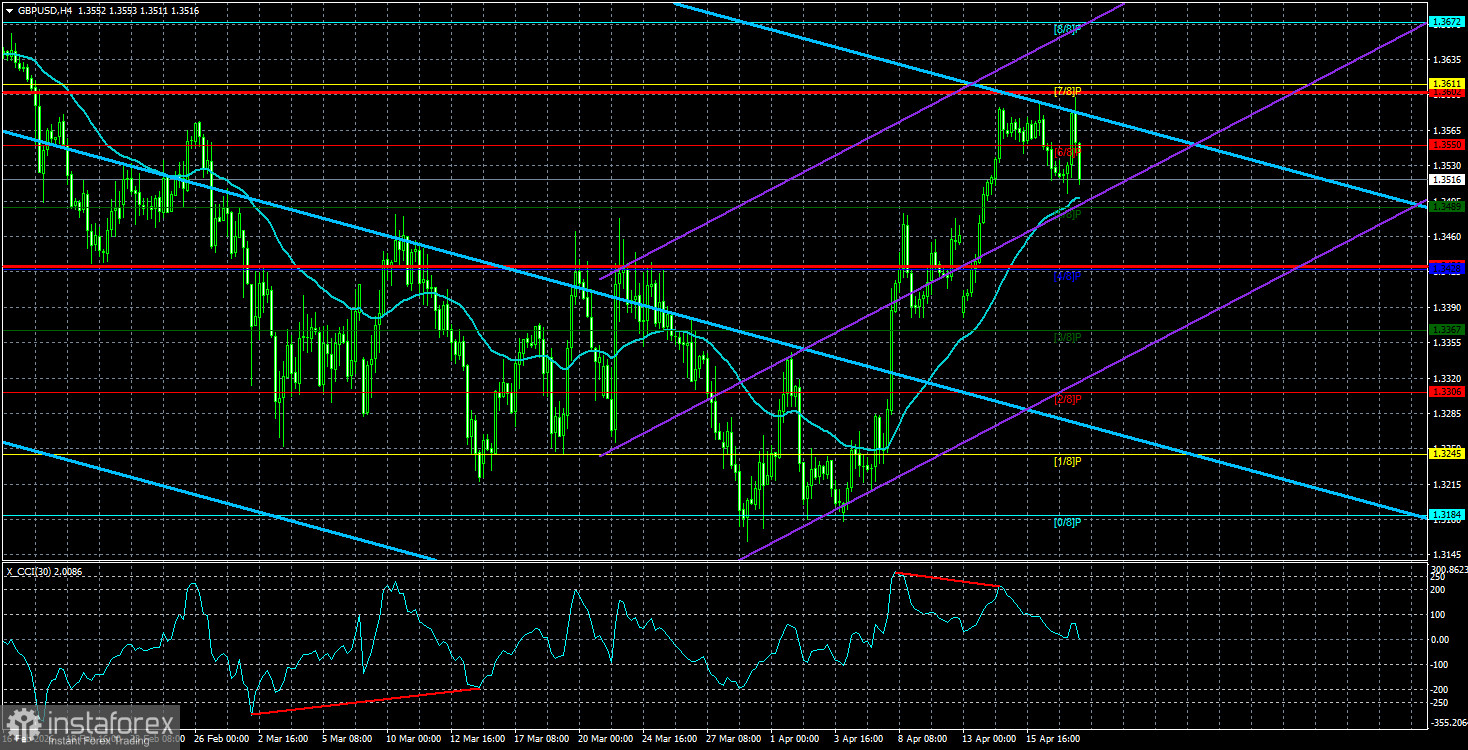
The GBP/USD currency pair will again be at the mercy of geopolitics in the new week. Over the weekend, it was revealed that Iran closed the Strait of Hormuz in response to the US' refusal to lift its blockade. This event could not be priced in over the weekend, so on Monday, volatility and a rise in the US dollar can be expected again. It should be noted that on Friday, despite very optimistic news about the opening of Hormuz, the market did not continue to shed the safe-haven dollar. We believe the most positive scenario for developments in the Middle East was already priced in before Friday, which is why the anticipated purchases of the EUR/USD pair did not materialize. In this case, the market is currently not inclined towards new purchases of the euro and the pound, and given the deterioration of the geopolitical situation, it is unlikely to show any desire to do so on Monday.
In addition, news about the second round of negotiations between Iran and the US' could come at any moment, but it is already known that Tehran still refuses to hand over its enriched uranium. Thus, the second round may conclude in the same way as the first. From a technical perspective, the pair is overdue for a decline. Last week, two "bearish" divergences formed on the CCI indicator, and the growth of the European currency lasted about two weeks, which also suggests a correction. The macroeconomic backdrop is unlikely to have a significant impact on market sentiment this week, so traders will again base their decisions on geopolitical factors. Still, let's briefly go over the key macroeconomic events...
In the UK, reports on unemployment, jobless claims, wages, inflation, retail sales, and indices of business activity in services and manufacturing sectors will be published. Of course, the inflation report will be key. In light of recent events, the Strait of Hormuz may remain blocked for some time, so there is no reason to expect a slowdown in inflation growth. In this case, the Bank of England may maintain its "hawkish" stance regarding monetary policy; however, this factor will not be significant for traders. The market will continue to trade based on geopolitical factors.
In the US, retail sales, business activity indices (excluding the ISM), jobless claims, and the University of Michigan consumer sentiment index are scheduled for release. As we can see, almost all the reports are secondary, so we do not expect any reaction to them. Thus, we believe that geopolitical factors will influence traders' decisions by up to 90%.
This does not mean that a new phase of medium-term growth for the US currency will begin on Monday. Most likely, the market has already priced in the most pessimistic scenario in the Middle East. However, a correction is needed, and there is no reason to sell the dollar after the latest Hormuz closure.
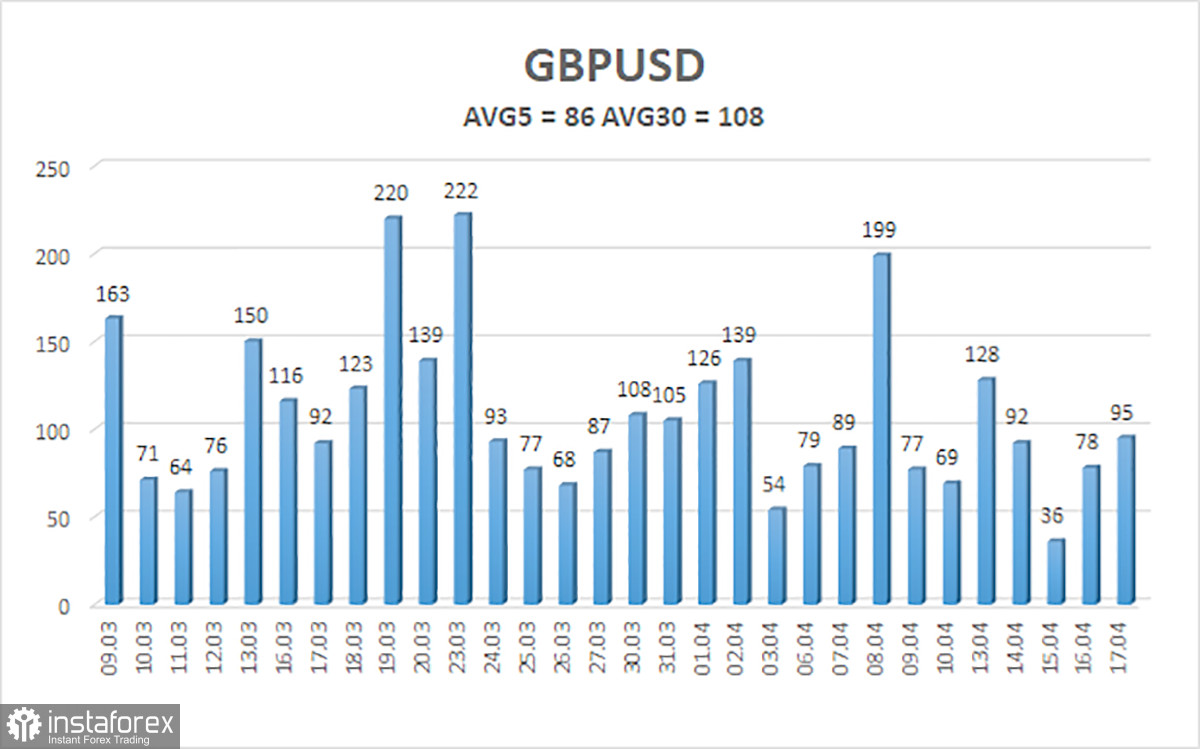
The average volatility of the GBP/USD pair over the last 5 trading days is 86 pips. For the pound/dollar pair, this value is considered "average." On Monday, April 18, we therefore expect movement within a range bounded by 1.3430 and 1.3602. The upper linear regression channel has turned down, indicating a trend change. The CCI indicator has entered overbought territory and formed a "bearish" divergence, warning of a possible downward pullback.
S1 – 1.3489
S2 – 1.3428
S3 – 1.3367
R1 – 1.3550
R2 – 1.3611
R3 – 1.3672
The GBP/USD currency pair continues its recovery after two "months of geopolitics." Donald Trump's policies will continue to put pressure on the US economy, so we do not expect the US currency to grow in 2026. Thus, long positions with a target of 1.3916 and above remain relevant when the price is above the moving average. If the price is below the moving average line, short positions can be considered, with targets at 1.3428 and 1.3367, based on geopolitical factors. In recent months, nearly all news and events have turned against the British pound, leading to an extended downtrend. However, geopolitics no longer supports the dollar, and the pound now feels freer.
Linear regression channels help to define the current trend. If both are directed in the same way, it means the trend is currently strong;
The moving average line (settings 20,0, smoothed) determines the short-term trend and the direction in which trading should currently be conducted;
Murray levels are target levels for movements and corrections;
Volatility levels (red lines) indicate the probable price channel in which the pair will operate over the next day, based on current volatility readings;
The CCI indicator – its entrance into the oversold area (below -250) or the overbought area (above +250) indicates that a trend reversal in the opposite direction may be approaching.
InstaForex analytical reviews will make you fully aware of market trends! Being an InstaForex client, you are provided with a large number of free services for efficient trading.


