 Zostať
Podmienky obchodovania
Nástroje



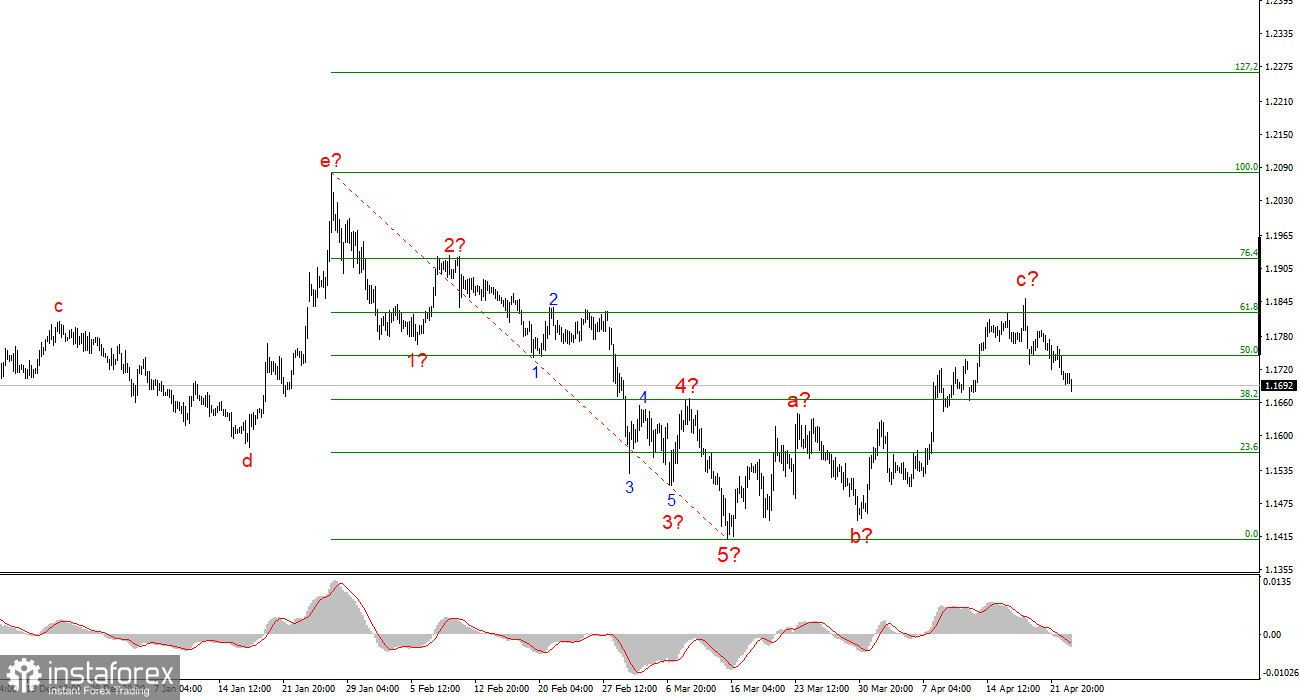
The wave pattern on the 4-hour chart for EUR/USD has changed. There is still no indication that the upward trend segment (lower chart), which began in January of last year, has been canceled. However, the wave structure itself now looks quite ambiguous. In such situations, I always recommend switching to a lower timeframe (upper chart) and focusing on the simplest and smallest wave structures to make short-term forecasts—this is usually sufficient for opening trades. Wave structures can become very complex and allow for multiple scenarios. The simplest approach is to trade based on standard "five-three" patterns.
In the chart above, we can identify a classic five-wave impulse structure with an extended third wave. If this is indeed the case, then the formation of this structure has been completed, and a corrective pattern of at least three waves is currently unfolding. We have already seen three waves, so the market may soon form at least one more corrective wave. Future developments will depend on geopolitics: either a more complex correction will develop, or a new downward trend segment will begin.
The EUR/USD pair declined by another 20–30 basis points on Thursday, with low volatility. Market participants could have shifted their focus from the largely uneventful geopolitical news flow to economic data. However, it cannot be said that PMI figures from Germany and the eurozone influenced trading.
In Germany, the manufacturing PMI came in at 51.2 (in line with expectations), while the services PMI was 46.9 (significantly below expectations). In the eurozone, manufacturing rose to 52.2, while services declined to 47.4. Thus, two out of four indicators were positive, and two were negative. The weak price movement suggests that the market largely ignored these reports.
There were no other significant reports. In the US, weekly jobless claims were released, but this data is generally considered insignificant for assessing the labor market, as it is published every week and rarely influences sentiment. PMI data from S&P (similar to European indicators) was also released, but the market tends to rely more on ISM indices, which are published monthly. As a result, no significant movement occurred, although the pair may still show slight movement before the end of the day.
The market remains focused on geopolitics, even though no major developments have occurred for about a week. Each day brings the same updates: the Strait of Hormuz remains closed, and negotiations between Tehran and Washington are being discussed but have yet to take place.
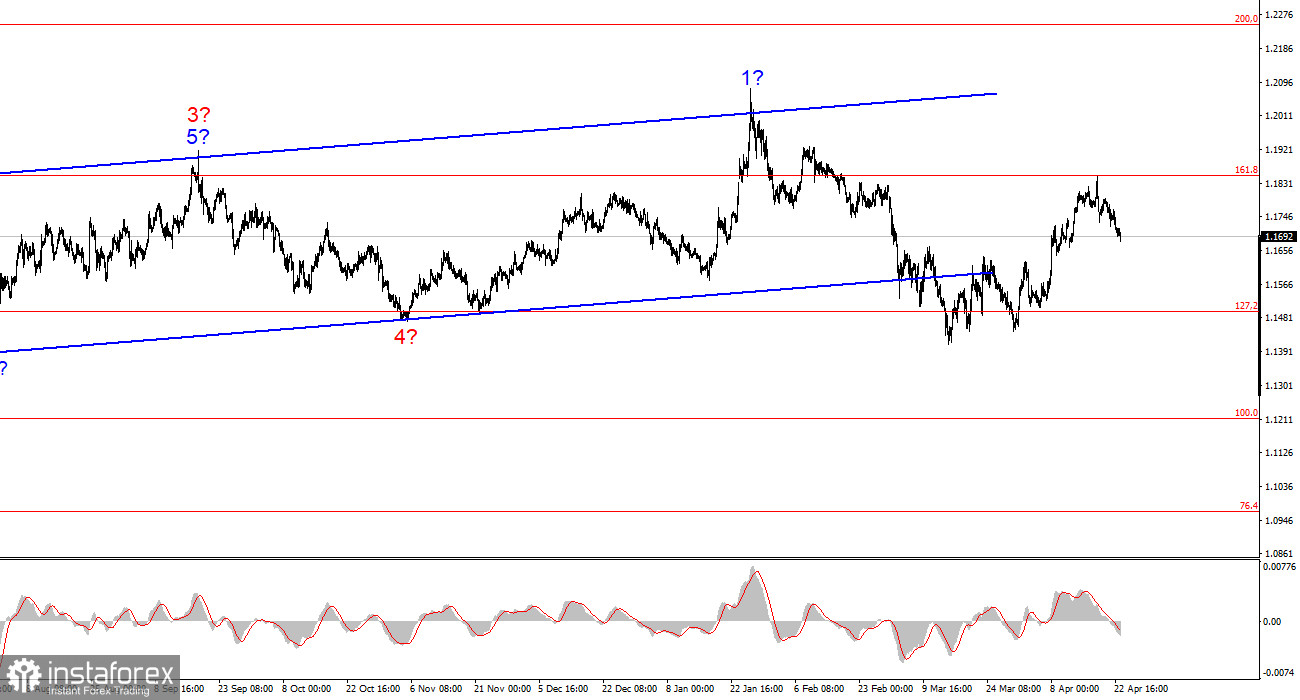
Based on the analysis, EUR/USD remains within an upward trend segment (lower chart) in the broader perspective, while in the short term it is in a corrective phase. The corrective wave structure appears largely complete and could become more complex and extended only if a stable, long-term ceasefire is established among Iran, the US, Israel, and other countries in the Middle East.
Otherwise, a new downward wave structure may begin from current levels—or the correction could continue.
On the lower timeframe, the entire upward trend segment is visible. The wave structure is somewhat unconventional, as corrective waves differ in size. For example, the larger wave 2 is smaller than the internal wave 2 within wave 3. Such cases do occur. It is better to focus on clear and understandable structures rather than strictly labeling every wave. The trend may reverse in the near future.
Key Principles of My Analysis
InstaForex analytical reviews will make you fully aware of market trends! Being an InstaForex client, you are provided with a large number of free services for efficient trading.


