 Zostať

Podmienky obchodovania
Nástroje


Oil has slightly recovered from yesterday's plunge. Brent has returned above $98 per barrel, while WTI is near $92. The catalyst for this movement was the new U.S. military strikes on missile launchers and vessels in the Strait of Hormuz—the market interpreted these actions as a sign of ongoing escalation and restored part of the geopolitical premium that was shed on Monday.
Negotiations are ongoing; however, the timelines have shifted again. Rubio, speaking in New Delhi, stated that it would take "a few more days" to finalize the wording of the agreement. The outlines of a possible deal remain the same: an extension of the ceasefire for about two months, the U.S. lifting the blockade, and Iran reopening the strait. The sticking point remains Tehran's demand to regulate maritime shipping through this strategically important waterway, which is absolutely unacceptable to Washington, the Arab states, and Europe. There's also uncertainty about what will happen next with Iran's enriched uranium and how the trajectory of Iran's nuclear program will develop.
It's worth noting that the market has heard promises of breakthroughs many times before, which led to nothing. The recent U.S. attacks clearly indicate that it is premature to discuss a peace agreement, let alone its compliance. Both sides have repeatedly claimed success in negotiations or the reopening of the strait over the past months—and each time, nothing materialized. Additionally, another complicating factor has emerged: Israel has announced an increase in strikes against Hezbollah in Lebanon, while Tehran insists that halting hostilities there is a prerequisite for any deal with the U.S. This significantly broadens the scope of negotiations.
Meanwhile, a supply shortfall is increasing. According to the IEA, energy reserves worldwide are declining at record rates—both commercial and strategic reserves in the U.S. are evaporating at an unprecedented pace. This means that even if agreements are reached, the physical restoration of supplies will take time, and prices will not plummet instantly.
For central banks, the situation also remains extremely uncomfortable. European Central Bank Executive Board member Isabel Schnabel stated yesterday that the central bank must raise rates next month, even in the event of a swift resolution to the conflict—an inflationary shock has already occurred, and its effects cannot be mitigated by a single diplomatic document.
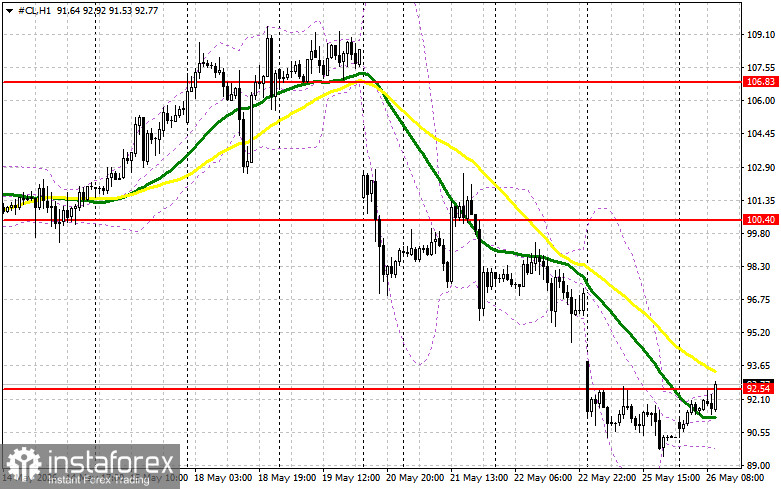
Regarding the current technical picture for oil, buyers need to overcome the nearest resistance at $92.50. This will allow targeting $100.40, above which it will be quite difficult to break through. The furthest target will be $106.80. In the event of a decline in oil, bears will try to take control at $86.50. If they succeed, a breakout of the range will deal a significant blow to bullish positions and may push oil down to a low of $81.40, with the prospect of reaching $74.85.
InstaForex analytical reviews will make you fully aware of market trends! Being an InstaForex client, you are provided with a large number of free services for efficient trading.


