 Zostať

Podmienky obchodovania
Nástroje


The July Westpac-Melbourne Institute consumer confidence index showed a notable increase of 4.1%, reaching 83.9 points from 80.6 in June. This is the highest level since the beginning of the year and indicates a slight easing of households' concerns. However, even with this increase, it remains in the lowest 10% of all values over the survey's 50-year history.
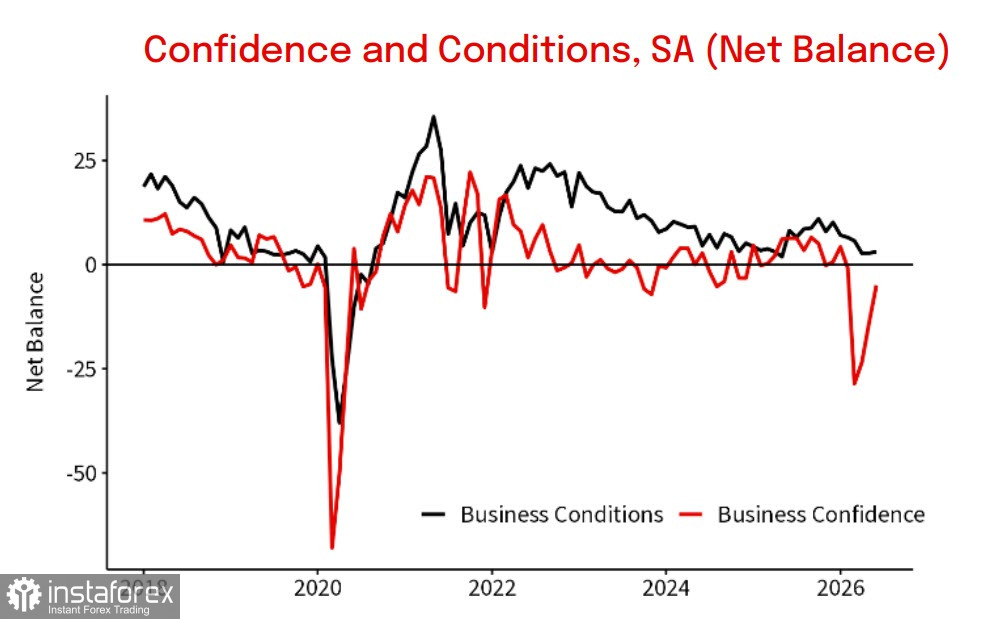
The NAB business confidence index rose by 9 points to -5 in June, demonstrating the third consecutive month of recovery after the collapse in March caused by the onset of the conflict in the Middle East. However, the negative value still indicates that there are more pessimistic companies than optimistic ones. Both surveys took place against the backdrop of a decrease in escalation in June, but the situation has now worsened and is hardly different from that which dominated in February-March.
Australia imports 80-90% of all petroleum products consumed—gasoline, diesel, and jet fuel. Two decades ago, there were eight oil refineries in the country that covered most of the domestic demand. Today, only two remain, with the rest coming from Asia-Pacific countries, which are critically dependent on crude oil from the Persian Gulf, supplied through the Strait of Hormuz.
Australia is the largest diesel fuel importer in the world. Due to the length of the logistics chain (from the Persian Gulf to Asia—20-30 days, then another 10-20 days to Australia), the full effect of the shock is delayed. Furthermore, Australia lacks a strategic fuel reserve and is the only country in the IEA that does not comply with the requirement to maintain reserves for at least 90 days.
Escalation poses direct threats of fuel price increases, inflationary pressure, and, in the worst-case scenario, a physical deficit and restrictions. The longer the confrontation between the U.S. and Iran continues, the more serious and stronger the threats to the Australian economy will become.
The current RBA rate is 4.35%, and according to Westpac, confidence in an August rate hike has increased. The RBA forecasts a peak inflation rate of 4.8% in June 2026, and core inflation is expected to remain above 3% until mid-2027. The baseline scenario assumes the rate will increase by 60 basis points by the end of the year, in line with market expectations. If the fuel supply situation does not become critical, the RBA has a chance to keep inflation under control, and rising yields will support the Australian dollar. If fears of fuel shortages increase, the economy will quickly slip into recession, the trade balance will deteriorate, and this will inevitably increase pressure on the Australian dollar.
The net short position on the AUD stands at -1.7 billion, with a small bearish excess, but the overall trend remains clearly negative, with the calculated price confidently holding below the long-term average.
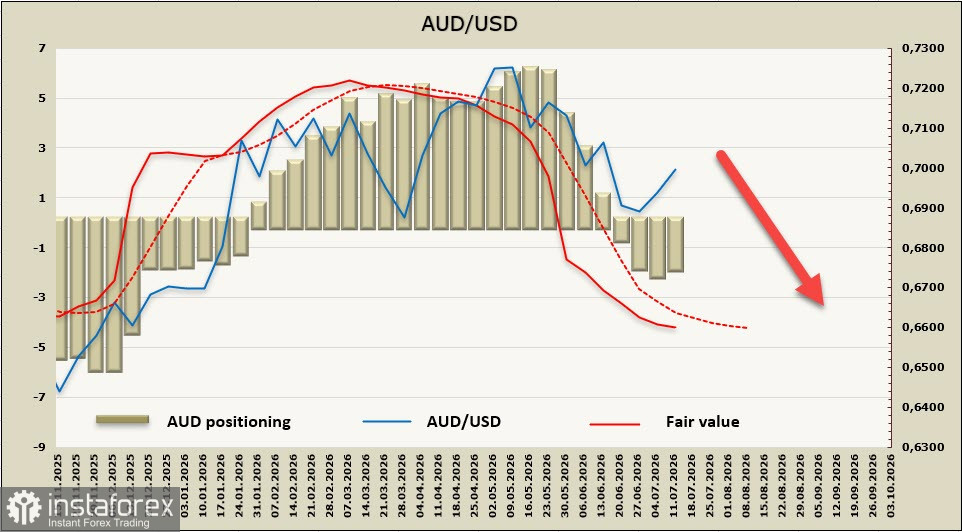
The AUD/USD pair attempted to return to a bullish channel, but it is unlikely that this trend will develop. Most likely, we are witnessing a short-term reaction to recent indicators of activity. Regarding the overall dynamics, the continued escalation of threats to the Australian economy remains too strong to expect a resumption of growth in AUD/USD. Resistance at 0.7090 has minimal chances of being broken, and a return to the lower boundary of the channel and a move toward the June 30 low of 0.6865 seem more probable.
InstaForex analytical reviews will make you fully aware of market trends! Being an InstaForex client, you are provided with a large number of free services for efficient trading.


