 Zostať

Podmienky obchodovania
Nástroje


Oil is heading into its longest stretch of declines in more than a year as Saudi Arabia prepares to restart a key pipeline and U.S. officials report progress in talks with Iran aimed at ending the region's war. Brent fell to around $98/bbl, down for a sixth straight day and off more than 9% over that period — the longest drawdown since August 2025, before Washington and Israel jointly struck Iran. WTI for November delivery traded near $89.
Saudi Arabia expects to restore exports via the East-West pipeline in the coming days, a route that allows Riyadh to bypass the contested Strait of Hormuz. The pipeline — with capacity of about 7 million barrels per day — was damaged in attacks earlier this month, and the prospect of its imminent return to service, together with diplomatic progress, became one of the two main reasons for the sell-off.
Yesterday U.S. President Donald Trump described a meeting between U.S. officials and Iranian representatives as "very productive," after warning in his UN speech that Iran could be destroyed. He said further meetings are planned. Trump said special envoys Steve Witkoff and Jared Kushner were involved, and Witkoff wrote on social media that mediated talks with an Iranian delegation had completed a round of discussions that promised to be "constructive and promising." That combination of tough public rhetoric from Trump and softer diplomatic comments from his envoys supports cautious optimism rather than confident expectation of a breakthrough.
Yet such declarations are familiar, so they should not be overread. Excess optimism leads people to see good news where reality does not fully warrant it. Iran's foreign-ministry spokesman Esmail Baghaei stressed that the talks via Qatar were to convey Tehran's demands — an end to hostilities, lifting of the U.S. blockade, and unfreezing of Iranian assets — so the discussions are more an exchange of conditions than a concluded deal.
Year-to-date oil is still up more than 60% after Middle East fighting disrupted shipments through the Strait of Hormuz, and refined-product prices have risen even faster than crude, fueling higher-than-expected inflation. Amid fuel shortages, Trump has urged advisers to consider a U.S. ban on diesel exports — a move that would hit export-oriented refiners but could restrain domestic fuel prices for American consumers and businesses.
Previous efforts to end the war yielded only temporary pauses. The U.S. maintains a blockade of Iranian ports, curbing export revenue, and Iran continues to attack vessels in the Strait of Hormuz.
In my view, the six-day drop rests on two parallel but not fully confirmed developments: diplomacy and the pipeline restart. The more than 9% fall looks to be running ahead of confirmed progress. I do not rule out a quick rebound to $100–102/bbl if talks stall or pipeline repairs are delayed; a physically verified return of Saudi volumes to the market would be a much firmer basis for continued declines than Witkoff's words alone.
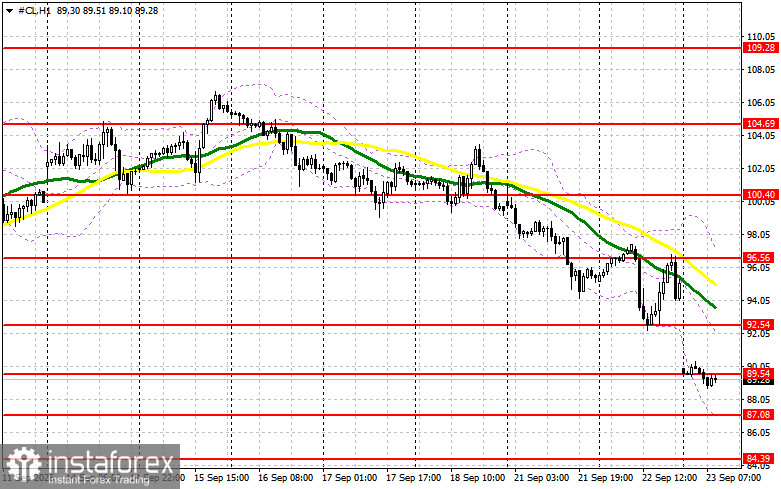
Technical picture: buyers need to take the nearest resistance at $92 to target $96, above which a breakout would be difficult. A farther target sits around $100. On the downside bears will try to seize $89; a break there would seriously damage long positions and push Oil toward $87 with a prospect of extending to $84.
InstaForex analytical reviews will make you fully aware of market trends! Being an InstaForex client, you are provided with a large number of free services for efficient trading.


