 Zostať

Podmienky obchodovania
Nástroje


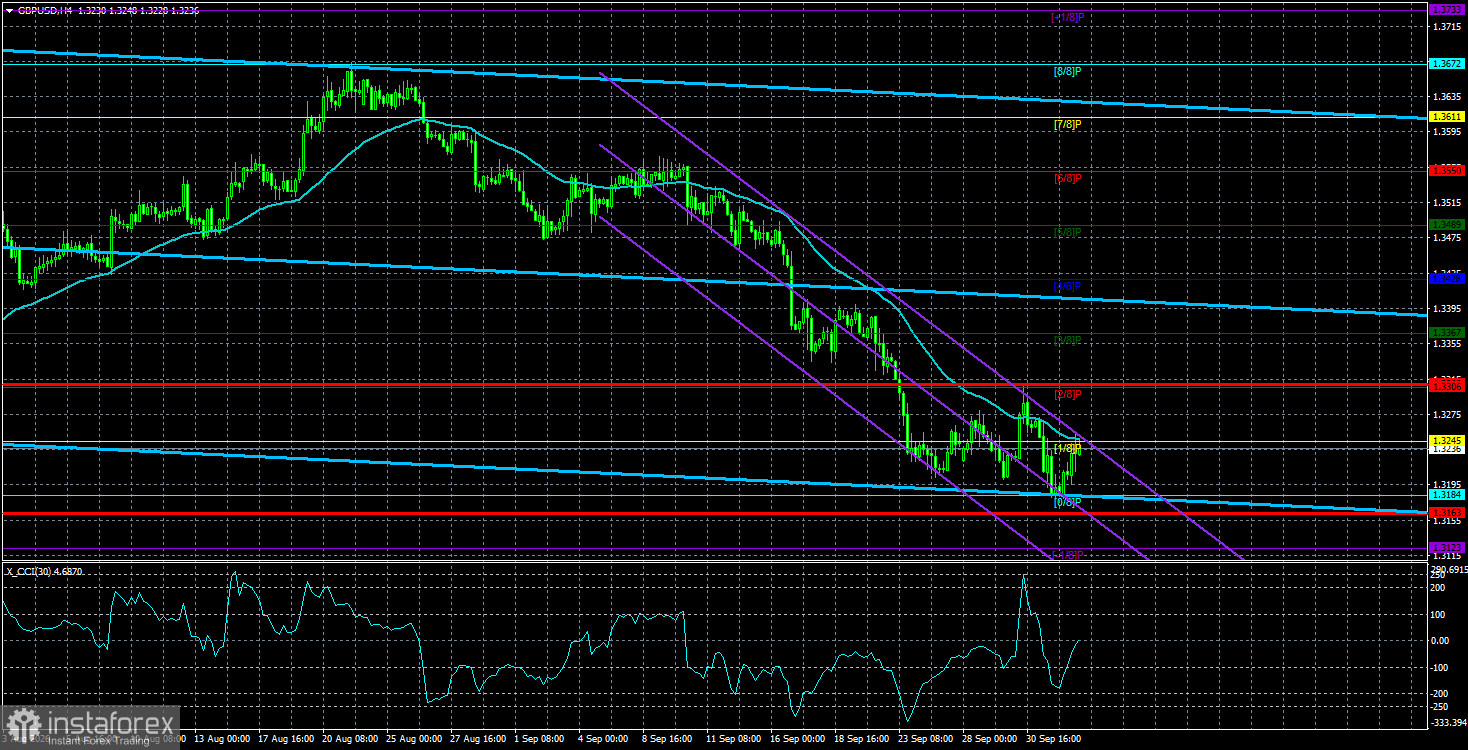
The GBP/USD currency pair rose slightly more than EUR/USD on Friday — about 40 pips. Traders can draw the obvious conclusion themselves about how logical such a move was on the last trading day of the week. In recent weeks we have often talked about global factors while largely ignoring local events and reports. That's because local events provide no support for the dollar, and yet the dollar rises. Of course one can point out that last week's US Q2 GDP came in higher than expected, but that is one report in favor of the dollar. How many were there against it? Certainly, any macroeconomic indicator can be interpreted any way you like. Take the latest ISM manufacturing index: it printed 54.5, below forecasts and below the prior month. Yet the reading itself isn't weak. So one can say ISM missed forecasts but still showed a high level.
We should remind readers that the market prices in expectations in advance. Thus, for ISM (and other indicators), the market initially had one value priced for the dollar, and after the release the market's expectations turned out to be incorrect. Therefore, how a particular report is interpreted matters little. There is a rule of thumb: a weak reading — currency falls; a strong reading — currency rises. If that rule no longer holds, why pay attention to macro data at all? If any report can be turned upside down and yield opposite conclusions?
We would also rather be silent about central bank monetary policy. The European Central Bank has raised key rates twice and... the euro continues to fall. Last week inflation in the EU and Germany exceeded forecasts, which effectively increases the likelihood of a third ECB tightening at the next meeting (or the one after — what difference does it make if the market expects a hike at some point?). Did that help the euro at all? Or was September's EU inflation "not high enough"? The Bank of England also prepares to deliver two rounds of tightening soon, but that factor likewise seems irrelevant.
We continue to believe the key factor for the pound, at least, remains the weekly-timeframe flat. That explains the pair's utterly illogical moves in recent weeks. Since price is currently near the lower boundary of the sideways channel 1.3150–1.3780, expect an upward reversal and a move toward the upper boundary. The overall uptrend from 2022 remains intact.
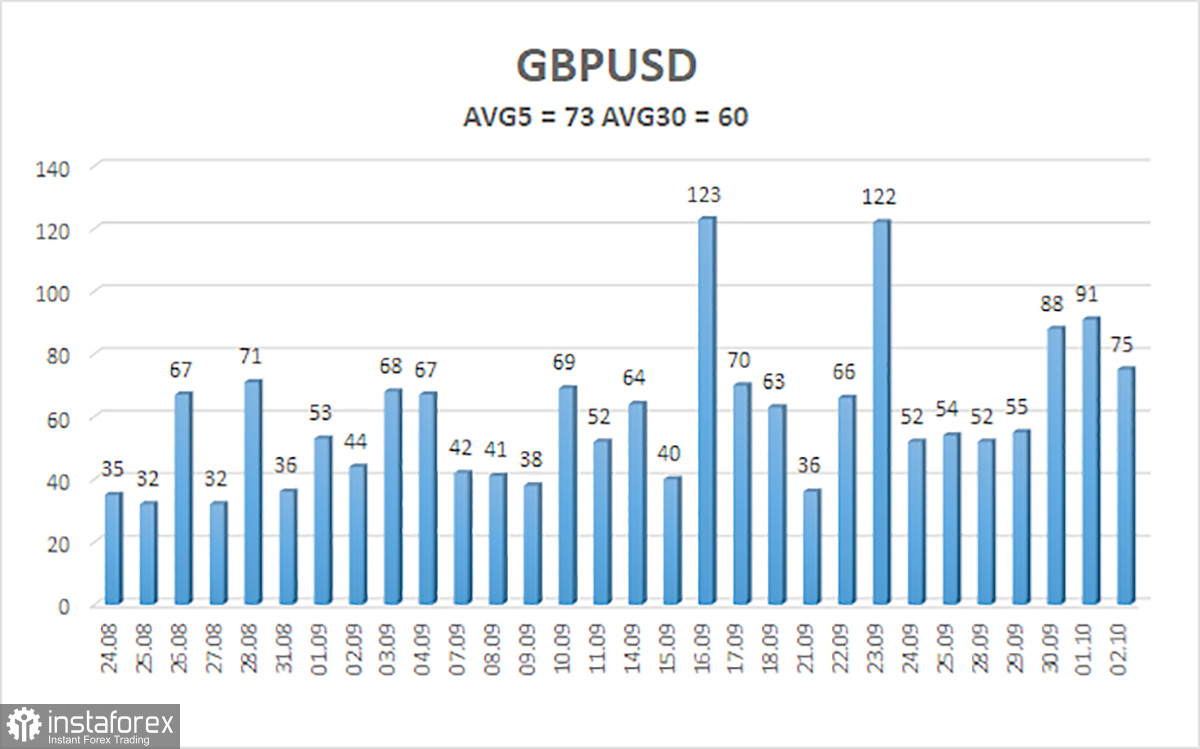
The average volatility of the GBP/USD pair over the last 5 trading days is 73 pips. For the pound/dollar pair, this value is "average." On Monday, October 5, therefore, we expect movement within the range bounded by levels 1.3163 and 1.3309. The higher linear regression channel is turning down again. The CCI indicator has entered the oversold area twice already, warning of a possible end to the downward trend.
S1 – 1.3184
S2 – 1.3123
S3 – 1.3062
R1 – 1.3245
R2 – 1.3306
R3 – 1.3367
The GBP/USD currency pair continues its illogical downward movement. Donald Trump's policies will continue to put pressure on the US economy, so we do not expect the US dollar to rise in the long term. So far, 2026 has been positive for the dollar due to geopolitics and inflation, which forced capital to flee to safety and the Fed to return to monetary tightening. However, on the weekly TF, a flat range persists between 1.3150 and 1.3780 within a four-year uptrend, suggesting medium-term growth in the British currency. Consider long positions with targets of 1.3367 and 1.3428 when price is above the moving average. When price is below the moving average, you can trade to the downside, targeting 1.3184 and 1.3163. Be careful with short positions, as the price is located at the lower boundary of the long-term sideways channel!
InstaForex analytical reviews will make you fully aware of market trends! Being an InstaForex client, you are provided with a large number of free services for efficient trading.


