 Zostať

Podmienky obchodovania
Nástroje


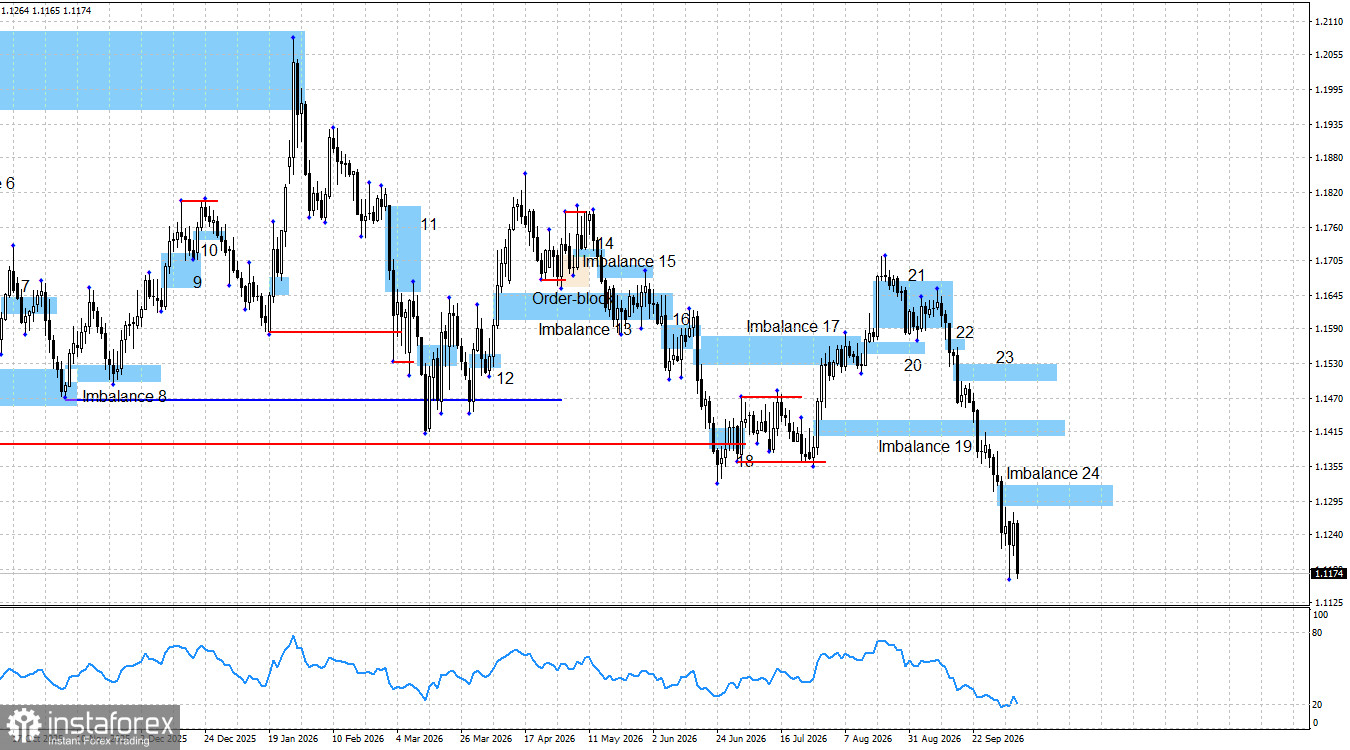
The EUR/USD pair has been declining for the 20th consecutive day, apart from brief pauses. During this period, the European currency has lost 470 points. The decline in the European currency began a month ago as the market prepared for an FOMC key rate hike. Since then, the market has continued buying the dollar, using any formal reason to do so. In the language of market traders, such movements are referred to as "order flow," meaning the flow of orders. Typically, large market participants build up an order flow for some time, after which those orders begin to be executed. At that point, the fundamental backdrop accompanying the move becomes largely irrelevant—the orders have already been placed and are being executed. For example, this week the reasons for selling the euro were rather questionable. Yet the charts show a continuous one-directional move with no indication of a corrective pullback.
Last week, a public protest broke out in France against cuts in education spending. On Monday, it became known that there was a "hole" of several tens of billions of euros in the French budget. On Wednesday, reports emerged that the French Finance Minister and the current government were prepared to adopt the 2027 budget at any cost, with spending cuts and tax increases built into it. Is this a reason to sell the euro? Yes, it is. But why is the pound falling along with the European currency? Is the euro pulling the pound lower? Yes, this happens quite often, as these currencies have historically shown a high degree of correlation. Nevertheless, I believe that the dollar is strengthening rather than the euro or the pound weakening.
So far, nothing has been able to stop the decline in the European currency. Neither tighter ECB policy, nor positive economic data from the European Union, nor disappointing U.S. labor-market data, nor the technical picture and bullish patterns have been sufficient. Since imbalance 19 has been invalidated, the European currency now has every chance of falling below the psychological $1.10 level. Meanwhile, bullish imbalance 19 has turned into a bearish inverted imbalance and generated a sell signal. Buyers failed to capitalize on bullish imbalance 19, failed to capitalize on two bullish swings, and failed to capitalize on the weak U.S. labor-market data. This week, the bears did not even need to reach imbalance 24 before resuming their advance. Therefore, the current rise in the European currency remains merely a weak corrective pullback.
In September, the FOMC not only raised the interest rate but also signaled its willingness to continue tightening policy, which was enough to sustain the bears' broad advance. Even after the Fed tightened monetary policy in September and may tighten it again in October or December, I do not believe that the European currency has lacked positive developments throughout this period.
Overall, in my view, the fundamental backdrop remains favorable to the bulls. Despite the Fed's more hawkish monetary policy stance, this is not the only factor determining exchange rates. I would like to remind you that U.S. Treasury yields are hitting record highs, placing significant pressure on the budget; the U.S. economy has been slowing in recent quarters; the U.S. labor market has been disappointing more often than it has exceeded expectations; Donald Trump resumed a series of trade and non-trade disputes with numerous countries around the world in 2026; and the U.S. stock market continues to raise serious concerns due to uncontrolled leveraged investment in technology companies involved in AI development.
The current technical picture points to continued bearish momentum. Last week ended with the formation of a new bearish imbalance 24, which could provide traders with another sell signal as early as this week. Buyers can now rely only on the next nearby swing at 1.1066 and a liquidity sweep of that level.
The economic backdrop was virtually absent on Wednesday, and there were no important news releases during the day. Nevertheless, the bears once again began selling, while buyers continued to remain inactive.
There are still plenty of reasons for buyers to act in 2026. Structurally and globally, Trump's policies, which led to a significant decline in the dollar last year, have not changed. At present, I do not see any significant factors supporting the U.S. currency despite the FOMC's hawkish stance. Geopolitical developments, which supported demand for the U.S. currency for much of the first half of 2026, are no longer providing such support.
Economic Calendar for the United States and the European Union:
On October 8, the economic calendar contains only one secondary event. The economic backdrop is expected to have no significant impact on market sentiment on Thursday.
EUR/USD Forecast and Trading Tips:
In my view, the pair remains in the process of forming a bullish trend that has taken a one-year corrective pause. The fundamental backdrop shifted sharply in favor of the bears seven months ago, but the broader trend, which has been in place for four years, cannot yet be considered invalidated or complete. Buyers may resume their advance in 2026, but their only realistic opportunity at present is the 1.1066 low established in June last year and a potential liquidity sweep of that level. The bears received a new sell signal at imbalance 19 and may receive another signal at imbalance 24 this week. Even weak Nonfarm Payrolls data and a sharp rise in inflation in the European Union have failed to help the buyers.
InstaForex analytical reviews will make you fully aware of market trends! Being an InstaForex client, you are provided with a large number of free services for efficient trading.


