 Zostať

Podmienky obchodovania
Nástroje



Today, Wednesday, the euro is showing a tentative recovery against the US dollar. The current movement is driven primarily by the weakening of the US currency ahead of the release of US inflation data, rather than by any significant appreciation of the euro itself. EUR/USD is trading slightly above 1.1200, recovering after falling to a 17-month low near 1.1150 earlier this week. Nevertheless, the pair's overall trend remains bearish.
On Wednesday, the US dollar partially surrendered its recent gains against the world's major currencies as market participants awaited the release of the US Consumer Price Index (CPI) report for September. Headline consumer inflation is forecast to accelerate to 3.6% year over year, up from 3.4% in August. Meanwhile, core inflation, which excludes food and energy prices, is expected to rise more moderately, reaching 2.5% from 2.4% a month earlier.
Investors will also pay close attention to a speech by Michelle Bowman, the Federal Reserve's Vice Chair for Supervision, at the International Monetary Fund's annual summit in Bangkok. Her comments may provide further clues about the Fed's future monetary policy decisions.
A day earlier, John Williams, President of the Federal Reserve Bank of New York, sought to downplay market expectations of possible interest rate hikes in 2027, which also put pressure on the US dollar.
The yield on 10-year US Treasury securities declined to approximately 5.20% after recently rising to a multi-year high of 5.36%. The US Dollar Index (DXY), which measures the US dollar against a basket of six major currencies, fell by 0.1% to around 102.10. The index also retreated from its annual high of 102.61, recorded on Monday.
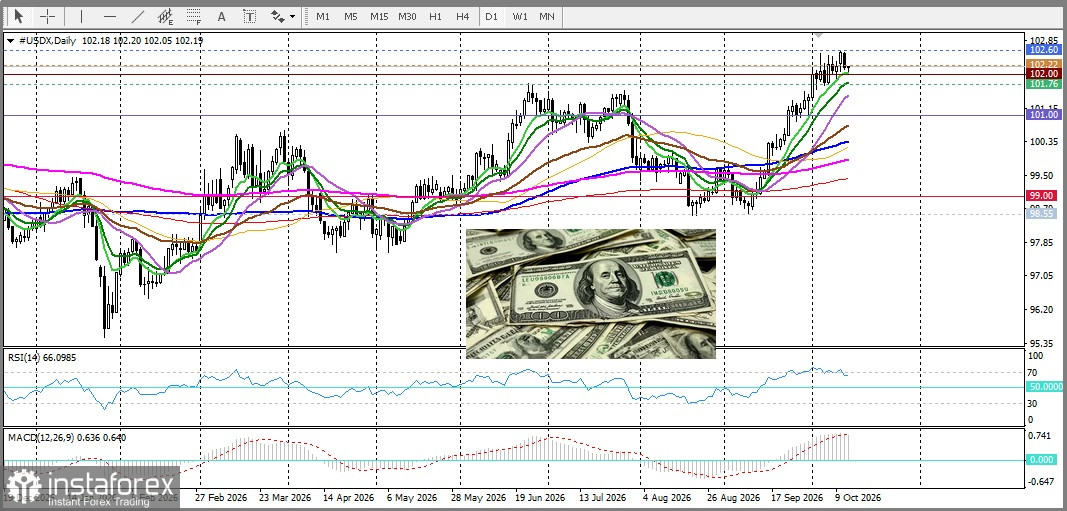
According to CME FedWatch data, traders are almost certain that the Federal Reserve will leave interest rates unchanged at its meeting scheduled for the end of this month. At the same time, the market continues to anticipate a rate hike in December.
Meanwhile, the euro faces several significant headwinds. Rising oil prices and continued political and financial uncertainty in France are limiting the single currency's recovery potential. European Central Bank President Christine Lagarde has called on French authorities to consolidate fiscal policy and ruled out intervention in the bond market to ease pressure on France's public debt. ECB President Christine Lagarde is currently delivering a speech. Will the euro respond to Lagarde's remarks?
Macroeconomic data released on Wednesday for the euro area pointed to persistent inflationary pressures associated with high energy costs, increasing the likelihood of further ECB monetary policy tightening. In Germany, the producer price index for wholesale goods rose by 1.9% in September, following a 0.9% increase in August, although analysts had forecast a slowdown to 0.7%. In Spain, the Harmonised Index of Consumer Prices (HICP) rose by 0.6% month over month and 5% year over year in September, matching the previous month's readings. These figures had a limited impact on the euro's exchange rate.
From a technical perspective, EUR/USD is trading at the psychologically important 1.1200 level, maintaining a bearish bias as the price remains below all key moving averages. The nearest resistance is the 9-day exponential moving average (EMA). However, to ease bearish pressure, bulls need to break above the 20-day simple moving average (SMA). The month's low near 1.1150 provides significant support. Meanwhile, oscillators remain in negative territory, confirming the bears' advantage.
InstaForex analytical reviews will make you fully aware of market trends! Being an InstaForex client, you are provided with a large number of free services for efficient trading.


